Monday, September 25, 2023
Review: "The Blackwoods" by Brandy Colbert
Published October 2023 via Balzer + Bray
★★★★
The Blackwoods have been in Hollywood for decades, and acting even before that. Success has always come with a price, but there's no denying that they've made it. But when Blossom, the matriarch of the family, passes away, the family comes up against answers to long-asked questions—and some new questions as well.
Colbert couldn't write a bad book if she tried, and I don't think I even read the description before I shelved this as to-read. She describes the book as her "ode to Black Hollywood", and the book fills a niche that I hadn't given enough thought to before now—I've read my fair share of YA Hollywood books featuring (thin, rich) white heroines, but far, far fewer featuring BIPOC heroines or paying tribute to the ones who paved the way.
The Blackwoods slips back and forth between generations of women, from Blossom's mother, Flossie, to Hollis and Ardith, two of the younger generation. What I love most is that many of the climactic moments come relatively early in the book, leaving the characters to handle the fallout throughout the rest of the book. Also, because the book follows multiple characters, the big moments they each have are allowed to be parts of their story (and the family story) rather than taking over the narrative completely. I won't go into detail, but a number of things go down throughout the book that could be a book's main conflict, and I loved the sense that the book wasn't willing to limit the story to any one of those things. Readers may also like Martha Southgate's Third Girl from the Left, which (if I remember correctly; it's been a while) takes a grittier look at Black Hollywood, especially blaxploitation films.
If you struggle with the intro, I'd suggest carrying on to see if the next chapters fit better. I don't love either the intro chapter or the final chapter, neither of which feels as present and natural as the rest of the book.
Thanks to the author and publisher for providing a review copy through NetGalley.
Sunday, September 24, 2023
Review: "Brutes" by Dizz Tate
Published February 2023 via Catapult
★★★
2.5 stars? I don't really know what to make of this. In Brutes, a pack of young girls runs wild through the Florida suburbs. Brutes, their mothers call them, as they tease and taunt and torment, as they use their scorn and their soulless stares to keep each other in line and outsiders uneasy. Brutes, their mothers call them, but I think I would go with feral.
Most of the novel is told in the first person plural: we. The occasional chapter brings us into something closer to the present day, when these feral children have grown up to be marginally less feral but no more happy adults; those adult chapters are told from individual perspectives, but because the girls are so closely enmeshed in their younger years, they are hard to tell apart even as first-person-singular adults. As children, they are obsessed with a somewhat older girl, Sammy, and with the search to find Sammy, who has gone missing from her bedroom and cannot be found. Has she been murdered in the nearby building site, drowned in the lake, abducted by a stranger? If the girls, who aim to see everything while others underestimate them, know anything, they're not saying. They're too busy directing fire ants towards their mothers' sandals and practicing seduction and cutting every single other person they meet down to size.
There's something rotten in the state of Florida, and that rot permeates every part of these girls' lives. Only late in the book do we start to understand what they, too, are starting to understand. I suspect that there's a lot of symbolism and undertone here that I'm missing, and that I would have gotten more from it with a more consistent first-person singular perspective. Even a feral one.
Saturday, September 23, 2023
Review: "In Light of All Darkness" by Kim Cross
In Light of All Darkness by Kim Cross
Published October 2023 via Grand Central Publishing
★★★★
A parent's worst nightmare: Polly Klaas was safe at home, in her bedroom, having a slumber party no less—and then she was gone, and despite her friends' eyewitness accounts investigators had barely a clue of who had taken her or whether she was still alive. The odds were against them, and against Polly.
Although true crime (in this case a decades-old, solved case) is not Cross's usual material, she had unusual access to information about the case: her father-in-law was the FBI agent who ran the case at the time. While the simple facts of the story are common knowledge, then, Cross had access to research material and interview subjects that most journalists would not. I didn't have much knowledge of the case going in—you know early on in the book how it ends, but I avoided looking things up until I'd finished reading—but I read Cross's earlier book of narrative nonfiction (result: I will never live in Alabama) and was impressed by the blend of research and storytelling. The same holds true here: Cross knows how to build a story and a set of characters, and she knows how to weave in the critical details that bring the case to life.
In some ways what makes this most interesting—since, again, it's not a new or recent case—is the discussion of various changes that came about because of the Polly Klaas case. These ranged from procedural (which agencies worked together, and how) to policy-based (learning to not treat witnesses who were children as, basically, suspects) to legal (California's much-debated "three strikes" law and its many problems). I'm also fascinated by the work done to create sketches of the suspect. Two were released to the public—one done early on, after initial interviews with the friends Polly was with when she was kidnapped, and another later on, by a different sketch artist who had a different approach. I haven't been able to find the first sketch online, but there's a picture in the book, and what's striking to me is that the second one is better, but—maybe it's just my untrained, unartistic eye, they're both actually very good. It's impossible to know, but I'm curious about what the lasting impression of the first sketch would have been had the second one not been done. (Much was made of the possibility that the kidnapper had (or hadn't) been wearing a yellow bandana, and I have to say that I did spend much of the book wondering "But when is somebody going to point out that he could just take the bandana off?")
All told, a gripping—and carefully told—story. I like my true crime meticulous rather than salacious, and Cross hits the mark here.
Thanks to the author and publisher for providing a review copy through NetGalley.
Friday, September 22, 2023
Review: "Trouble the Living" by Francesca McDonnell Capossela
Published September 2023 via Lake Union Publishing
★★★★
1997, County Tyrone, Northern Ireland: For Bríd, home and country are everything—but hers is a country divided. She is her mother's daughter, both determined to have a free and united Ireland at any cost. But she is not the apple of her mother's eye, and as the clock ticks forward they both say, and do, things that will haunt them for the rest of their lives.
2016, Los Angeles County, California, United States: Life with her mother is all Bernie has ever known—her mother, who asks repeatedly for promises that Bernie will come home, and who wants Bernie to need no one else, and who sometimes stays in bed for days. Bernie knows nothing about her mother's life before her, and between Bríd's secrets and Bernie's occasional recklessness—and as the two timelines converge—things come to a head.
Passive myself, I'd been shaped by others until I became potent, frightening, with the potential for disaster. (loc. 675)
Unusually for a dual-timeline story, I was fully invested in both plots and storylines. I'm reluctant to give too many details about the plot, as I think it's better to let the story unfold without knowing all of the themes straight away, but I will say that there are heavy themes of family, mother-daughter relationships, history (sort of) repeating itself (but also not really), and independence/choice. Every time I read about the Troubles, too, I'm reminded of how little I really know about that time and place, and I appreciate the way the Troubles are woven into the fabric of Bríd's life in Ireland, neither the intense focus of the story nor pushed to the background.
I will say that this isn't going to be a book to everyone's tastes: there are some hot-button topics in here, and even with that aside, both Bríd and Bernie make decisions that are...influenced by the rashness of youth, let's say. But I'm less interested in what decisions characters make (although: also, on board with certain decisions Bernie makes later in the book) and more interested in how they make those decisions, and what happens in terms of character development as a result. I love that romance is only barely a blip in the book and that not everything can be tied up with a bow by the end.
Thanks to the author and publisher for providing a review copy through NetGalley.
Thursday, September 21, 2023
Review: "Undiscovered" by Gabriela Wiener
Translated by Julia Sanches
Published September 2023 via HarperVia
★★★
The strangest thing about being alone here in Paris, in an anthropology museum gallery more or less beneath the Eiffel Tower, is the thought that all these statuettes that look like me were wrenched from my country by a man whose last name I inherited. (loc. 87*)
We all have skeletons somewhere in the familial closet. Sometimes they're out on display, sitting at the dinner table—but Wiener's family skeletons were displayed more prominently than most, in European museums. Not their literal skeletons (this particular analogy is perhaps a little confusing, whoops), but the artifacts that Charles Wiener, an Austrian-French explorer, had looted from Peru and brought to France. Not long after he left Peru, a Peruvian baby was born bearing the last name Wiener, and in many ways it was this history that Gabriela Wiener's family in Peru was most proud of: here was their connection to history, to prestige.
For years my dad treasured this book with its dozens of costumbrista etchings of Indigenous life, keeping it stashed away in a special part of our library. Every time I tried to cozy up to it and linger in its pages, I wound up shutting it in horror. I just couldn't read it the way so many others did: as a fascinating nineteenth-century travel account. More than that, I couldn't brush aside Charles's vile assertions about so-called savage Indians. That man—cruel, violently racist, and blinkered by his Eurocentrism—has nothing to do with who I am today, no matter how much my family has chosen to glorify him. (loc. 238)
In Undiscovered, Wiener sets out to learn more about Charles's travels in Peru—and what they might mean for her own identity as a Peruvian woman; as a Peruvian woman living in Spain; as a Peruvian woman living in Spain in a polyamorous relationship with a Peruvian man and a Spanish woman.
I think it's safe to say that Charles Wiener is the least interesting part of her story.
This is described as a blend of fiction and nonfiction, and I'm not clear just how much of this I'm supposed to take as fact—I read it primarily as fact with the exception of the sections in which Wiener imagines important moments in Charles's life, but I'm not sure if it's more interesting if that's the case or if there is a great deal more fiction blended in here. (And where do I hope that things are more true, and where do I hope that they are more fictional?) I realize I'm trying to build something out of pieces lifted from an unfinished story, writes Wiener (loc. 399), and in a way that feels accurate to this book, too: Charles's story is incomplete (he was not a big enough name that his whole life can be readily picked apart and examined), and her own story is still being written.
Much of the book is about unpicking colonization and what it means in Wiener's own life—again, as a minority woman living in Spain, with a family history marked by colonialism—and I'm fascinated and horrified by, well, a lot of it. (See the Wikipedia article on Expo 58—specifically, the section on the human zoo—for some of that; it staggers me to think that some of the people involved in that could still be alive.) The book may be reading for its discussion of polyamory alone, but it's far more interesting in the context of political and family history—and learning that truths you have held your whole life may be more complicated than you thought. I think I'm due for some more historical-political reading...
Thanks to the author and publisher for providing a review copy through NetGalley.
*Quotes are taken from an ARC and may not be final.
Wednesday, September 20, 2023
Review: "Angel Mommy" by Linda Krikorian
Published 2000
★★
Well, it is what the title promises. This is written in part as a letter to Krikorian's children, and in some ways I think that's the saddest part of this—it's an in-case-I'm-no-longer-here sort of thing, written from deep within the depths of an eating disorder, but...I have to think that if one's parent died, receiving in exchange a blow-by-blow account of the illness that killed them (or at least was a major factor in their life), including descriptions of being unwilling to gain weight even for the sake of a healthy pregnancy (not the author's fault—eating disorders are a mindfuck—but still), would be just about the last thing one wanted.
It's been more than twenty years since this was published. I hope Krikorian has found some peace and balance since then, and that her children have many, many more positive memories to look back on.
Tuesday, September 19, 2023
Review: "People Collide" by Isle McElroy
Published September 2023 via HarperVia
★★★★
In a studio flat in Bulgaria, Eli wakes up to a new perspective: he has somehow slipped into the body of his wife, Elizabeth, and Elizabeth—along with Eli's body—is gone. What follows is a romp from Bulgaria to Paris to the US Midwest as Eli follows the clues of Elizabeth's disappearance and tries to make some sense out of what comes next.
Without question one of the odder things I've read recently, People Collide stands out for not asking the obvious questions. Eli and Elizabeth are together in an opposites-attract sort of way, with Elizabeth powering through on a Type A schedule and Eli drifting through life. In a subversion of Hollywood expectation (anyone else remember "On Thin Ice" with Tara Lipinski?), he takes his shift into Elizabeth's body in stride, sinking into the new body rather than questioning it and trying to both hold on to the commentary he imagines from Elizabeth and apply his own self to the experience.
People Collide is not a novel of a trans experience, exactly, but it is impossible not to see the connections. There would be so much to explore in a paper on this novel—if I'd read this as a grad student in a lit class I'd have been all over it for allegory and metaphor and symbolism. (Also, if I'd read this in grad school it probably would have been in a short-story format—in a way this feels like a very long short story.) You have to be ready to accept the unexplained and let the story take you where it wants to, but if you're in the mood for it those are some interesting places indeed.
Thanks to the author and publisher for providing a review copy through NetGalley.
Sunday, September 17, 2023
Review: "Fire from the Sky" by Moa Backe Åstot
Translated by Eva Apelqvist
Published September 2023 via Levine Querido
★★★
In northern Sweden, Ánte is sure of a few things: he loves the traditions of his Sámi upbringing. He loves his village and can't imagine a future somewhere else. He loves his best friend, Erik—and he also can't see a life in which he can be both a reindeer herder and gay, something all but unheard of in his village.
I read this largely because I have read precious few books that take place among reindeer-herding communities (maybe 2) and even fewer by writers who are themselves Sámi (0). I love that this presents a modern take: Ánte is a reindeer herder, yes, but he's also a teenage boy who wants to hang out with his friends, play video games, and go to parties. Reindeer herding is in his blood, in his past and present and future, but it's largely in the background of the book. That feels very realistic for this day and age, and I'm here for that.
There's also a fascinating side plot about a book Ánte ends up with, one that is in part based on Herman Bernhard Lundborg (d. 1943) and his work. The short version: racism is everywhere, and the Sámi, like other minorities, were subject to scientists hell-bent on their eugenics-heavy theories. It's a piece of history I wasn't aware of (I'm only loosely familiar present-day struggles for Sámi rights—basically, the few things that make it into the mainstream news—and not at all with historical struggles), and it's one of the things that troubles Ánte throughout the book.
The book is translated from Swedish, and I'm not sure if it's the original writing or the translation but the phrasing does get quite awkward in places. This is perhaps exacerbated by Ánte's situation—he is an angsty teenager trying to figure out how he can reconcile two parts of his identity—but it sometimes took me clear out of the story. (That said: the copy I read had yet to be proofread, so the final English version may feel smoother.)
Thanks to the author and publisher for providing a review copy through NetGalley.
Saturday, September 16, 2023
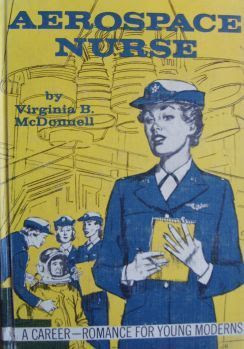
Review: "Aerospace Nurse" by Virginia McDonnell
First published 1968
★★★
Ah, the delights of 1960s YA. In Aerospace Nurse, Terry becomes—you guessed it—a nurse to astronauts. Very little of the book is actually about astronaut nursing life, though, as first Terry has to get her bachelor's of nursing, join the Air Force, get some experience, become a flight nurse, and eventually apply to be an aerospace nurse. (It is, as you might expect, quite the ride!)
Some nice things here: Terry has a boy-next-door waiting for her, and—it's the 60s, remember—he's convinced that the thing to do is for Terry to give up her silly career aspirations, marry him, and live a nice dull life. When Terry questions her nursing skills, Johnny's answer is simple: "Take my fraternity pin," he said. "That should prove what you're worth and where you belong in this life" (37). Terry sticks to her guns—she's just told him that "Before I can be a wife, I have to be a person in my own right" (37)—but she's told over and over, by numerous characters, that Johnny won't wait around forever, he's been terribly generous to "let" her pursue her education/career before making a decision about marriage (note that she hasn't even committed to going steady with him), et cetera. (The sixties, man.) Johnny's ultimately a decent guy, to be clear, and this is not unusual for YA/romance books of the time. It's just...still kind of wild to me.
Meanwhile, the nursing: it's a thing in YA nurse books of the era for the book to be really, really enthusiastic about girls taking up nursing—it seems there was something of a nursing shortage, so the characters in these books all wax rhapsodic about the amazing opportunities they have, and the friends they make, and what a wonderful chance it is to do something for their country, et cetera et cetera. In this case, because Terry joins the Air Force, we also hear about the amazing things that nurses were doing in World War I, World War II, and the Korean War. What's that? No, no. Those are the only wars. Definitely no chance of Terry being sent off to some...other war. Oh—wait—you mean Vietnam? No, no, nothing going on—oh, okay, Terry pops over to Vietnam for five minutes when she's on holiday in Japan, as a favor when another nurse gets sick and can't do some sort of murky medevac flight, because that's definitely how it works in the Air Force. But the only thing Terry ever has to be worried about in Vietnam is whether her skills will hold up. That's it. Nothing else to worry about, no guns no blood no guts no gore, and if you join the Air Force as a nurse in the 60s you're definitely more likely to be selected to train as a space nurse than to be sent...somewhere...else.
Ahem.
Shall we talk about romance? Let's talk about romance.
I won't say too much except that Terry ends up with two options—Johnny, the boy next door who wants her to quit work and start popping out babies stat, and the mystery man with whom she has an instant sizzle of connection. And why can I not say too much? Because Terry has approximately one conversation with the mystery man—we learn his name and his job and that he's the precursor to the alpha male that runs amok in contemporary romance—before they decide that they're made for each other, baby, and if she doesn't say yes when he proposes then as her Air Force superior he'll order her to do so.
And really, what more could a girl want in a space-doctor-cowboy?
Friday, September 15, 2023
Review: "Counting the Cost" by Jill Duggar
Published September 2023 via Gallery Books
★★★
Much of Jill Duggar's childhood was chronicled for television. The fourth child and second daughter of the (infamous?) Duggar family, her family got bigger and bigger—and with it the media attention grew too. A television special, another television special, a reality TV show...
And then the scandals started, and Jill* started to see that not everything she'd been taught was true, and the incredibly sheltered way in which she'd been raised did not always offer the level of protection that she'd been promised.
Now, I've never watched 19 Kids and Counting or any of the other shows and specials—I've didn't grow up with TV and I can't stomach the thought of sitting through those shows now—but I've long found the overall story fascinating for being so wildly different from the way I grew up and the way I live now. It doesn't take much time on the Internet to make it clear that the rosy portrait that the family has tried to portray is not all that it seems, but the family has historically, for the most part, presented a united front. Even when Jill's sister Jinger wrote her second memoir—a treatise on why what she believed as a child is wrong and why what she believes now is right—she was very careful to say only positive things about her parents.
But with 19 kids in the family, plus assorted spouses and next-gen folks and relatives and hangers-on...the odds have always been pretty good that someone would break rank. And when Jill appeared in the Amazon docu-series Shiny Happy People (which covers the abuses and other problems of the religious homeschooling organization in which she was raised), and then announced this memoir, it became clear that that person was going to be Jill.
This is not a tell-all, per se: Jill is very careful not to tell her siblings' stories, and she is also very careful not to lump her parents, Jim Bob and Michelle, together. But it does paint a damning portrait of Jim Bob, who—as Jill describes it—maintained a manipulative, at times verbally and emotionally abusive level of control over the family, especially (but not only) when it came to money. And she brings receipts: most staggering, perhaps, the long letter detailing from Jim Bob detailing the money that had come out of his bank account to cover things for Jill—to justify why she'd never received any of the money he had told the IRS that she had. (That's called tax fraud, by the way. Unclear if Jill is aware of that, although I'm quite sure that her husband, who helped ghostwrite and previously worked as an accountant, is.) Or, when Jill finally got her hands on some numbers and realized that when she gave birth, the resulting specials had put some $100,000 in her father's pocket—none of which she'd seen, and none of which her father wanted to part with to cover the hospital costs.
And things that might seem small, or innocuous, but point to a greater habit of hypocrisy: rules being loosened for the sake of more entertaining television; viewers seeing the family shopping for groceries only when the film crew was around and TLC was paying for the nicer food, not when the family was living on bean sandwiches; timelines being bent for the sake of TV; the family and the IBLP preaching and preaching and preaching about the "umbrella of protection", in which Jesus protects men, who protect their wives and children, and then instead Jim Bob protecting his son, and only his son, at the expense of his daughters.
Jill's views will probably never really align with mine, but it's clear that she's come a long, long way from the approval-hunting girl she describes at the beginning of the book. (If you know anything about the fundie world, this will speak volumes: she grew up with the KJV as the only valid translation of the Bible; her current church uses a different translation.)
As to the writing: It's a little rough in places; the publication date was pushed up following the wild success of Shiny Happy People, and the editing was definitely rushed. Jill and her husband did work with an experience ghostwriter, though, which makes a world of difference. It's definitely better read if you're already familiar with the basics of the family story, or willing to not quite follow everything in parts of the book, but if you are familiar with the story...it's a pretty explosive read.
*Normally I'd use last names for authors, but for the sake of clarity I'm going with first names here.
Review: "The Prince and the Dressmaker" by Jen Wang
The Prince and the Dressmaker by Jen Wang Published February 2018 via First Second ★★★ Frances just wants to make dresses—someday she'd ...
-
The Ferryman and His Wife by Frode Grytten, translated from the Norwegian by Alison McCullough Published November 2025 via Algonquin Books ★...
-
The Keeper by Tana French Published March 2026 via Viking ★★★★ Book three—of three—in the Cal Hooper series. Time has passed: Trey is growin...
-
Three Ordinary Girls by Tim Brady Published February 2021 via Citadel Press ★★★ For all that I've heard about the strength of the Dutch ...