More Than What Eyes See by Miso Kwak, illustrated by Thaís Mesquita (Free Spirit Publishing)
I Spark Like Lightning by Jenna Elyse Johnson, illustrated by Sue Teodoro (Free Spirit Publishing)
Tic-errific Me by Alicia Meyers, illustrated by Cait Brennan (Free Spirit Publishing)
Back into the world of children's books...this time about disabilities!
In More Than What Eyes See, Maya is blind—but that doesn't stop her from doing, well, whatever she wants to do. The book takes young readers through some of the realities of being blind, from the irritation of being called "inspirational" for just existing to some of the sports designed for blind and vision-impaired players.
I think the best fits here are sighted young readers who know somebody who is blind and perhaps children who have recently lost or are likely to lose their sight—could also be one for kids born blind, of course, but some of this is informative in a way that not all kids with this lived experience would need. That said, it's a nicely empowering read that goes beyond just simple representation. I love Kwak's explanation at the end of why she opted not to include guide dogs in the book (the short version: they're not actually common, especially for young kids). There's also mention of several "brilliant blind people", and I can't tell you how delighted I was to realize that one of them is an acquaintance! Which is neither here nor there, I suppose, but it's proof positive that the book mentions contemporary, not just historical, people kids might look up to.
Simple but full-page, colorful illustrations complete the book. Obviously some kids with vision loss will be able to see all or some of the illustrations, while others won't; I'd be super curious to see a version of the book that took that into account, because I bet there are ways to make a textured storybook for kids who can't see the illustrations.
Meanwhile, Jen's brain sparks. Well, everyone's brain sparks, sending electricity through the body to connect mind and muscle. But in I Spark Like Lightning, we hear from a girl whose brain sometimes misfires, causing a seizure.
I read this as something of a follow-up to More Than What Eyes See, because I love that these books are helping to normalize disabilities for kids. Here, the book reinforces the point that Jen can do all the things other kids can (dance, swim, play), just sometimes with extra considerations. It also gently acknowledges some of the indignities that can come along with neurological differences, which seems like a useful conversation-starter for kids. I might have liked a little more detail (e.g., the difference between a tonic-clonic seizure and an absence seizure), but I think that's partly just me being terminally curious, and not having read many (or possibly any!) other books that discuss epilepsy in any detail.
The illustrations are simple but well done. The ones where we see Jen in dance class are probably my favorite, as they best convey a sense of movement, but in general they're soothing and bright (and the service dog looks like a floofball, which is nice).
And as a follow-up to both More Than What Eyes See and I Spark Like Lightning...Tic-errific Me! This one takes kids through some of what it means to have Tourette syndrome, which is characterized by uncontrollable vocal and motor tics.
When I think about Tourette syndrome I remember a classmate when I was a kid who had (I learned only later) Tourette syndrome. In elementary school I don't think kids really noticed, but in middle school he'd sometimes tic during tests (which makes sense in retrospect), and a couple of kids would get annoyed, and he'd try to make it a joke, and the teacher (who presumably knew more than we did about this all) would laugh with him and redirect the other kids. I'm not sure why that has stuck with me, but whenever I think about it now I think I hope his other teachers were also supportive and also I hope things got easier for him socially. I knew absolutely nothing about Tourette syndrome at the time, and I assume the same was true for most of our classmates. I don't know what would have changed if we'd known more, but I'm glad for books like this that give kids a little more information in a compassionate way.
Anyway. That was a long digression! I like that this book acknowledges the variety of tics that someone with Tourette syndrome might have, and that there are some things that can help but that at the end of the day tics aren't a choice. When the book mentions that lots of other people have Tourette syndrome, I did wish specific people had been mentioned (assuming that they're open about their condition, of course!), because I love a good rabbit hole and it would give interested kids more people to look up. The art isn't super interesting, but it's consistent and bright, and there's a cute illustration/game/strategy board included at the end.
Thanks to the authors and publisher for providing review copies through NetGalley.
Showing posts with label children's. Show all posts
Wednesday, June 3, 2026
Sunday, May 17, 2026
Children's books: Marine animals: "How to Get an Alligator Out of the Bathtub", "Float", and "The Octopus
How to Get an Alligator Out of the Bathtub by Lynsey Martin, illustrated by Colleen C. Coggins (MamaBear Books)
Float by Larry Daley (Bookling Media)
The Octopus by Guojing (Two Lions)
Back into the world of children's books...this time with marine animals!
In How to Get an Alligator Out of the Bathtub, it's bathtime, but there's a problem—there's an alligator in the bathtub!
Luckily this particular alligator is reasonably charming (snobby, yes, but good-natured). The boys want their bathtub back, but they pretty quickly get over any residual fear of being eaten (though...parents in Florida...maybe remind your kids that alligators in the bathtub are all good and well, but only in fiction?). It's a quick-moving and playful story, with equally playful illustrations to help carry the story along.
I read an ARC and hope that there's been a last round of proofreading since the ARC was made available; I appreciate that they story isn't in rhyme (rhyme can be nice, but it takes some serious skill to keep it from feeling contrived), but there are some minor punctuation errors. I learned so much about grammar and punctuation through reading as a kid (ah, the American education system, where teaching these things is considered a "nice to have" rather than a "must have"!) that I always wonder what kids pick up from small errors. (I am probably overthinking this.)
All that said, this is super cute, and I can imagine little kids dreaming up their own alligators in the bathtub. A good one to pair with an alligator stuffed animal as a birthday gift.
In Float, Rosie's been waiting for weeks for just this day—field trip to the aquarium! There's a baby sea turtle, and she could not be more excited. As a bonus, she has the best lunch ever...until a seagull steals her lunchbox, and she has to leap into action to rescue her snacks.
This is adorable. The illustrations are colorful and detailed—probably my favorite illustration is the one where the seagull actually steals Rosie's lunchbox, but Rosie sprinting through the aquarium's atrium, leaving chaos in her wake, is a close second—and the story lively. Rosie is clearly a live wire, and, ah, stopping to think before she acts is not her forte.
Adults reading this with kids might want to have a bit of a discussion about how running in an aquarium or similar is not advised, and jumping in the aquarium tanks is definitely not advised(!). I would also not advise that adults take Rosie's lunch box as a guideline, as she seems to have about 75% junk and 25% food that will not make her crash in an hour...but I think kids will enjoy the colorful chaos of the book.
And finally, in The Octopus, a little girl finds a baby octopus struggling on the beach—and when she helps it get to safety, she goes on an underwater adventure.
My family had a copy of Jan Ormerod's Sunshine when I was growing up, and my gosh I loved that book. Like The Octopus, it's a wordless picture book, all the character's emotions and thoughts played out across their faces and actions rather than through words. A successful wordless picture book takes such a tremendous amount of skill, and it was such fun to see how things played out in The Octopus. The illustrations are lovely, with soft colors and some intentional haziness. The little girl's adventure is so fantastical (that picture of all the seashells glowing like gems!), and it also has a subtle message about the damage pollution does to marine life.
This one should probably be read to young kids with a clear reminder that no matter what happens to book characters, real-life kiddos can't breathe underwater and shouldn't go gallivanting near the water's edge without an adult nearby! But my gosh it's sweet. At the end, you can just hear the little girl chattering to her mother about her adventure, and her mother enjoying the imagination of a child.
Thanks to the authors and publishers for providing review copies through NetGalley.
Float by Larry Daley (Bookling Media)
The Octopus by Guojing (Two Lions)
Back into the world of children's books...this time with marine animals!
In How to Get an Alligator Out of the Bathtub, it's bathtime, but there's a problem—there's an alligator in the bathtub!
Luckily this particular alligator is reasonably charming (snobby, yes, but good-natured). The boys want their bathtub back, but they pretty quickly get over any residual fear of being eaten (though...parents in Florida...maybe remind your kids that alligators in the bathtub are all good and well, but only in fiction?). It's a quick-moving and playful story, with equally playful illustrations to help carry the story along.
I read an ARC and hope that there's been a last round of proofreading since the ARC was made available; I appreciate that they story isn't in rhyme (rhyme can be nice, but it takes some serious skill to keep it from feeling contrived), but there are some minor punctuation errors. I learned so much about grammar and punctuation through reading as a kid (ah, the American education system, where teaching these things is considered a "nice to have" rather than a "must have"!) that I always wonder what kids pick up from small errors. (I am probably overthinking this.)
All that said, this is super cute, and I can imagine little kids dreaming up their own alligators in the bathtub. A good one to pair with an alligator stuffed animal as a birthday gift.
In Float, Rosie's been waiting for weeks for just this day—field trip to the aquarium! There's a baby sea turtle, and she could not be more excited. As a bonus, she has the best lunch ever...until a seagull steals her lunchbox, and she has to leap into action to rescue her snacks.
This is adorable. The illustrations are colorful and detailed—probably my favorite illustration is the one where the seagull actually steals Rosie's lunchbox, but Rosie sprinting through the aquarium's atrium, leaving chaos in her wake, is a close second—and the story lively. Rosie is clearly a live wire, and, ah, stopping to think before she acts is not her forte.
Adults reading this with kids might want to have a bit of a discussion about how running in an aquarium or similar is not advised, and jumping in the aquarium tanks is definitely not advised(!). I would also not advise that adults take Rosie's lunch box as a guideline, as she seems to have about 75% junk and 25% food that will not make her crash in an hour...but I think kids will enjoy the colorful chaos of the book.
And finally, in The Octopus, a little girl finds a baby octopus struggling on the beach—and when she helps it get to safety, she goes on an underwater adventure.
My family had a copy of Jan Ormerod's Sunshine when I was growing up, and my gosh I loved that book. Like The Octopus, it's a wordless picture book, all the character's emotions and thoughts played out across their faces and actions rather than through words. A successful wordless picture book takes such a tremendous amount of skill, and it was such fun to see how things played out in The Octopus. The illustrations are lovely, with soft colors and some intentional haziness. The little girl's adventure is so fantastical (that picture of all the seashells glowing like gems!), and it also has a subtle message about the damage pollution does to marine life.
This one should probably be read to young kids with a clear reminder that no matter what happens to book characters, real-life kiddos can't breathe underwater and shouldn't go gallivanting near the water's edge without an adult nearby! But my gosh it's sweet. At the end, you can just hear the little girl chattering to her mother about her adventure, and her mother enjoying the imagination of a child.
Thanks to the authors and publishers for providing review copies through NetGalley.
Wednesday, April 22, 2026
Review (Deutsch): "Das Klugscheisserchen" von Marc-Uwe Kling
Das Klugscheisserchen von Marc-Uwe Kling
Herausgegeben 2023 von Silberfisch
★★★★
In Das Klugscheisserchen haben wir zwei Kinder, die...naja, die Klugscheisserchen sind. Und dann treffen sie auf ein echtes Klugscheisserchen...
Dieses Hörbuch war sowohl lustig und süß. Oder, vielleicht ist "süß" nicht das korrekte Wort, aber mann kann verstehen, warum die Kinder denken, wie sie denken...und auch warum die Eltern denken, wie sie denken. Mit vielen Stimmen und Soundeffekten ist das Buch sehr schnell vergangen (und ich habe mit 0.75 Geschwindigkeit gehört!)
Es gibt nicht so viel zum Thema Plot zu sagen—das Buch ist kurz, und so ist der Plot—aber ich kann das Buch (und definitiv das Hörbuch) für kleine Klugscheisserchen und ihre Eltern empfehlen.
Thanks to the author and publisher for providing a review copy through NetGalley. Deutsch ist nicht meine Muttersprache, und alle Fehler sind meine eigenen.
Herausgegeben 2023 von Silberfisch
★★★★
In Das Klugscheisserchen haben wir zwei Kinder, die...naja, die Klugscheisserchen sind. Und dann treffen sie auf ein echtes Klugscheisserchen...
Dieses Hörbuch war sowohl lustig und süß. Oder, vielleicht ist "süß" nicht das korrekte Wort, aber mann kann verstehen, warum die Kinder denken, wie sie denken...und auch warum die Eltern denken, wie sie denken. Mit vielen Stimmen und Soundeffekten ist das Buch sehr schnell vergangen (und ich habe mit 0.75 Geschwindigkeit gehört!)
Es gibt nicht so viel zum Thema Plot zu sagen—das Buch ist kurz, und so ist der Plot—aber ich kann das Buch (und definitiv das Hörbuch) für kleine Klugscheisserchen und ihre Eltern empfehlen.
Thanks to the author and publisher for providing a review copy through NetGalley. Deutsch ist nicht meine Muttersprache, und alle Fehler sind meine eigenen.
Saturday, March 14, 2026
Children's books: Trucks: "Point & Play: Trash Trucks", "I Truck", and "Science Takes a Trip"
Point & Play: Trash Trucks, illustrated by Steven Wood (Z Kids)
I Truck by Kelly Rice Schmitt, illustrated by Jam Dong (Millbrook Press)
Science Takes a Trip by Maria Rentetzi, illustrated by Pieter de Decker (Clavis)
Into the world of children's books...this time with trucks! And also a bus or two...
It's your first day on a garbage route...where to begin?
Point & Play: Trash Trucks is designed for very young readers who are fascinated by (you guessed it) garbage trucks. It teaches kids a bit more about what a garbage-collection route looks like, plus gives adults an opportunity to help kids practice counting and motor skills. The book instructs kids to wiggle their fingers to get their gloves on—take five big steps to get into the truck cab—shake the book to make the engine start—and on it goes. Really my only complaint is that, though there is a recycling truck shown on the page, there's no other mention of ways to reduce trash production (just a call for kids to count the number of broken toys thrown in the dump).
This would be great as a whole series of board books, each with a different kid-friendly job and associated movements. (As a bonus, the movements probably help get some wiggles out!) The illustrations aren't particularly inspiring to my adult eye, but they have lots of details for young kids to focus on, including lots to spark the imagination. Would you rather live in a castle or a lighthouse...?
Back on the road, I Truck is something of a follow-up to I Ship, treating readers to a look at the life of a long-haul truck (and driver, but that's secondary here). I loved I Ship and was delighted to see this follow in its wake. Simple but rich illustrations, casual diversity, lots of information sprinkled throughout the book, and lots more information included at the end. In particular, nice to see some of the downsides of truck driving discussed, like difficulty getting exercise during long stints on the road and many nights spent away from home—putting those at the end lets the story stay upbeat but provides food for thought for curious young readers.
Planes might be the logical next book here...ooh, or trains. I'll hope for trains. But I'd also take some kind of bright-yellow construction truck! Or a helicopter...
At any rate, we can call this a satisfying follow-up and an excellent read for kids who are fascinated by eighteen-wheelers on the highway.
Did you know that in the 1950s and 60s, the US sent two bus-laboratories around the world to share knowledge about nuclear science (and get ahead in the Cold War while they were at it)? I did not! But in Science Takes a Trip, we're taken along to various countries that the buses visited and get to learn a little about the science that was possible on the buses.
The text is pretty straightforward and factual—this happened, and this is why, and then this happened—and I would have loved to learn a bit about the teams that drove these buses and what the experience was like for them. Imagine taking part in a trip like that, especially back when travel was slower and more difficult than it is now! Best for fairly confident readers or to be read aloud to kids old enough to have some processing power; also probably best for kids who are actively curious about science (or about trucks and buses!) rather than those who want a character-driven story.
The art is gorgeous: lush detail but with a slight (intentional) graininess and faded hues to really give the sense that the reader is going back in time. I don't know what I would have made of the story as a kid (as an adult I'd happily read a full-length book about this), but I would have spent a long time poring over the pictures.
Thanks to the authors and publishers for providing review copies through NetGalley.
I Truck by Kelly Rice Schmitt, illustrated by Jam Dong (Millbrook Press)
Science Takes a Trip by Maria Rentetzi, illustrated by Pieter de Decker (Clavis)
Into the world of children's books...this time with trucks! And also a bus or two...
It's your first day on a garbage route...where to begin?
Point & Play: Trash Trucks is designed for very young readers who are fascinated by (you guessed it) garbage trucks. It teaches kids a bit more about what a garbage-collection route looks like, plus gives adults an opportunity to help kids practice counting and motor skills. The book instructs kids to wiggle their fingers to get their gloves on—take five big steps to get into the truck cab—shake the book to make the engine start—and on it goes. Really my only complaint is that, though there is a recycling truck shown on the page, there's no other mention of ways to reduce trash production (just a call for kids to count the number of broken toys thrown in the dump).
This would be great as a whole series of board books, each with a different kid-friendly job and associated movements. (As a bonus, the movements probably help get some wiggles out!) The illustrations aren't particularly inspiring to my adult eye, but they have lots of details for young kids to focus on, including lots to spark the imagination. Would you rather live in a castle or a lighthouse...?
Back on the road, I Truck is something of a follow-up to I Ship, treating readers to a look at the life of a long-haul truck (and driver, but that's secondary here). I loved I Ship and was delighted to see this follow in its wake. Simple but rich illustrations, casual diversity, lots of information sprinkled throughout the book, and lots more information included at the end. In particular, nice to see some of the downsides of truck driving discussed, like difficulty getting exercise during long stints on the road and many nights spent away from home—putting those at the end lets the story stay upbeat but provides food for thought for curious young readers.
Planes might be the logical next book here...ooh, or trains. I'll hope for trains. But I'd also take some kind of bright-yellow construction truck! Or a helicopter...
At any rate, we can call this a satisfying follow-up and an excellent read for kids who are fascinated by eighteen-wheelers on the highway.
Did you know that in the 1950s and 60s, the US sent two bus-laboratories around the world to share knowledge about nuclear science (and get ahead in the Cold War while they were at it)? I did not! But in Science Takes a Trip, we're taken along to various countries that the buses visited and get to learn a little about the science that was possible on the buses.
The text is pretty straightforward and factual—this happened, and this is why, and then this happened—and I would have loved to learn a bit about the teams that drove these buses and what the experience was like for them. Imagine taking part in a trip like that, especially back when travel was slower and more difficult than it is now! Best for fairly confident readers or to be read aloud to kids old enough to have some processing power; also probably best for kids who are actively curious about science (or about trucks and buses!) rather than those who want a character-driven story.
The art is gorgeous: lush detail but with a slight (intentional) graininess and faded hues to really give the sense that the reader is going back in time. I don't know what I would have made of the story as a kid (as an adult I'd happily read a full-length book about this), but I would have spent a long time poring over the pictures.
Thanks to the authors and publishers for providing review copies through NetGalley.
Saturday, December 27, 2025
Review: "Brighty of the Grand Canyon" by Marguerite Henry
Brighty of the Grand Canyon by Marguerite Henry
Published 1953
★★★★
Yet another childhood reread. I'm not sure how it came about, but I was obsessed with this and King of the Wind (which I have yet to reread) and Brighty of the Grand Canyon; although I had (and read) some of the Misty books, these two were the ones that I came back to over and over again.
This is definitely one to be read in the context of time and place; the hunting material isn't really contemporary (though...the focus on guns might be...), and personally I find the good-guy-bad-guy material a little reductive, but eh, I don't think that part really has to do with the age of the book. I love the emphasis on Brighty's independence, which feels like a reminder to readers that not everything must, or should, be tamed.
If I read this for the first time now, I'd probably give it three stars and not think much more about it, but...what can I say, the stuff that stuck with you in childhood sometimes sticks with you. Would still recommend it for young readers, along with perhaps a discussion about what has changed since then and a Playmobil Wild West set.
Sunday, December 21, 2025
Children's books: Deutsch: "Giraffenhund und Kratzbürste" (Paris und Tokio) und "Der kleine Bubu"
Giraffenhund und Kratzbürste - Eine Reise nach Paris von Isabelle Schelling
Giraffenhund und Kratzbürste - Eine Reise nach Tokio von Isabelle Schelling
Der kleine Bubu von Lisa-Marie Dickreiter (Arena Verlag)
Kinderbücher...diesmal auf Deutsch!
In Giraffenhund und Kratzbürste - Eine Reise nach Paris haben wir zwei Hunde—Giraffenhund will reisen, aber Kratzbürste nicht. Was kann ein Hund tun?
Dieses Buch war ganz süß: einfache Reime mit interessantem Vokabular...und natürlich ein Tour durch Paris! Die Bilder sind farbenfroh und sehr detailreich. Ein gutes Buch (eine gute Serie!) für junge Leser/innen, die ein bisschen mehr von der Welt sehen wollen. Es freut mich, dass Eine Reise nach Paris nur der erste Band ist, und dass das nächste eine Reise nach Tokio zeigt.
Empfohlen für Kinder im Alter von ca. 5 bis 7 Jahren.
Und in Giraffenhund und Kratzbürste - Eine Reise nach Tokio haben wire eine zweite Reise für Giraffenhund und Kratzbürste. In Eine Reise nach Tokio fliegen sie nach...warte...Tokio. Seit ihrer Reise nach Paris hat Kratzbürste gelernt, dass Reisen Spaß machen kann...vielleicht. Er ist immer noch nicht sicher...und immer noch ein bisschen mürrisch.
Diese Serie ist so süß—es freut mich, dass in diesem zweiten Buch gehen die beiden Tiere irgendwo weiter weg. Das Buch erforscht verschiedene japanische Traditionen (von Teezeremonien bis Karaoke), und, genau wie im ersten Buch, die Bilder sind reich und frohlich. Eine Geschichte über Abenteuer und enge Beziehungen.
Wo werden Giraffenhund und Kratzbürste als Nächstes reisen...? Nur die Zeit wird es zeigen.
Und endlich ist es Zeit für ein Nickerchen—und die Erwachsenen wollen schlafen, aber die Kinder nicht! Zum Glück gibt es Hilfe: den kleine Bubu und den große.
Der kleine Bubu ist ganz, ganz süß und perfekt für kleine Kinder, die nicht schlafen wollen. (Als Erwachsene bin ich mit den Eltern...ich will immer ein Nachmittagsnickerchen!) Die Reime haben viel Energie, und die Bilder haben viele Details. Man kann das Ende voraussehen, aber für so eine Geschichte ist das kein Problem; Kinder können sich selbst in entweder den Buch-Kinder oder den Bubus wiedererkennen.
Wenn ich Kinder hätte, würde ich dieses Buch gerne kaufen, um zur Nickerchenzeit zu lesen.
Thanks to the authors and publishers for providing review copies through NetGalley. Deutsch ist nicht meine Muttersprache, und alle Fehler sind meine eigenen.
Giraffenhund und Kratzbürste - Eine Reise nach Tokio von Isabelle Schelling
Der kleine Bubu von Lisa-Marie Dickreiter (Arena Verlag)
Kinderbücher...diesmal auf Deutsch!
In Giraffenhund und Kratzbürste - Eine Reise nach Paris haben wir zwei Hunde—Giraffenhund will reisen, aber Kratzbürste nicht. Was kann ein Hund tun?
Dieses Buch war ganz süß: einfache Reime mit interessantem Vokabular...und natürlich ein Tour durch Paris! Die Bilder sind farbenfroh und sehr detailreich. Ein gutes Buch (eine gute Serie!) für junge Leser/innen, die ein bisschen mehr von der Welt sehen wollen. Es freut mich, dass Eine Reise nach Paris nur der erste Band ist, und dass das nächste eine Reise nach Tokio zeigt.
Empfohlen für Kinder im Alter von ca. 5 bis 7 Jahren.
Und in Giraffenhund und Kratzbürste - Eine Reise nach Tokio haben wire eine zweite Reise für Giraffenhund und Kratzbürste. In Eine Reise nach Tokio fliegen sie nach...warte...Tokio. Seit ihrer Reise nach Paris hat Kratzbürste gelernt, dass Reisen Spaß machen kann...vielleicht. Er ist immer noch nicht sicher...und immer noch ein bisschen mürrisch.
Diese Serie ist so süß—es freut mich, dass in diesem zweiten Buch gehen die beiden Tiere irgendwo weiter weg. Das Buch erforscht verschiedene japanische Traditionen (von Teezeremonien bis Karaoke), und, genau wie im ersten Buch, die Bilder sind reich und frohlich. Eine Geschichte über Abenteuer und enge Beziehungen.
Wo werden Giraffenhund und Kratzbürste als Nächstes reisen...? Nur die Zeit wird es zeigen.
Und endlich ist es Zeit für ein Nickerchen—und die Erwachsenen wollen schlafen, aber die Kinder nicht! Zum Glück gibt es Hilfe: den kleine Bubu und den große.
Der kleine Bubu ist ganz, ganz süß und perfekt für kleine Kinder, die nicht schlafen wollen. (Als Erwachsene bin ich mit den Eltern...ich will immer ein Nachmittagsnickerchen!) Die Reime haben viel Energie, und die Bilder haben viele Details. Man kann das Ende voraussehen, aber für so eine Geschichte ist das kein Problem; Kinder können sich selbst in entweder den Buch-Kinder oder den Bubus wiedererkennen.
Wenn ich Kinder hätte, würde ich dieses Buch gerne kaufen, um zur Nickerchenzeit zu lesen.
Thanks to the authors and publishers for providing review copies through NetGalley. Deutsch ist nicht meine Muttersprache, und alle Fehler sind meine eigenen.
Saturday, October 25, 2025
Review: "Princess Megan" by Trisha Magraw
Princess Megan by Trisha Magraw
Published 1998
★★
A quick dip back into the Magic Attic Club strain of my childhood rereads. In this one, real-world Megan faces a dilemma when her high-powered attorney mother wants Megan to step in for her at a volunteer event—but Megan has a volunteer commitment of her own. When she's magically transported to a version of medieval France that has unicorns and invisibility cloaks and Merlin, she has to put her problem-solving skills to use to save a unicorn. How are these two plotlines related? Nobody knows.
I'm not sure I read this one as a kid—it rings very few bells. (I just read it now because I wanted to see what they'd do with a princess plotline.) I don't think this is one of the stronger books of the series; in some, the characters are magically (and temporarily) given the skills and knowledge they need to function in their magic-attic roles, but here, Megan is basically just herself. She's immediately befriended by a servant her age (who doesn't think it at all odd that Megan knows nothing about their world, and who tells Megan all the secrets that could presumably get the servant's family banished or killed), and the girl just...tows Megan around and tells her all the things that Megan should already know.
I rather wish this one hadn't gone into fantasyland. Seems like there was a chance to add to the historical background and information, no? We get bits and pieces about what life might have entailed in medieval France (e.g., servants sleeping on straw on the floor; Megan learns that not everyone can read), but then Megan has to go steal an invisibility cloak and chase down a unicorn, and that's kind of the end of the historical information.
Back in the real world, Megan manages to have an adult sit-down conversation with her mother, with the satisfying-to-them result that her mother's commitments are spread between Megan and her friends. Who are ten. Because it's great parenting to have to get elementary schoolers to take over an adult's job...
Published 1998
★★
A quick dip back into the Magic Attic Club strain of my childhood rereads. In this one, real-world Megan faces a dilemma when her high-powered attorney mother wants Megan to step in for her at a volunteer event—but Megan has a volunteer commitment of her own. When she's magically transported to a version of medieval France that has unicorns and invisibility cloaks and Merlin, she has to put her problem-solving skills to use to save a unicorn. How are these two plotlines related? Nobody knows.
I'm not sure I read this one as a kid—it rings very few bells. (I just read it now because I wanted to see what they'd do with a princess plotline.) I don't think this is one of the stronger books of the series; in some, the characters are magically (and temporarily) given the skills and knowledge they need to function in their magic-attic roles, but here, Megan is basically just herself. She's immediately befriended by a servant her age (who doesn't think it at all odd that Megan knows nothing about their world, and who tells Megan all the secrets that could presumably get the servant's family banished or killed), and the girl just...tows Megan around and tells her all the things that Megan should already know.
I rather wish this one hadn't gone into fantasyland. Seems like there was a chance to add to the historical background and information, no? We get bits and pieces about what life might have entailed in medieval France (e.g., servants sleeping on straw on the floor; Megan learns that not everyone can read), but then Megan has to go steal an invisibility cloak and chase down a unicorn, and that's kind of the end of the historical information.
Back in the real world, Megan manages to have an adult sit-down conversation with her mother, with the satisfying-to-them result that her mother's commitments are spread between Megan and her friends. Who are ten. Because it's great parenting to have to get elementary schoolers to take over an adult's job...
Friday, July 25, 2025
Children's books: Multicultural: "Twist, Tumble, Triumph", "Why We Eat Fried Peanuts", and "The Black Mambas"

Twist, Tumble, Triumph by Deborah Bodin Cohen and Kerry Olitzky, illustrated by Martina Peluso (Kar-Ben Publishing)
Why We Eat Fried Peanuts by Zed Zha, illustrated by Sian James (becker&mayer! kids)
The Black Mambas by Kelly Crull (Millbrook Press)
Diving back into the world of picture books—multicultural edition!
As a champion gymnast, Ágnes Keleti was used to being upside down—but she wasn't used to the ways in which war turned her entire world upside down. Twist, Tumble, Triumph tells a young-reader version of her story of survival as a Jewish girl in 1940s Hungary—and her later success, when it was safe for her to compete again.
Keleti had quite the life; the book notes at the end that with the 1952 Olympics "she was just getting started", but her trials weren't over yet either; she later claimed asylum in Australia to avoid a life under the USSR and only moved back to Budapest in 2015.
The art is a little simpler than is my preference, but it's clean and gets the job done. A lot of detail is left out in the book, of course, because of the target age range, but adult readers will pick up on some of the things left unsaid or unexplored. It makes for a nice combination of history and sports book for young readers.
"Dad, why do we eat fried peanuts every New Year?" Mèng asks—and so we get a story about culture and family and history and language and, yes, fried peanuts, all in this short children's book. Why We Eat Fried Peanuts introduces young readers to a Chinese tradition, all wrapped in a story that also teaches them something about the past and about the hardships their forebears may have faced.
This makes for a charming and thoughtful read, with full-color illustrations to bring the story to life. I love that Mèng's father acknowledges that women have often been forgotten in history (Mèng's great grandmother is known only as tài nǎi nai, or "great grandmother", because her name has been lost to history) but that their stories should not be forgotten. I might have liked to see a bit more detail about the woman we see at the end of the story—she is even more lost to history, and her story is much sadder—but I might be asking a bit much out of a 32-page picture book that is already doing so much!
All in all, a solid addition to any young reader's shelves. I wouldn't mind reading some variation on this story written for adults, either. (Oh, and there's a recipe for fried peanuts at the end—too close to deep-frying for me, but if I were comfortable deep-frying at home I'd absolutely make them!)
And finally, The Black Mambas tells the story of an all-woman anti-poaching unit in South Africa. Told from the perspective of the women, readers are taken through their daily work and the importance of protecting the animals in the reserve.
I recently went on a tour in a tiger reserve in India, and our naturalist was one of only three woman naturalists in the reserve (3 women and 31 men). The naturalists were are from the local community, and their training was really just about how to present their knowledge—because they'd grown up in villages in the area and already knew how to track animals and what to look for. (I'm not sure whether there was an anti-poaching element—my partner was translating, and the naturalist was definitely most comfortable with animal questions, so there was a limit to how much I could ask.) And so of course I'm reminded of that in reading this book: of women stepping up to roles traditionally denied to them and doing fascinating and important work.
Most of the pictures in The Black Mambas are photographs, with the occasional fun activity for kids—guessing animal footprints, thinking through what route to take through the park under the given circumstances, etc. It's a really compassionate book, both celebrating the women doing this work (and the animals they're protecting) and noting that many poachers are just trying to feed their families and don't understand the broader implications of their actions.
I hope one (or more!) of these women eventually writes a full-length memoir, because the work they're doing is so interesting...but in the meantime, this makes for a great way to get kids curious about and interested in conservation work.
Thanks to the authors and publishers for providing review copies through NetGalley.
Saturday, January 25, 2025
Review: "Born Naughty" by Jin Wang
Born Naughty by Jin Wang with Tony Johnston, illustrated by Anisi Baigude
Published May 2024 via Anne Schwartz Books
★★★
I'm forever curious about places I haven't been, so I was eager to pick up this memoir of growing up in inner Mongolia (an autonomous region of China).
With the title being what it is, I admit that I was sort of hoping for a modern-day My Naughty Little Sister—a little scamp constantly in low-key trouble. That isn't the case here; Wang describes occasional disobedience, sure, but really just normal curious-kid things. What's more striking to me is how much I am reminded of the Little House books, both in style of telling and in some of the challenges Wang and her family faced in their tiny, remote village. Getting water was a constant chore; the popcorn man or the photographer coming to the village was a great source of excitement; clothing was precious and difficult to replace. More than a century and half a world apart, and yet.
Born Naughty is marketed for "young middle grade readers", and I'd suggest heeding that "young" designation; Wang is about 8 throughout the book, and I'd guess the reading level to be closer to elementary school than middle school. Would be great to see this expanded into a series, as I expect she has quite a lot more stories saved up, and they probably got even more complicated when she and her family eventually left their village.
Published May 2024 via Anne Schwartz Books
★★★
I'm forever curious about places I haven't been, so I was eager to pick up this memoir of growing up in inner Mongolia (an autonomous region of China).
With the title being what it is, I admit that I was sort of hoping for a modern-day My Naughty Little Sister—a little scamp constantly in low-key trouble. That isn't the case here; Wang describes occasional disobedience, sure, but really just normal curious-kid things. What's more striking to me is how much I am reminded of the Little House books, both in style of telling and in some of the challenges Wang and her family faced in their tiny, remote village. Getting water was a constant chore; the popcorn man or the photographer coming to the village was a great source of excitement; clothing was precious and difficult to replace. More than a century and half a world apart, and yet.
Born Naughty is marketed for "young middle grade readers", and I'd suggest heeding that "young" designation; Wang is about 8 throughout the book, and I'd guess the reading level to be closer to elementary school than middle school. Would be great to see this expanded into a series, as I expect she has quite a lot more stories saved up, and they probably got even more complicated when she and her family eventually left their village.
Saturday, December 21, 2024
Children's books: "The Rock in My Throat", "My Bright Shining Star", and "Clara's Curiosity & Her Foxy Friends"
The Rock in My Throat by Kao Kalia Yang, illustrated by Jiemei Lin (Carolrhoda Books)
My Bright Shining Star by Fatima Whitbread, illustrated by Rhian Wright (Quarto Publishing Group)
Clara's Curiosity & Her Foxy Friends by Karen Belanger-Richmond, illustrated by Paul Mathews (Mascot Kids!)
Back into the world of children's books!
In The Rock in My Throat, Yang gives voice to a story that had stayed trapped inside her for far too long. As a young child, having recently immigrated to the US, she stopped speaking—to speak was to invite criticism from (white) native English speakers, or worse, to become like them. But as a child, this was too hard and mysterious to articulate, and so now Yang is returning to this story to, perhaps, help other young readers understand.
This is beautifully done, both in the intentionality of the text and in the full-page illustrations. The ending is a little abrupt, but I find the choice to leave the story where it ends intriguing; I imagine there was some amount of back-and-forth and consideration about how far the narrative should go. Maybe in the 2020s a child in Yang's position would have more resources available to her and better understanding from the adults around her, but then again...maybe not. I'm glad that this book can be something of a resource in itself.
I'm left wanting to read Yang's memoir Latehomecomer—how much story she must have stored up, in those years when she could not yet express herself fully!
In My Bright Shining Star, Fatima's future is uncertain—but her present is secure. Living in a children's home, she might not know if or when she'll find a new family, but for the time being she has the security of Aunty Rae, the bright shining star who carries her through.
This picture book is informed by the author's experiences growing up in the care system, but more than that it's a tribute to a woman who provided a sense of stability in Whitbread's childhood. After finishing the picture book I looked up an old interview with Whitbread, and safe to say that (appropriate for the age group) this is a much, much happier version of events than her lived experience. When she got older, Whitbread was a very successful athlete, and I love that she has chosen here to focus not on athletics (there are lots of books about sports and success stories) but instead on children who might feel forgotten; I can imagine this being a reassuring gift for a child entering the foster care system.
The art is simple and playful, with a lot of warmth and color. An excellent addition to a library or classroom.
In Clara's Curiosity & Her Foxy Friends, the titular protagonist is entranced by a small family of foxes living nearby. With the encouragement of the adults in her life, she learns as much as she can about their habits and lives—and I think we have a budding scientist here.
This makes for a sweet and informative book, perhaps especially got for children who are living at the intersection of city and nature. Clara is encouraged in her curiosity, but also in her respect for nature—she learns to keep a respectful distance and to satisfy at least some of her curiosity with books. The illustrations are bright and cheerful—I love Clara's rain boots, and I love that in the pictures we really see her being a kid. For the most part I like the simplicity of the writing, though I'm not so keen on the dialogue (doesn't always feel super realistic, I think), but that's a relatively small part of the book. At any rate, nice to see realistic books about kids adventuring outside and learning about the world around them.
Thanks to the authors and publishers for providing review copies through NetGalley.
My Bright Shining Star by Fatima Whitbread, illustrated by Rhian Wright (Quarto Publishing Group)
Clara's Curiosity & Her Foxy Friends by Karen Belanger-Richmond, illustrated by Paul Mathews (Mascot Kids!)
Back into the world of children's books!
In The Rock in My Throat, Yang gives voice to a story that had stayed trapped inside her for far too long. As a young child, having recently immigrated to the US, she stopped speaking—to speak was to invite criticism from (white) native English speakers, or worse, to become like them. But as a child, this was too hard and mysterious to articulate, and so now Yang is returning to this story to, perhaps, help other young readers understand.
This is beautifully done, both in the intentionality of the text and in the full-page illustrations. The ending is a little abrupt, but I find the choice to leave the story where it ends intriguing; I imagine there was some amount of back-and-forth and consideration about how far the narrative should go. Maybe in the 2020s a child in Yang's position would have more resources available to her and better understanding from the adults around her, but then again...maybe not. I'm glad that this book can be something of a resource in itself.
I'm left wanting to read Yang's memoir Latehomecomer—how much story she must have stored up, in those years when she could not yet express herself fully!
In My Bright Shining Star, Fatima's future is uncertain—but her present is secure. Living in a children's home, she might not know if or when she'll find a new family, but for the time being she has the security of Aunty Rae, the bright shining star who carries her through.
This picture book is informed by the author's experiences growing up in the care system, but more than that it's a tribute to a woman who provided a sense of stability in Whitbread's childhood. After finishing the picture book I looked up an old interview with Whitbread, and safe to say that (appropriate for the age group) this is a much, much happier version of events than her lived experience. When she got older, Whitbread was a very successful athlete, and I love that she has chosen here to focus not on athletics (there are lots of books about sports and success stories) but instead on children who might feel forgotten; I can imagine this being a reassuring gift for a child entering the foster care system.
The art is simple and playful, with a lot of warmth and color. An excellent addition to a library or classroom.
In Clara's Curiosity & Her Foxy Friends, the titular protagonist is entranced by a small family of foxes living nearby. With the encouragement of the adults in her life, she learns as much as she can about their habits and lives—and I think we have a budding scientist here.
This makes for a sweet and informative book, perhaps especially got for children who are living at the intersection of city and nature. Clara is encouraged in her curiosity, but also in her respect for nature—she learns to keep a respectful distance and to satisfy at least some of her curiosity with books. The illustrations are bright and cheerful—I love Clara's rain boots, and I love that in the pictures we really see her being a kid. For the most part I like the simplicity of the writing, though I'm not so keen on the dialogue (doesn't always feel super realistic, I think), but that's a relatively small part of the book. At any rate, nice to see realistic books about kids adventuring outside and learning about the world around them.
Thanks to the authors and publishers for providing review copies through NetGalley.
Saturday, December 7, 2024
Children's books: Science: "Forest", "Sharks! Sharks! Sharks!", and "Human Body"
Forest by Christie Matheson (Princeton Architectural Press)
Sharks! Sharks! Sharks! by Susan Martineau, illustrated by Vicky Barker (Happy Fox Books)
Human Body by Isabel Thomas, illustrated by Damien Weighill (Wide Eyed Editions)
Into the world of children's books...this time, with science!
Into the woods! Forest is a quiet introduction to the wonders of the forest for young readers. With minimalist prose and watercolor illustrations, children are introduced to some of the creatures they might see in the forest, and some of the purposes those trees serve.
The forest (broadly speaking!) is just about my favorite place, so I'm always delighted to see books encouraging young kids to explore in nature. Forest places an emphasis on treading softly and leaving space in nature for the animals that call it home, and I could see it either as a general book in a kindergarten library (probably not older than kindergarten; it's definitely a book for early readers) or something to read with city kids who are going to get their first exposure to real nature soon. And if it makes kids excited about the woods...I'm all for it.
Shark attack!
...but no, Sharks! Sharks! Sharks! is not about shark attacks; rather, it's about the diversity of sharks, and how their bodies are built, and why they're fascinating creatures. I find sharks kind of terrifying (in the same category as zombies—dead behind the eyes, cannot be reasoned with), but I love the enthusiasm with which sharks are approached here, and the fact that the book calls out some misconceptions about sharks. (They don't generally want to attack humans—most shark "attacks" are really a shark trying to figure out if a human is food.) There's a wide, wide variety of sharks under discussion here, and my favorite is definitely the Greenland shark, which I'd never heard of—did you know that a Greenland shark is estimated to live hundreds of years, and they don't procreate until they're 150 or so? (And—this per Wikipedia—when they do procreate, the gestational period is 8–18 years long? Jeepers creepers.)
This is not the sort of children's book with a lot of story or plot, and it's probably best suited to more advanced readers who have recently come home with a lot of questions about sharks, or about the ocean in general. But if you have one of those kids in your life...? This is definitely a book for them.
Human Body is an in-depth exploration of (you guessed it!) the human body for young readers. Think a more science-focused version of Where's Waldo?—the book asks kids to peer closely at each illustration to find pictures-within-pictures and better understand how different processes work.
I'm all for books that make science more accessible to kids, and this has plenty of information and interest to keep a kid busy for a while! This is probably best given to kids with an accompanying magnifying glass, both to look more closely at the illustrations and because the text is quite small. (I read an ebook version on my computer—physical copies will likely be a bit bigger and thus easier to read.) It's a good book to jump around in, though, especially if a child is expressing interest in a certain bodily part (e.g., the ear or mouth following an ear appointment or dentist visit). Another good one for elementary-school bookshelves!
Thanks to the authors and publishers for providing review copies through NetGalley.
Sharks! Sharks! Sharks! by Susan Martineau, illustrated by Vicky Barker (Happy Fox Books)
Human Body by Isabel Thomas, illustrated by Damien Weighill (Wide Eyed Editions)
Into the world of children's books...this time, with science!
Into the woods! Forest is a quiet introduction to the wonders of the forest for young readers. With minimalist prose and watercolor illustrations, children are introduced to some of the creatures they might see in the forest, and some of the purposes those trees serve.
The forest (broadly speaking!) is just about my favorite place, so I'm always delighted to see books encouraging young kids to explore in nature. Forest places an emphasis on treading softly and leaving space in nature for the animals that call it home, and I could see it either as a general book in a kindergarten library (probably not older than kindergarten; it's definitely a book for early readers) or something to read with city kids who are going to get their first exposure to real nature soon. And if it makes kids excited about the woods...I'm all for it.
Shark attack!
...but no, Sharks! Sharks! Sharks! is not about shark attacks; rather, it's about the diversity of sharks, and how their bodies are built, and why they're fascinating creatures. I find sharks kind of terrifying (in the same category as zombies—dead behind the eyes, cannot be reasoned with), but I love the enthusiasm with which sharks are approached here, and the fact that the book calls out some misconceptions about sharks. (They don't generally want to attack humans—most shark "attacks" are really a shark trying to figure out if a human is food.) There's a wide, wide variety of sharks under discussion here, and my favorite is definitely the Greenland shark, which I'd never heard of—did you know that a Greenland shark is estimated to live hundreds of years, and they don't procreate until they're 150 or so? (And—this per Wikipedia—when they do procreate, the gestational period is 8–18 years long? Jeepers creepers.)
This is not the sort of children's book with a lot of story or plot, and it's probably best suited to more advanced readers who have recently come home with a lot of questions about sharks, or about the ocean in general. But if you have one of those kids in your life...? This is definitely a book for them.
Human Body is an in-depth exploration of (you guessed it!) the human body for young readers. Think a more science-focused version of Where's Waldo?—the book asks kids to peer closely at each illustration to find pictures-within-pictures and better understand how different processes work.
I'm all for books that make science more accessible to kids, and this has plenty of information and interest to keep a kid busy for a while! This is probably best given to kids with an accompanying magnifying glass, both to look more closely at the illustrations and because the text is quite small. (I read an ebook version on my computer—physical copies will likely be a bit bigger and thus easier to read.) It's a good book to jump around in, though, especially if a child is expressing interest in a certain bodily part (e.g., the ear or mouth following an ear appointment or dentist visit). Another good one for elementary-school bookshelves!
Thanks to the authors and publishers for providing review copies through NetGalley.
Sunday, November 24, 2024
Children's books: Adventure: "The Spell of a Story", "The Hoys", and "Addy's Chair to Everywhere"
The Spell of a Story by Mariajo Ilustrajo (Frances Lincoln Children's Books)
The Hoys by Kes Gray, illustrated by Mark Chambers (Happy Yak)
Addy's Chair to Everywhere by Debi Novotny, illustrated by Jomike Tejido (Free Spirit Publishing)
Into the world of children's books...and off on an adventure or two!
The Spell of a Story is everything you could want in a children's book—adventure, drama, a tiny moral to the story, and a story-within-a-story. Oh, and lively illustrations to keep things extra interesting. When the main character is told to read a book over vacation, she can't imagine anything worse—and things don't get better when her mother takes her to the library. But it doesn't take long before she falls into the story and things start to change...
What I loved most about this is the way the character falls into the story and we get to see snippets of what's going on between the pages, all in full color and with plenty of adventure. The witches are my favorite; mischevious or no, they look like a delight to hang out with. I didn't need a book like this as a kid (from a very young age my father could stick me in the back of a conference room with a few books and I'd be happy as a clam for the duration), but I still would have loved reading it, just as I loved reading it now. After all, life is so much more colorful with a book or twelve...
There's something so delightful about children's-book pirates. I'd rather not meet one in real life, but the pirates of The Hoys are a cheerful bunch!
I picked this up because it reminded me a bit of The Man Whose Mother Was a Pirate, which my family read repeatedly when I was little. There don't appear to be any lady pirates here, unfortunately, but instead Pirate Jake goes looking for the elusive hoys. (What's a hoy, you ask? Well, who else did you think is being referred to when a pirate shouts "Ahoy there!"?)
Colorful illustrations keep things lively, and while some of the vocabulary will probably call for a parent's explanation, I've come to really appreciate picture books that are not in verse; without that constraint, the language is often much more interesting. Enjoy the story...and then don't be surprised if the next small child who reads it wants to hunt for some hoys in remote corners of the beach.
Addy's chair can take her places—in real life and in her imagination. And in Addy's Chair to Everywhere, we see Addy worrying that her chair will set her apart, but then using that same chair to fuel not just her own imagination but her classmates' imaginations.
The book world is getting better about diversity, but it still has a ways to go, and it's wonderful to see more books working to 1) represent kids who might not usually see themselves on the page and 2) casually remind other readers of ways to be inclusive. The reason Addy uses a wheelchair is not named here, and I love that—first because it's a reminder that her disability, whatever it is, is only one part of her story, and second because it lets more kids who use wheelchairs imagine themselves in her chariot. I also love that we see Addy out of her chair, playing with other kids on the ground; it's a small and subtle thing, but as far as I can remember I never had a class with someone who used a wheelchair when I was in school, and when I was a kid I'm not sure it even would have occurred to me that someone could, you know, get down out of their wheelchair and play.
I don't think the book needed rhyme, but it doesn't feel forced or get in the way of the story. The book also includes several pages of suggestions and resources for teachers, which I hope will spur educators into thinking about inclusive solutions even before they know that the need is in front of them.
Thanks to the authors and publishers for providing review copies through NetGalley.
The Hoys by Kes Gray, illustrated by Mark Chambers (Happy Yak)
Addy's Chair to Everywhere by Debi Novotny, illustrated by Jomike Tejido (Free Spirit Publishing)
Into the world of children's books...and off on an adventure or two!
The Spell of a Story is everything you could want in a children's book—adventure, drama, a tiny moral to the story, and a story-within-a-story. Oh, and lively illustrations to keep things extra interesting. When the main character is told to read a book over vacation, she can't imagine anything worse—and things don't get better when her mother takes her to the library. But it doesn't take long before she falls into the story and things start to change...
What I loved most about this is the way the character falls into the story and we get to see snippets of what's going on between the pages, all in full color and with plenty of adventure. The witches are my favorite; mischevious or no, they look like a delight to hang out with. I didn't need a book like this as a kid (from a very young age my father could stick me in the back of a conference room with a few books and I'd be happy as a clam for the duration), but I still would have loved reading it, just as I loved reading it now. After all, life is so much more colorful with a book or twelve...
There's something so delightful about children's-book pirates. I'd rather not meet one in real life, but the pirates of The Hoys are a cheerful bunch!
I picked this up because it reminded me a bit of The Man Whose Mother Was a Pirate, which my family read repeatedly when I was little. There don't appear to be any lady pirates here, unfortunately, but instead Pirate Jake goes looking for the elusive hoys. (What's a hoy, you ask? Well, who else did you think is being referred to when a pirate shouts "Ahoy there!"?)
Colorful illustrations keep things lively, and while some of the vocabulary will probably call for a parent's explanation, I've come to really appreciate picture books that are not in verse; without that constraint, the language is often much more interesting. Enjoy the story...and then don't be surprised if the next small child who reads it wants to hunt for some hoys in remote corners of the beach.
Addy's chair can take her places—in real life and in her imagination. And in Addy's Chair to Everywhere, we see Addy worrying that her chair will set her apart, but then using that same chair to fuel not just her own imagination but her classmates' imaginations.
The book world is getting better about diversity, but it still has a ways to go, and it's wonderful to see more books working to 1) represent kids who might not usually see themselves on the page and 2) casually remind other readers of ways to be inclusive. The reason Addy uses a wheelchair is not named here, and I love that—first because it's a reminder that her disability, whatever it is, is only one part of her story, and second because it lets more kids who use wheelchairs imagine themselves in her chariot. I also love that we see Addy out of her chair, playing with other kids on the ground; it's a small and subtle thing, but as far as I can remember I never had a class with someone who used a wheelchair when I was in school, and when I was a kid I'm not sure it even would have occurred to me that someone could, you know, get down out of their wheelchair and play.
I don't think the book needed rhyme, but it doesn't feel forced or get in the way of the story. The book also includes several pages of suggestions and resources for teachers, which I hope will spur educators into thinking about inclusive solutions even before they know that the need is in front of them.
Thanks to the authors and publishers for providing review copies through NetGalley.
Saturday, September 21, 2024
Review: "Alison on the Trail" by Catherine Connor (Magic Attic Club)
Alison on the Trail by Catherine Connor
Originally published 1995
★★
In school, Alison's impulsivity and competitiveness lead to a minor shock—but out on the trail, with a crew of young children relying on her, she finds that the stakes are much higher.
I don't remember reading this one as a child, but I love me a hiking book so thought I'd pick it up. Even after reading a few of these, I can't really tell the girls apart, but I guess Alison is one of the more strong-willed ones? In any case, she finds herself leading a group of seven-year-olds on a multi-hour hike through the woods, reliant on a map and some trail signs and her own good judgement...if she can in fact rely on that last one.
This is a book where I officially feel old: I probably would have enjoyed this as a kid, but as an adult all I can think is who is letting this completely untried child take a bunch of even younger children into the woods? Alison has a lot of knowledge about wilderness safety, which is never explained (something of a theme in these books—the girls seem to pop through the mirror with whatever skills and knowledge they need, though whether or not they retain any of it on the other side is another question), but she also makes rash decisions like taking what she thinks is a shortcut, without a map, in territory completely unfamiliar to her. Because this is a children's book, things turn out just fine, but not without some genuinely dangerous moments (literally, there are multiple chances for these children to die), and Alison gets to wave it off with an "Oops! So sorry. I've learned my lesson!" I'm not sure what I would have liked to see here, but at least a horrified adult or two?
This makes me think more generally about consequences in this series—the girls treat each scenario as though the consequences are real (which is good), but I don't know if we ever really know if they...are. Some of their adventures take place in the real world or something close to it, but some of them take place in magical scenarios, and as far as I can tell the books don't really pose (or answer) questions about what real-life ramifications these adventures have (if a girl had drowned in Alison's adventure, would she be able to find something about it in the paper when she got back to her normal life?). I mean...obviously this is outside the scope and age range of these books. But gosh. I'm not usually in it for the moral of the story, but I hope Alison learned her lesson in this one.
Originally published 1995
★★
In school, Alison's impulsivity and competitiveness lead to a minor shock—but out on the trail, with a crew of young children relying on her, she finds that the stakes are much higher.
I don't remember reading this one as a child, but I love me a hiking book so thought I'd pick it up. Even after reading a few of these, I can't really tell the girls apart, but I guess Alison is one of the more strong-willed ones? In any case, she finds herself leading a group of seven-year-olds on a multi-hour hike through the woods, reliant on a map and some trail signs and her own good judgement...if she can in fact rely on that last one.
This is a book where I officially feel old: I probably would have enjoyed this as a kid, but as an adult all I can think is who is letting this completely untried child take a bunch of even younger children into the woods? Alison has a lot of knowledge about wilderness safety, which is never explained (something of a theme in these books—the girls seem to pop through the mirror with whatever skills and knowledge they need, though whether or not they retain any of it on the other side is another question), but she also makes rash decisions like taking what she thinks is a shortcut, without a map, in territory completely unfamiliar to her. Because this is a children's book, things turn out just fine, but not without some genuinely dangerous moments (literally, there are multiple chances for these children to die), and Alison gets to wave it off with an "Oops! So sorry. I've learned my lesson!" I'm not sure what I would have liked to see here, but at least a horrified adult or two?
This makes me think more generally about consequences in this series—the girls treat each scenario as though the consequences are real (which is good), but I don't know if we ever really know if they...are. Some of their adventures take place in the real world or something close to it, but some of them take place in magical scenarios, and as far as I can tell the books don't really pose (or answer) questions about what real-life ramifications these adventures have (if a girl had drowned in Alison's adventure, would she be able to find something about it in the paper when she got back to her normal life?). I mean...obviously this is outside the scope and age range of these books. But gosh. I'm not usually in it for the moral of the story, but I hope Alison learned her lesson in this one.
Sunday, September 1, 2024
Children's books: Alphabet and more: "The Little i Who Lost His Dot", "The Day Punctuation Came to Town", "The Mighty Silent e!", and "Red Rover, Red Rover, Send a Vowel Over"
The Little i Who Lost His Dot by Kimberlee Gard, illustrated by Sandie Sonke (Familius)
The Day Punctuation Came to Town by Kimberlee Gard, illustrated by Sandie Sonke (Familius)
The Mighty Silent e! by Kimberlee Gard, illustrated by Sandie Sonke (Familius)
Red Rover, Red Rover, Send a Vowel Over by Kimberlee Gard, illustrated by Sandie Sonke (Familius)
In The Little i Who Lost His Dot, a twist on a classic alphabet book, Little i goes off to school...only to find that he's lost his dot! His classmates are ready to leap in and provide solutions: Little a finds an acorn to use as a dot, Little l suggests a light bulb...but nothing seems quite right. What is a lowercase letter to do?
The illustrations are simple but colorful, letting the alphabet letters be the stars of the show. I also really like that there's more story here than just the alphabet—there's a whole alphabet school where little letters learn to make words, and alphabet parents—and that the things the other little letters suggest are largely a departure from things seen in many alphabet books.
Overall, a cute and useful read for little ones who are making it out of ABC and into abc.
There are some new kids in town—what should the alphabet make of them‽ The Day Punctuation Came to Town, the next book of the series, sets out to answer just that...
Now, I don't know how little kids feel about books about punctuation, but I'm all for them. This book keeps it simple: period, comma, exclamation mark, question mark (silent apostrophe hovering about on occasion). You won't see dashes or interrobangs or ellipses; you won't see colons or semicolons (or parentheses). I'd love to have those addressed in a book for slightly more advanced readers. But the playful way these stories play out reminds me of the Schoolhouse Rock videos I sometimes watched in class when I was little, and that can only ever be a good thing. This won't give an early reader a perfect understanding of punctuation, but the characters are distinct/memorable enough to be helpful to kids who are just shaky on the idea of punctuation in general.
Meanwhile, in The Mighty Silent e!, Little e feels a little left out sometimes...but mostly he doesn't mind being on the outskirts. He knows that someday it'll be his turn to shine—and when words that require a silent "e" crop up in class, it's his time to shine.
The Mighty Silent e! (which I may have mentally retitled as The Silent e Saves the Day) introduces early readers to the idea that English requires (you guessed it) a silent "e" in some words to make the word sound right. (Or: som words hav an "e" becaus otherwis they don't mak sens...) Readers might not understand why the word works this way, but the illustrations will give them a chance to practice sounding out words with and without that dastardly—excuse me, heroic—e and maybe come up with some words of their own that might work this way. (Would be a great read for any Kates, Nates, Janes...)
Colorful illustrations personify the letters in a super cute way and might help reluctant learners to feel a little more invested in the plight of the silent e.
In Red Rover, Red Rover, Send a Vowel Over, the classroom vowels aren't quite sure where they fit in...though Little a is a little disgruntled that she's always asked to go first. But a quick game (or rather, reinvention) of Red Rover fixes all that—because you can't do much without vowels!
(Just for fun: n Rd Rvr, Rd Rvr, Snd Vwl v, th clssrm vwls rn't qt sr whr thy ft n...thgh Lttl s lttl dsgrntld tht sh's lwys skd t g frst. Bt qck gm (r rthr, rnvntn) f Rd Rvr fxs ll tht—bcs y cn't d mch wtht vwls!)
Like the other books in this series, this is a very introductory look at a part of language, but I can see it helping early readers remember what's a consonant and what's a vowel...and what one special letter can be either. (I'm glad the book mentions that, because when I saw Little y playing with the consonants I was a little concerned that y would be written off as only a consonant!) A worthy addition to the collection.
Thanks to the authors and publisher for providing review copies through NetGalley.
The Day Punctuation Came to Town by Kimberlee Gard, illustrated by Sandie Sonke (Familius)
The Mighty Silent e! by Kimberlee Gard, illustrated by Sandie Sonke (Familius)
Red Rover, Red Rover, Send a Vowel Over by Kimberlee Gard, illustrated by Sandie Sonke (Familius)
In The Little i Who Lost His Dot, a twist on a classic alphabet book, Little i goes off to school...only to find that he's lost his dot! His classmates are ready to leap in and provide solutions: Little a finds an acorn to use as a dot, Little l suggests a light bulb...but nothing seems quite right. What is a lowercase letter to do?
The illustrations are simple but colorful, letting the alphabet letters be the stars of the show. I also really like that there's more story here than just the alphabet—there's a whole alphabet school where little letters learn to make words, and alphabet parents—and that the things the other little letters suggest are largely a departure from things seen in many alphabet books.
Overall, a cute and useful read for little ones who are making it out of ABC and into abc.
There are some new kids in town—what should the alphabet make of them‽ The Day Punctuation Came to Town, the next book of the series, sets out to answer just that...
Now, I don't know how little kids feel about books about punctuation, but I'm all for them. This book keeps it simple: period, comma, exclamation mark, question mark (silent apostrophe hovering about on occasion). You won't see dashes or interrobangs or ellipses; you won't see colons or semicolons (or parentheses). I'd love to have those addressed in a book for slightly more advanced readers. But the playful way these stories play out reminds me of the Schoolhouse Rock videos I sometimes watched in class when I was little, and that can only ever be a good thing. This won't give an early reader a perfect understanding of punctuation, but the characters are distinct/memorable enough to be helpful to kids who are just shaky on the idea of punctuation in general.
Meanwhile, in The Mighty Silent e!, Little e feels a little left out sometimes...but mostly he doesn't mind being on the outskirts. He knows that someday it'll be his turn to shine—and when words that require a silent "e" crop up in class, it's his time to shine.
The Mighty Silent e! (which I may have mentally retitled as The Silent e Saves the Day) introduces early readers to the idea that English requires (you guessed it) a silent "e" in some words to make the word sound right. (Or: som words hav an "e" becaus otherwis they don't mak sens...) Readers might not understand why the word works this way, but the illustrations will give them a chance to practice sounding out words with and without that dastardly—excuse me, heroic—e and maybe come up with some words of their own that might work this way. (Would be a great read for any Kates, Nates, Janes...)
Colorful illustrations personify the letters in a super cute way and might help reluctant learners to feel a little more invested in the plight of the silent e.
In Red Rover, Red Rover, Send a Vowel Over, the classroom vowels aren't quite sure where they fit in...though Little a is a little disgruntled that she's always asked to go first. But a quick game (or rather, reinvention) of Red Rover fixes all that—because you can't do much without vowels!
(Just for fun: n Rd Rvr, Rd Rvr, Snd Vwl v, th clssrm vwls rn't qt sr whr thy ft n...thgh Lttl s lttl dsgrntld tht sh's lwys skd t g frst. Bt qck gm (r rthr, rnvntn) f Rd Rvr fxs ll tht—bcs y cn't d mch wtht vwls!)
Like the other books in this series, this is a very introductory look at a part of language, but I can see it helping early readers remember what's a consonant and what's a vowel...and what one special letter can be either. (I'm glad the book mentions that, because when I saw Little y playing with the consonants I was a little concerned that y would be written off as only a consonant!) A worthy addition to the collection.
Thanks to the authors and publisher for providing review copies through NetGalley.
Sunday, August 4, 2024
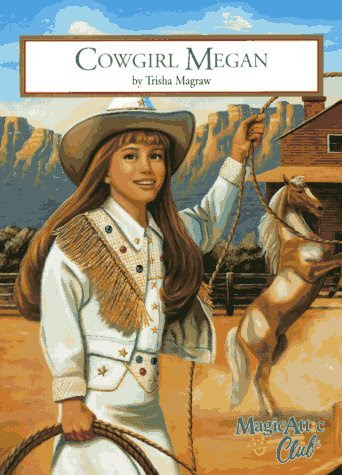
Review: "Cowgirl Megan" by Trisha Magraw
Cowgirl Megan by Trisha Magraw
Published 1998
★★★
I don't plan to reread a whole lot of this series, so I'm picking and choosing. Cowgirl Megan> has, I think, the strongest nostalgia vibes of any of the series for me—not so much the book itself, but that cover. Or, more accurately, that jacket—I remember so vividly how cool I thought a white leather fringed jacket studded with jewels was. Also, now that I think about it, the version of Megan on the cover is pretty much a dead ringer for the American Girl doll I had around the same time.
Unlike the contents of the other books of this series I've dipped into as an adult, this book also rings some other bells. Here, Megan is feeling slighted by her friends—who are, it must be said, astonishingly quick to cut Megan down to size when she displays the barest amount of ambition (more on that in a moment)—when she heads up into the attic to escape reality for a bit. When she slips through the fabric of reality, she finds herself in the Wild West...with a girl whose dream of showing her prowess in the competition ring is being thwarted by circumstances outside her control. It's up to Megan to help her come up with a plan—and in the process learn to speak up for herself.
Because the girls tend to adventure independently in this series, we actually see very little of their friendship—they're eager to ask each other where the mirror in the attic has taken them, and to sit together at lunch, but the books are short and so their time together is limited. But okay: let's trust that they're the best and most supportive of friends (most of the time). The other girls eventually (it's a feel-good children's/early MG book, after all) apologize to Megan and concede that having dreams makes sense. Good for them, and good for Megan for standing up for herself. What does it say about perceptions of female friendship, though, that they are so quick to encourage Megan to make herself smaller? I wonder what a contemporary book would do with this.
Published 1998
★★★
I don't plan to reread a whole lot of this series, so I'm picking and choosing. Cowgirl Megan> has, I think, the strongest nostalgia vibes of any of the series for me—not so much the book itself, but that cover. Or, more accurately, that jacket—I remember so vividly how cool I thought a white leather fringed jacket studded with jewels was. Also, now that I think about it, the version of Megan on the cover is pretty much a dead ringer for the American Girl doll I had around the same time.
Unlike the contents of the other books of this series I've dipped into as an adult, this book also rings some other bells. Here, Megan is feeling slighted by her friends—who are, it must be said, astonishingly quick to cut Megan down to size when she displays the barest amount of ambition (more on that in a moment)—when she heads up into the attic to escape reality for a bit. When she slips through the fabric of reality, she finds herself in the Wild West...with a girl whose dream of showing her prowess in the competition ring is being thwarted by circumstances outside her control. It's up to Megan to help her come up with a plan—and in the process learn to speak up for herself.
Because the girls tend to adventure independently in this series, we actually see very little of their friendship—they're eager to ask each other where the mirror in the attic has taken them, and to sit together at lunch, but the books are short and so their time together is limited. But okay: let's trust that they're the best and most supportive of friends (most of the time). The other girls eventually (it's a feel-good children's/early MG book, after all) apologize to Megan and concede that having dreams makes sense. Good for them, and good for Megan for standing up for herself. What does it say about perceptions of female friendship, though, that they are so quick to encourage Megan to make herself smaller? I wonder what a contemporary book would do with this.
Thursday, June 13, 2024
Review: "The Secret of the Attic" by Sheri Cooper Sinykin
The Secret of the Attic by Sheri Cooper Sinykin
Published 1995 via Scholastic Inc.
★★★
I've been doing some quick childhood rereads recently, and this cropped up. I don't remember the plots of this series terribly well, but the covers give me this sweeping sense of nostalgia, and I hoped that maybe I'd remember more upon reading. That wasn't really the case here, but you never know—maybe one of the later books (the cover of Cowgirl Megan gives me some of the strongest nostalgia of the bunch, though Keisha the Fairy Snow Queen isn't far behind) will deliver.
The Secret of the Attic was published in 1995, and it's definitely a reminder that diversity in books at the time was, like...one of them is blonde! One of them is a brunette! One of them is a redhead! One of them is Black (African American, in the 90s)! And they don't all celebrate the same holidays—one of them is Jewish, and one of them celebrates Kwanzaa! I'm now wondering whether this book is partially responsible for my brief confusion as a kid about Kwanzaa; all the Black kids I knew (in my racially-and-socioeconomically-but-not-otherwise-very diverse elementary school) celebrated Christmas, but I remember being very confused by that because the message I'd gotten from books and, I think, school was that Black people didn't celebrate Christmas because they celebrated Kwanzaa instead. (It is obvious to me now that these things are not mutually exclusive, but at the time...)
The other thing of note now, which I certainly wouldn't have noticed at the time, is that it's actually pretty creepy that a bunch of kids meet a strange woman who is so enthusiastic about them going to play in her attic. Granted, the book takes pains to make it not creepy—the kids regularly check in with their parents, who are familiar with the strange woman—but even so, I hope that if someone had told me to run along and play in their attic when I was a kid I'd have maintained a healthy level of suspicion...? On the other hand, I hope even as an adult that a magic attic will crop up and I'll get to have a bunch of random adventures, so.
Published 1995 via Scholastic Inc.
★★★
I've been doing some quick childhood rereads recently, and this cropped up. I don't remember the plots of this series terribly well, but the covers give me this sweeping sense of nostalgia, and I hoped that maybe I'd remember more upon reading. That wasn't really the case here, but you never know—maybe one of the later books (the cover of Cowgirl Megan gives me some of the strongest nostalgia of the bunch, though Keisha the Fairy Snow Queen isn't far behind) will deliver.
The Secret of the Attic was published in 1995, and it's definitely a reminder that diversity in books at the time was, like...one of them is blonde! One of them is a brunette! One of them is a redhead! One of them is Black (African American, in the 90s)! And they don't all celebrate the same holidays—one of them is Jewish, and one of them celebrates Kwanzaa! I'm now wondering whether this book is partially responsible for my brief confusion as a kid about Kwanzaa; all the Black kids I knew (in my racially-and-socioeconomically-but-not-otherwise-very diverse elementary school) celebrated Christmas, but I remember being very confused by that because the message I'd gotten from books and, I think, school was that Black people didn't celebrate Christmas because they celebrated Kwanzaa instead. (It is obvious to me now that these things are not mutually exclusive, but at the time...)
The other thing of note now, which I certainly wouldn't have noticed at the time, is that it's actually pretty creepy that a bunch of kids meet a strange woman who is so enthusiastic about them going to play in her attic. Granted, the book takes pains to make it not creepy—the kids regularly check in with their parents, who are familiar with the strange woman—but even so, I hope that if someone had told me to run along and play in their attic when I was a kid I'd have maintained a healthy level of suspicion...? On the other hand, I hope even as an adult that a magic attic will crop up and I'll get to have a bunch of random adventures, so.
Monday, April 29, 2024
Children's books: Role models: "Simone Biles", "Malala's Mission for the World", and "Sally Ride"
Simone Biles by Maria Isabel Sanchez Vegara, illustrated by Nadia Fisher (Frances Lincoln Children's Books)
Malala's Mission for the World by Aida Zaciragic, illustrated by Ana Grigorjev
Sally Ride by Maria Isabel Sanchez Vegara, illustrated by Alona Millgram (Frances Lincoln Children's Books)
Simone Biles
Always nice to see stories of trailblazers and role models. You'd have to have lived under a rock for the past decade to not have any idea who Simone Biles is, but this is a great intro for young readers who are interested in gymnastics or other sports.
It's particularly interesting to me to see that the book alludes to recent scandals in the gymnastics world—in a very age-appropriate way—and also that it gives a nod to Biles taking some time off when the pressure was too much. It's easy to focus on the relatively simple things like gold medals (easy to understand!), but just as valuable, if not more, for kids to get messages about speaking up when something's not right and making sure to prioritize health. (And also nice to see the book say directly that Biles lived with her grandparents—I'm guessing that there aren't that many books where young kids who live with non-parental guardians can see their experience reflected in a neutral-positive way.)
All told, a nice addition to a child's library...especially one who tends to do cartwheels all over the furniture.
Malala's Mission for the World
I love seeing books for young readers about women making a difference in the world, and Malala Yousafzai is a great example. In Malala's Mission for the World, readers are introduced to her life in Pakistan and her passion for learning—and how quickly things changed for her.
The book is pretty text-heavy—better for more confident readers or read with an adult's support, but it allows for a lot more information and story than something briefer, so I'm generally on board with it. The illustrations are beautiful, but the text has its fair share of errors, awkward constructions, and presumably accidental repetitions. I do wish the book had been more carefully edited/proofread, because that would have made it a much more useful tool for kids working on language and vocab skills as well as learning something about (recent) history, other countries, and women in the world. Overall a thoughtful and age-appropriate read, though, and I'm glad to see that Malala's parents are also highlighted as proponents of education and equality for girls.
Sally Ride
What a delightful look at one of my favorite figures from women's history—well, history more general, but Sally Ride was an absolute trailblazer for women. Sally Ride takes young readers through her life, from her interest in science from a young age to the company she started with her partner, Tam O'Shaughnessy.
I vaguely remember the media about Sally Ride when she died, and when the fact that she was in a long-term relationship with a woman became public. I'm glad that this book mentions it, and casually at that. This is part of an extended series of biographies of famous people by this publisher, and they're clearly putting in the effort to make sure that diversity doesn't get lost in the shuffle, from making note of LGBTQ folks in history to ensuring that there's representation (is that an artificial leg I see?) in the illustrations. The text is on point, and the illustrations have lots of little details to find. It would make for a wonderful book for early readers who are interested in science.
Thanks to the authors and publishers for providing review copies through NetGalley.
Malala's Mission for the World by Aida Zaciragic, illustrated by Ana Grigorjev
Sally Ride by Maria Isabel Sanchez Vegara, illustrated by Alona Millgram (Frances Lincoln Children's Books)
Simone Biles
Always nice to see stories of trailblazers and role models. You'd have to have lived under a rock for the past decade to not have any idea who Simone Biles is, but this is a great intro for young readers who are interested in gymnastics or other sports.
It's particularly interesting to me to see that the book alludes to recent scandals in the gymnastics world—in a very age-appropriate way—and also that it gives a nod to Biles taking some time off when the pressure was too much. It's easy to focus on the relatively simple things like gold medals (easy to understand!), but just as valuable, if not more, for kids to get messages about speaking up when something's not right and making sure to prioritize health. (And also nice to see the book say directly that Biles lived with her grandparents—I'm guessing that there aren't that many books where young kids who live with non-parental guardians can see their experience reflected in a neutral-positive way.)
All told, a nice addition to a child's library...especially one who tends to do cartwheels all over the furniture.
Malala's Mission for the World
I love seeing books for young readers about women making a difference in the world, and Malala Yousafzai is a great example. In Malala's Mission for the World, readers are introduced to her life in Pakistan and her passion for learning—and how quickly things changed for her.
The book is pretty text-heavy—better for more confident readers or read with an adult's support, but it allows for a lot more information and story than something briefer, so I'm generally on board with it. The illustrations are beautiful, but the text has its fair share of errors, awkward constructions, and presumably accidental repetitions. I do wish the book had been more carefully edited/proofread, because that would have made it a much more useful tool for kids working on language and vocab skills as well as learning something about (recent) history, other countries, and women in the world. Overall a thoughtful and age-appropriate read, though, and I'm glad to see that Malala's parents are also highlighted as proponents of education and equality for girls.
Sally Ride
What a delightful look at one of my favorite figures from women's history—well, history more general, but Sally Ride was an absolute trailblazer for women. Sally Ride takes young readers through her life, from her interest in science from a young age to the company she started with her partner, Tam O'Shaughnessy.
I vaguely remember the media about Sally Ride when she died, and when the fact that she was in a long-term relationship with a woman became public. I'm glad that this book mentions it, and casually at that. This is part of an extended series of biographies of famous people by this publisher, and they're clearly putting in the effort to make sure that diversity doesn't get lost in the shuffle, from making note of LGBTQ folks in history to ensuring that there's representation (is that an artificial leg I see?) in the illustrations. The text is on point, and the illustrations have lots of little details to find. It would make for a wonderful book for early readers who are interested in science.
Thanks to the authors and publishers for providing review copies through NetGalley.
Saturday, April 6, 2024
Children's books: Parents: "Always Carry Me with You", "I Love You", and "Call Your Mother"
Always Carry Me with You by Hervé Éparvier, illustrated by Fred Benaglia (Ivy Kids Echo)
I Love You by Mary Murphy (Happy Yak)
Call Your Mother by Tracy C. Gold, illustrated by Vivian Mineker (Familius)
Always Carry Me with You
I'm not sure if this is a science lesson hidden within a love letter or a love letter hidden within a science lesson, but either way, it works. In Always Carry Me with You, a father tells his daughter all sorts of cool things about rocks...and then compares his love for her to a rock, something she can carry in her pocket as a reminder that it's there.
It's sweet any way you slice it, but honestly, the first audience I thought about for this was children whose parents are terminally ill or otherwise facing an uncertain future. I don't mean this in a maudlin way (and obviously the book is perfectly appropriate in happier contexts!), but I imagine that one thing you'd want to do in that scenario is find ways to support your kid even after you're gone...which might include giving them a way to carry your love with them. (Just, uh. Make sure they know that it's not just one specific pebble that'll do the job. Kids lose things. Adults lose things.)
The drawings are playful (and somehow feel very French?), with more than enough whimsy to keep kids looking. The font feels like an afterthought, but that seems like a pretty minor objection, all things considered.
I Love You
What a sweet book. Reminiscent of "My Favorite Things" from "The Sound of Music", I Love You shows an adult and a baby panda romping through fun activities—each of which is a new way to tell the baby panda that it is loved. I love you like / a crayon drawing dragons, promises the book, and in turn I love the creativity that has gone into each choice.
The illustrations here are simple but high-contrast, with enough detail to keep readers entertained...and pandas that look truly snuggly. This is definitely one to be read aloud—young readers might enjoy it alone, of course, but it'll be at its best when it's not a solo endeavor; I'm willing to bet that the author made a point to read this aloud throughout the process of writing to check the flow and rhythm of the book. An excellent addition to an early reader's bookshelf.
Call Your Mother
You know the refrain here already: Call Your Mother. This deceptively simple picture book takes readers through a series of times a child might call its mother—from infancy (I don't have kids, but the exhausted mother stumbling in in the wee hours of the morning made me laugh with sympathy) through to schoolday nerves (my gosh that hug looks cozy) and into adulthood.
I think parts of this will resonate better with adults, who can perhaps remember each of these sorts of incidents better than a young reader can imagine, but I can also easily see it as a way to remind an anxious kid that their parent(s) will (...barring the unexpected, but maybe an anxious five-year-old doesn't need to hear that...) be there for them as they grow and age, in good times and in bad. My favorite illustration, far and away, is a variation on the cover illustration, but the whole thing is neatly done, with clean and soft lines. Would absolutely put this one on a young kid's shelves.
Thanks to the authors and publishers for providing review copies through NetGalley.
I Love You by Mary Murphy (Happy Yak)
Call Your Mother by Tracy C. Gold, illustrated by Vivian Mineker (Familius)
Always Carry Me with You
I'm not sure if this is a science lesson hidden within a love letter or a love letter hidden within a science lesson, but either way, it works. In Always Carry Me with You, a father tells his daughter all sorts of cool things about rocks...and then compares his love for her to a rock, something she can carry in her pocket as a reminder that it's there.
It's sweet any way you slice it, but honestly, the first audience I thought about for this was children whose parents are terminally ill or otherwise facing an uncertain future. I don't mean this in a maudlin way (and obviously the book is perfectly appropriate in happier contexts!), but I imagine that one thing you'd want to do in that scenario is find ways to support your kid even after you're gone...which might include giving them a way to carry your love with them. (Just, uh. Make sure they know that it's not just one specific pebble that'll do the job. Kids lose things. Adults lose things.)
The drawings are playful (and somehow feel very French?), with more than enough whimsy to keep kids looking. The font feels like an afterthought, but that seems like a pretty minor objection, all things considered.
I Love You
What a sweet book. Reminiscent of "My Favorite Things" from "The Sound of Music", I Love You shows an adult and a baby panda romping through fun activities—each of which is a new way to tell the baby panda that it is loved. I love you like / a crayon drawing dragons, promises the book, and in turn I love the creativity that has gone into each choice.
The illustrations here are simple but high-contrast, with enough detail to keep readers entertained...and pandas that look truly snuggly. This is definitely one to be read aloud—young readers might enjoy it alone, of course, but it'll be at its best when it's not a solo endeavor; I'm willing to bet that the author made a point to read this aloud throughout the process of writing to check the flow and rhythm of the book. An excellent addition to an early reader's bookshelf.
Call Your Mother
You know the refrain here already: Call Your Mother. This deceptively simple picture book takes readers through a series of times a child might call its mother—from infancy (I don't have kids, but the exhausted mother stumbling in in the wee hours of the morning made me laugh with sympathy) through to schoolday nerves (my gosh that hug looks cozy) and into adulthood.
I think parts of this will resonate better with adults, who can perhaps remember each of these sorts of incidents better than a young reader can imagine, but I can also easily see it as a way to remind an anxious kid that their parent(s) will (...barring the unexpected, but maybe an anxious five-year-old doesn't need to hear that...) be there for them as they grow and age, in good times and in bad. My favorite illustration, far and away, is a variation on the cover illustration, but the whole thing is neatly done, with clean and soft lines. Would absolutely put this one on a young kid's shelves.
Thanks to the authors and publishers for providing review copies through NetGalley.
Friday, March 1, 2024
Review: "Caroline's Mystery Dolls" by Molly Mia Stewart (created by Francine Pascal)
Caroline's Mystery Dolls by Molly Mia Stewart (created by Francine Pascal)
First published 1991
★★★
Continuing the spin through Sweet Valley—this one is largely unremarkable, but I remembered it vaguely from when I was little. I suppose the writers didn't want to let Jessica go full bonkers at this point (bad example for the kiddos!), so she's pretty mild in these younger books. Though she does still get a more interesting plot than Elizabeth...
The doll plot isn't too exciting, but I remember being really jealous of how many "name" items Jessica had—my name is uncommon enough that I've never seen a single premade (as opposed to customisable) "name" item that fit me, or even one with my middle names. (I prefer my uncommon name, but it does have occasional downsides!) Reminds me a little bit of one of the Face on the Milk Carton books, actually, where Janie meets her biological family and is presented with a lot of items with her name...
Anyway. These Sweet Valley Kids books are way, way out of my age range these days, but the nostalgia factor is nice. And there's still hope for Jessica in this series! Oh, those bright, optimistic days...
First published 1991
★★★
Continuing the spin through Sweet Valley—this one is largely unremarkable, but I remembered it vaguely from when I was little. I suppose the writers didn't want to let Jessica go full bonkers at this point (bad example for the kiddos!), so she's pretty mild in these younger books. Though she does still get a more interesting plot than Elizabeth...
The doll plot isn't too exciting, but I remember being really jealous of how many "name" items Jessica had—my name is uncommon enough that I've never seen a single premade (as opposed to customisable) "name" item that fit me, or even one with my middle names. (I prefer my uncommon name, but it does have occasional downsides!) Reminds me a little bit of one of the Face on the Milk Carton books, actually, where Janie meets her biological family and is presented with a lot of items with her name...
Anyway. These Sweet Valley Kids books are way, way out of my age range these days, but the nostalgia factor is nice. And there's still hope for Jessica in this series! Oh, those bright, optimistic days...
Saturday, February 17, 2024
Review: "Trapped in Toyland" by Molly Mia Stewart (created by Francine Pascal)
Trapped in Toyland by Molly Mia Stewart (created by Francine Pascal)
First published 1994
★★★★
I've been rereading a few of the Sweet Valley books, and the description of this one triggered something in my memory, so I thought I'd add it to the pile. In Trapped in Toyland, Elizabeth and Jessica go to the fancy new department store with their parents, eager to spend their collected $15.63 on a Christmas gift for their mother. (Their father and brother get a construction-paper photo frame and a handwritten story, respectively.) Now, if this were one of the SV Twins or SV High books, it seems likely that Jessica would end up spending all the money before they could buy a gift...but instead, because this is a SV Kids book* and Jessica still has some feelings for other people, she's eager and (mostly) focused on finding a gift for their mother. But shenanigans happen, and the girls find themselves locked in the department store overnight...without their purse full of money, but with everything else at their disposal—and with a rather aggressive burglar.
On the whole, this is just adorable. It makes for great wish fulfillment (who hasn't wanted to be locked in somewhere overnight? A toy store, a bookstore, a furniture store with huge floofy beds...), and I love Elizabeth and Jessica's blend of responsibility and kid-ness: when they eat ice cream from the food court (because, naturally, all they have to do is walk behind the counter and open a freezer to access all the junk food they could ever want), they make sure to clean up after themselves...but Elizabeth is readily talked into trying on fancy dresses and makeup (I remember being jealous of the sequined dress Elizabeth tries on), and it's goody-two-shoes Elizabeth who suggests a race in the toy cars. (Older Elizabeth would never.) They create a fair amount of gleeful, well-intentioned kid chaos, and the book is better for it.
There are many, many, many things about the plot that make no sense, or at least make no sense in the 2020s—the Wakefields let their seven-year-old twins wander the eight-story department store with only their brother (who is roughly nine) to provide any kind of supervision; there's no search of the mall when the Wakefields can't find their daughters; there's no accountability from the Wakefields for letting their small children wander around unsupervised; the girls are able to access everything in the department store without minor concerns like keys; they make all sorts of noise without the burglar noticing; they call 911 multiple times and are laughed at; the burglar bothers to steal a second-grader's purse while preparing for his much bigger heist; literally almost everything about the burglar; and on and on it goes. But it's a book for kids and written in the 90s, and what can you do?
*Note that even in the SV Kids books Jessica is not above spending money that isn't hers or cheating to win.
Subscribe to:
Posts (Atom)
Review: "My Chance to Fly" by Samantha Tonge
My Chance to Fly by Samantha Tonge Published August 2026 via Boldwood Books ★★★ Una's life is regimented, and that's just the way sh...
-
The Ferryman and His Wife by Frode Grytten, translated from the Norwegian by Alison McCullough Published November 2025 via Algonquin Books ★...
-
Three Ordinary Girls by Tim Brady Published February 2021 via Citadel Press ★★★ For all that I've heard about the strength of the Dutch ...
-
The Keeper by Tana French Published March 2026 via Viking ★★★★ Book three—of three—in the Cal Hooper series. Time has passed: Trey is growin...


.jpg)


.png)