Showing posts with label translated. Show all posts

Sunday, July 12, 2026

Review: "The Acrobat" by Wisława Szymborska

The Acrobat by Wisława Szymborska
Translated by Clare Cavanagh and Stanisław Barańczak
Published July 2026 via Ecco
★★★★


I like maps, / because they lie. / Because they give no access to the vicious truth. / Because great-heartedly, good-naturedly / they spread before me a world / not of this world. (loc. 369*)

Szymborska was an award-winning (Nobel-winning, in fact) Polish poet, and it's easy to see why. This collection pulls together some of her works, translated in English.

I haven't read any of Szymborska's poetry before, but honestly, these are poems I'd like to return to. I don't always understand them, but that's my preference in poetry; they're accessible enough that I could take something from each poem and complex enough to make me think, and think again.

He made himself a glass violin so he could see what music looks like. (loc. 564)

I don't speak Polish and can't comment on the translation, but I loved the introduction—for all that I enjoyed Szymborska's wit and sly commentary, I think I would have gotten less out of it without having read the introduction, written by one of the translators, first. Cavanagh spends some time talking about how they chose to approach the poetry, including rhymes and neologisms and alliteration. It was something I came back to again and again as the book progressed. How might this look in the original Polish, for example?

So much world all at once—how it rustles and bustles! / Moraines and morays and morasses and mussels, / the flame, the flamingo, the flounder, the feather— / how to line them all up, how to put them together? (loc. 497)

You can see that the translators leaned hard into rhyme and alliteration, presumably at the expense of literal translation. I imagine this is a judgement call for anyone doing translation work, not only but especially of poetry: When do you go for precision, and when do you go for vibe? I take no issue with the choice to go with vibe, but I'd be dead curious to see a translation that went for something directly literal, too.

Look at the happy couple. / Couldn't they at least try to hide it, / fake a little depression for their friends' sake! (loc. 687)

A high four stars and one I'm likely to return to.

*Quotes are from an ARC and may not be final.

Thanks to the translators and publisher for providing a review copy through NetGalley.

Thursday, May 28, 2026

Review: "The Fifth Year" by Marlen Haushofer

The Fifth Year by Marlen Haushofer
Translated from the German by Shaun Whiteside
English translation published May 2026 via New Directions
★★★★


Somewhere in the Austrian mountains, a young girl is growing up with her grandparents. The in-between generation is gone: some lost to illness, some lost to war; it is unclear what, exactly, befell Marili's parents, partly because she is old enough to ask questions but not really old enough to understand the full weight of the world in which she is growing up. Instead we see that Marili's grandparents are still grieving losses—some old, some new—that she can register but not, yet, put into context.

This was Haushofer's first published book, with the original Das fünfte Jahr coming out in 1952. War must have been so present still, in broken buildings but especially in the missing and the dead. "This," says Marili's grandmother, "is where they lie, Hans and Franz and your mother. We don't know anything about Stefan and your father, they're somewhere in Russia." (loc. 472*)

I'm reminded a bit of Heidi, of course (though these grandparents are neither recluses nor grumps), and of Claire Keegan's Foster, though the setting and situation are different. Mostly this is a sweet and charming story, but an undercurrent of darkness runs throughout the story, starting with Marili's fear of the crucified Jesus painting hanging in her room and continuing through the grief her grandparents will so clearly carry for the rest of their lives. (I'm extrapolating, but I got the sense that raising another child is more than they'd bargained for, but also that being able to do so in the face of such loss is one of the things that helps them get up in the morning.)

3.5 stars for a quiet and curious book.

*Quotes are from an ARC and may not be final.

Thanks to the publisher for providing a review copy through NetGalley.

Sunday, April 26, 2026

Review (Deutsch): "Run like a girl" von Amaka Egbe

Run like a girl von Amake Egbe, übersetzt von Henriette Zeltner-Shane
Run like a girl von Amaka Egbe, übersetzt von Henriette Zeltner-Shane
Herausgegeben 2025 von Dragonfly
★★★


Dera hat Pläne—Olympische Pläne. Aber es gibt einen Strich durch die Rechnung: Sie muss umziehen, und mit ihrem Vater wohnen...und ihre neue Schule hat keine Mädchenmannshaft.

Es gibt hier viele Themen: neue Schule, neue Freunde und Freundinnen, neue Beziehung zu Deras Vater (und kulturelle Unterschiede), neue Mannschaft; Olympische Tore; Mobbing und noch mehr Mobbing; Rasse; Teenager im sozialen Medienzeitalter zu sein; und natürlich (es ist YA!) eine Romanze.

Mein Lieblingsding hier ist etwas ein bißchen komisch: mein Deutsch ist nicht total flüssig, und obwohl ich die Geschichte verstehen kann (und die Formulierung und Übersetzung schätze), manchmal...verstehe ich nicht alles...und, ehrlich zu sein, das ist perfekt wenn man am Anfang nicht wissen will, wer das Liebesinteresse ist.

Es gab für mich vielleicht ein paar zu viele Themen. Normalerweise sage ich, dass weniger Romanze und mehr Freundschaft nett wäre, und das stimmt auch, aber hier denke ich, dass es ein bißchen zu viel Mobbing gab. War es realistisch? Ja, vielleicht. (Die Haare—arme Dera!) Es war auch viel, besonders wenn es Auswirkungen für Deras Zukunft gibt. Aber die Geschichte hat mir am Ende gefallen. 3,5 Sterne.

Ich habe nur das Deutsch gelesen, aber ich habe das Englisch aus der Bibliothek geliehen ("just in case!"). Ein paar interessante Übersetzungen:

EN: I was by no means the dullest tool in the shed
DE: Ich war bei Weitem nicht die schwächste Kerze auf der Torte (loc. 495*)

EN: no matter the hurdles that block our path (ba-dum-tss!)
DE: Egal welche Hürden uns im Weg stehen (ta-daa!) (loc. 3312)

EN: when her exasperation had reached its limit
DE: wenn sie mit ihrem Latein am Ende war (loc. 3586)

EN: “Are you?” Two words, six letters
DE: »Tut es das?« Drei Worte, acht Buchstaben. (loc. 4527)

EN: You look like someone killed your cat.
DE: Du siehst aus, als hätte jemand deine Katze vergiftet. (loc. 5107)

*Quotes are from an ARC and may not be final.

Thanks to the author and publisher for providing a review copy through NetGalley. Deutsch ist nicht meine Muttersprache, und alle Fehler sind meine eigenen.

Saturday, April 11, 2026

Review: "White Moss" by Anna

White Moss by Anna Nerkagi, translated by Irina Sadovina
English translation published 2026 via Pushkin Press
★★★


In the isolated Siberian tundra, things are changing: For generations, life was reindeers and fire and tents. Everyone had a place, and everyone knew their place. But for the characters of White Moss—first published in the 90s—things are changing.

I went down a Sámi reading hole a while back, and this stirred a spark of the same interest. The Nenets people are of course not Sámi, but some of the themes are the same: the isolation, the all-encompassing importance of their animals, the cold, the place on the outskirts of society. And: the precariousness of their way of life. By the time White Moss takes place, the children (like the author) are being sent off to boarding school during the year; the Soviet version of Big Brother casts a shadow across the land; the young adults are leaving for the city and not looking back.

It's an odd, quiet book. Not too much happens—Alyoshka, young and newly married, ignores his wife; the men make proclamations and tend to reindeer; the women, who are almost all unnamed, tend to the fire and the house. I'm not sure I can really say that the book is character-driven; we follow a few of the characters throughout the book (Alyoshka; the father of the woman he wishes he'd married; his mother; etc.), but they change little, and nor are they meant to. Rather, this is something of a portrait of a community and a way of life in a time of transition.

Nerkagi, like her characters, was born in Siberia; unlike her characters, she was not able to stay. I'd love to read more about her—as I understand it, her first novel is autobiographical, but I don't think it's been translated into English. White Moss focuses more on the men of the story (again: most of the women do not have so much as names; they are "the woman" or "his mother" or "his woman"), in a way that I think must have been intentional, but the fact is that Nerkagi was torn away from her community and then chose to go back, at a time when I'm guessing that more people were leaving than returning; the story is not altogether kind to those living away, but then, neither is it always kind to those who remain.

It's a short book, and probably not one I'll return to, but it made for an intriguing look into a place I'm not likely to ever visit and a culture I'll probably only ever understand on a surface level.

Thanks to the author and publisher for providing a review copy through NetGalley.

Friday, March 6, 2026

Review: "Repetition" by Vigdis Hjorth

Repetition by Vigdis Hjorth
Translated from the Norwegian by Charlotte Barslund
Published March 2026 via Verso Fiction
★★★★


In the present day, a writer sees a teenage girl with her parents, and she's reminded of her own teenage years in 1970s Norway: her mother terrified that she will somehow go astray, her father a distant figure, every visit with friends a negotiation at best, a battle at worst.

Hjorth is such a specific writer—I don't have a better word for it. I read Repetition because I found If Only so curious; not always pleasant but the kind of thing that pulls you in. (If Only itself I read for the cover, because sometimes I am shallow.) I read a translation, of course, and I don't know how true it is to the Norwegian (I will assume that it's accurate!), but these are long paragraphs and sometimes long sentences, run-on thoughts if not run-on sentences, a girl who is so uniquely teenage in her thoughts and actions, her careful planning and yet sometimes total lack of forethought. At sixteen, she is tired of the stifling atmosphere that is home and ready for excitement, for romance or perhaps just sex; at sixteen, she doesn't understand why her mother might be afraid.

This is a slim little novel. I started it once, stalled, started over a few weeks later because it's so easy to fly through it and I wanted to make sure I hadn't missed important things. I wondered, reading this, if parts of the novel might be autobiographical (without, mind, being able to articulate why, and definitely without any proof whatsoever); some searching tells me that there has been a fair amount of speculation about another novel in particular, and how much of it might be autobiographical. (That's a rabbit hole that I don't feel a need to go down, and whether there's any real life memory to it is really neither here nor there, but I find it curious partly just because I don't know why I have this "could it be" reaction!)

Not a happy book but a swift and interesting one. I don't think this is the last of Hjorth that I'll read.

Thanks to the author and publisher for providing a review copy through NetGalley.

Monday, February 9, 2026

Review: "Once We Are Safe" by Alessandra Carati

Once We Are Safe by Alessandra Carati
Translated from the Italian by Linda Worell and Laura Masini
Published October 2025 via Amazon Crossing
★★★


At home, I asked my mother if it was true that the war was coming. "No," she said, "it will never come to this village." I believed her. (loc. 92)

Aida is six when her family flees the Bosnian War and takes refuge in Milan—their village is no longer safe. It's temporary, her parents assure her, assure each other, over and over again. They'll be back to the village before they know it. But the war drags on, and they get settled in Italy, and by the time it's safe to go back most of what they knew is gone.

We didn't even hug goodbye. Everyone kept saying that it wouldn't be for long—two weeks at most, and then we'd go home. (loc. 159)

I was eager to read this because I've read precious little about this time and place. I was too young when the Bosnian War was happening to know that it existed, and it was only ever an afterthought in my history classes. And beyond that, even Italy in the early 90s is not something I've read much about. Literature in translation...yes please.

I found that the structure of the book impeded my interest somewhat, though. The book is short, and the chapters shorter; I sped right through. But each chapter feels more like a snapshot than anything: Despite the brief nature of the chapters, there's often a gap of time between one chapter and the next—sometimes only a day, sometimes much longer. Sometimes the breaks are longer; Aida jumps from seven years old to choosing what to study in high school, and later she jumps from studying classics in high school to a professional degree that she's previously shown no interest in. Her parents, meanwhile, change little; her mother never gets beyond the grief of leaving her homeland behind, or of losing so many of her loved ones.

There's one line that reminded me of something in The Unbreakable Heart of Oliva DenaroI couldn't understand why Abraham didn't just defy God and try to keep his son anyway. Babo would never have given up a male child, not for all the world, not even if he'd been asked by Allah. (loc. 572) It's striking for the understanding Aida has as a young child—she's still about six when she says this—how much more boys matter in her world, in the world generally. Her statement is neutral, matter of fact; it doesn't occur to her that her father might think the same way about a daughter. This is followed up on somewhat throughout the book, but I think I wish it had been covered a bit further. Aida's younger brother, who is born after this point in the book, eventually becomes the focus of the family's energies, though for different reasons than Aida expresses here, and so too does the book lose focus on what it is to have a homeland torn apart by war. I wish there had been a bit more of a sense of place; I didn't pick up all that much of a sense of being either in Bosnia or in Italy, and if the story had been picked up and put in the context of a different conflict, I don't think all that much would have to be changed.

So...glad to have read this, but I'm not sure how well it will stay with me. A quick read, though, and always nice to pick up something about a situation I don't know enough about.

Tuesday, February 3, 2026

Review: "The Cut Line" by Carolina Pihelgas

The Cut Line by Carolina Pihelgas, translated by Darcy Hurford
English translation published February 2026 via World Editions
★★★★


Rural Estonia: Liine has fled to her rural family cottage in the wake of a much-needed breakup. It's peaceful, and it's not: war hovers just around the corner, climate change is making its mark, and more than anything Liine doesn't really know what's next.

When everything is quiet, when the guns aren't firing, this is the most beautiful place in the world. (loc. 119*)

I'm fond of novels in translation for a couple of reasons—first, I often get to read about places that aren't so commonly written about in English; second, the rhythm and style of books written in different languages is often different. (Think, e.g., about the recent uptick in interest in translations of Japanese novels—could be wrong, but I assume one of the reasons for this is just that the style of writing is different than what most English-medium authors are doing.) As far as I can remember this is the first novel out of Estonia that I've read(!), so far be it from me to paint all Estonian novels with the same brush, but...nice to see contemporary things from places about which I know little.

Anyway, back to more specifics: The Cut Line is told in a not-quite-stream-of-consciousness style, as Liine works and ruminates and tries to avoid falling back into the angry orbit of her ex; as her family asks if he was so bad, really; as gunfire echos nearby; as nothing happens and everything changes anyway.

The description highlights climate change and the threat of war; the mention of climate change made me a little hesitant to read this (I already read too much real-life news), but I found nearby military action to make more of a impact when reading. (Also stressful, and also a little too close to real life! But worth noting that this is not a war story.) I don't know any Estonian, so I can't speak to the translation accuracy, but this made for a smooth read, and I never found myself wondering about the original—a good sign.

One for readers of lit fic and those looking for something slow, quiet, deeper currents moving under deceptively calm waters.

Thanks to the author and publisher for providing a review copy through NetGalley.

*Quotes are from an ARC and may not be final.

Tuesday, December 30, 2025

Review: "Sobibor" by Jean Molla

Sobibor by Jean Molla
Sobibor by Jean Molla, translated from the French by Polly McLean
English translation published 2005
★★★


Spoilers below

Pulled this one from deep deep down on my TBR, and it's an odd one. Part YA eating disorder story, part Holocaust story. Emma's anorexia/bulimia serve as...something of a penance, plus something of a visible sign of shame, I think? The timeline was a little confusing, but the short of it is that she discovers a Holocaust-era diary that her late grandmother had stashed away; the diary is written by a French Nazi sympathizer (and Nazi himself), and the more Emma reads the more she questions what she knows about her grandmother: in addition to what Emma learns through the diary (in which her grandmother makes appearances), why did she have this diary, and who was this man to her?

I'm not sure quite what to do with this. The comparison of the body of someone who is very sick with anorexia (and yes, Emma is very sick) to a person who survived—or, for that matter, didn't survive—the Holocaust is not a new one, but here it's a bit more literal. But...when Emma eventually works out the details, she understands that the writer of the diary, despite the different name, is her grandfather. There's a whole confrontation, and it just feels odd—like someone's (the writer's?) fantasy of, well, confronting a Nazi.

It would be interesting to see this spread out over more time. Most of Emma's reaction, other than the confrontation, is confined to her relationship with food and her body. But...I'd have liked to see her really wrestle with what this means for her memories of not just her grandfather but also her grandmother. Her grandfather gets the brunt of the blame, as well he should (he's the one who happily worked at a death camp and who, somewhat less happily, committed murder himself); her grandmother, who is dead by the time Emma is working all of this out, gets less attention. But she's in many ways the more interesting character: she was at the camp as forced labor from Poland, and her relationship with Emma's grandfather meant survival...but the fact that she stayed with him after the war, buried his secrets, is something separate, and I don't think the book really gives enough room for Emma to work all of that out.

Saturday, November 15, 2025

Review: "The Ferryman and His Wife" by Frode Grytten

The Ferryman and His Wife by Frode Grytten
The Ferryman and His Wife by Frode Grytten, translated from the Norwegian by Alison McCullough
Published November 2025 via Algonquin Books
★★★


The day starts like any other, but Nils Vik knows from the moment he wakes up that this one will be different—this is the day that he dies. And so he goes about his daily routine, slow and steady as ever, setting off on his ferry to pick up, one after another, the passengers who died before him.

The Ferryman and His Wife is a lovely, quiet story—over the course of the book (and the day) we see Nils' life unfold throughout the years, the critical moments and the mundane. His has been an interesting life, but a quiet one; Nils has never been one for the hustle and bustle of the city or for big dramas. He listens, he watches, he reads, and at the end of the day he's happiest out of the fjord with his boat and at home with his wife.

This is one for literary fiction readers and lovers of slow-moving books. I didn't fully connect with the book, though I'm not entirely sure why; it may just be that so much of what I read is by or about women, and I might have preferred a book from the perspective of Nils' wife Marta. But that's not a failing of the book, which is so thoughtfully written and translated. Might be one for me to return to at a different point in time, lest a different context be all it takes to read this a little differently. I did very much appreciate the mundanity of Nils' life and the details he remembers (because so often it's those small, inconsequential things that stick). Someday perhaps I'll find myself on a ferry in Norway, seeing some of it through my own eyes.

Thanks to the author and publisher for providing a review copy through NetGalley.

Friday, August 1, 2025

Review: "Embrace Your Size" by Hara

Embrace Your Size by Hara
Translated from the Japanese by Alethea Nibley
Published November 2022 via Yen Press
★★★


Interesting look at body image (and insecurities, and positivity) in the context of Japan. I love the illustrations here—manga, which is hit or miss for me (often solely due to personal preference), but Hara conveys a lot in simple sketches, and a lot of the drawings are super cute. For the most part good messages throughout. That said, I found the book very repetitive—I think it may have been written as a series of standalone pieces, but in any case a lot of the stories/plot points were repeated over and over again.

I haven't been to Japan, but everything I've heard suggests that it's even harder there to be plus-sized than it is in the West. Hara touches on this a couple of times (in the context of wondering how things are different in other countries, and observing that for many fat women there are more clothing options in the West); I'd have loved to see the repetition trimmed out and the extra space given to some research on the subject.

Tuesday, July 22, 2025

Review: "Hunting in America" by Tehila Hakimi

Hunting in America by Tehila Hakimi, translated by Joanna Chen
Published July 2025 via Penguin Books
★★★★


A woman moves to an unnamed place in the US, and she is invited to go hunting—a first for her, but not her first time with a gun. And the invitation to hunt is a welcoming gesture, but it comes with a layer of subtext. It's a test and it's a beginning and perhaps it's an end, all rolled into one.

The invitation to hunt isn't the only thing in Hunting in America that is rife with subtext. Layers upon layers of it: the narrator holds her thoughts close to her chest and her history closer, but there's potential for double meanings in huge swathes of what she chooses to tell the reader and how.

In voice I'm reminded in places of My Year of Rest and Relaxation, though I found this rather easier to read. It's the sense of a protagonist on the verge of self-destruction, I think; the protagonist here is detached even as she makes decisions based more on emotion and instinct than on calculation.

I read this quickly—meant to read it in a couple of days but shot through in one. Going in, I was a little uncertain about the focus on hunting (I'm a near lifelong vegetarian who has never touched a gun, and I'd like to keep both of those things as they are), but for all that so much of the book is about hunting, hunting is almost beside the point; so much of the story is behind the hunting blind, behind the sentences on the page. Not uplifting, but lots to parse, to think about after the fact.

Thanks to the author and publisher for inviting me to read a review copy through NetGalley.

Wednesday, April 23, 2025

Review: "The Story of a Single Woman" by Uno Chiyo

The Story of a Single Woman by Uno Chiyo, translated by Rebecca Copeland
English translation published April 2025 via Pushkin Press Classics
★★★


Most of Uno Chiyo's works, writes Rebecca Copeland, who translated this one, [...] fall under the category of watakushi-shōsetsu or 'I-novel', a distinctly Japanese form that is not fiction but not strictly autobiography either. (loc. 30*) And this is just that: a fictionalized version of Uno's life through the age of 30 or so, taking her from country to city and job to job and lover to lover. It's told from a looking-back perspective (Uno's self-insert, Kazue, reflecting on her youth from the perspective of her seventies) and thus carries some distance.

It's so clear that Uno just wasn't all that interested in conventionality. Here, Kazue is married off to a cousin at the age of thirteen (it was the early 1900s); the marriage goes nowhere, so Kazue quietly goes home and never returns to her once-upon-a-husband, and nobody really presses her on it. Later, she takes jobs as they come to her and works hard at them without any real passion; she drifts from lover to lover with no intent of marrying again and a cheerful disregard for the knowledge that such informal affairs are (again, it was the early 1900s) societally taboo.

This was something of an oddity of a book. I don't think I've read anything else in the watakushi-shōsetsu category, though of course I've read plenty of Western autobiographical fiction. It's hard for me to know how much of the things where I wanted more (more connection between Kazue and the reader, more details about her daily life, less floating through months or years in just a few sentences) are a function of me reacting to this particular book and how much they're a function of me not understanding the specific genre very well. The second half in particular focuses quite heavily on...not romance, not really, but various men in whose beds Kazue finds herself, sometimes with passion and sometimes because they were there and sometimes because they've taken advantage of her. On the one hand I really love the neutrality with which Uno presents Kazue (she's treated neither as hypersexual nor someone to be shamed, simply as someone who is comfortable with her desires), but on the other hand I wished for a bit less "and then she slept with this guy and then she slept with that guy".

The book ends rather abruptly (in a way that, oddly, reminds me of The Four Corners of the Heart), and I'll have to have a look to see whether there is (or was intended to be) a follow-up covering later parts of Kazue's life.

Even if you don't read the book (which I definitely recommend to lovers of literary oddities), it's worth having a read through Copeland's blog series about meeting Uno in the 80s.

*Quotes are from an ARC and may not be final.

Thanks to the author and publisher for providing a review copy through NetGalley.

Thursday, April 17, 2025

Review: "My Favourite" by Sarah Jollien-Fardel

My Favourite by Sarah Jollien-Farden, translated from the French by Holly James
My Favourite by Sarah Jollien-Farden
Translated from the French by Holly James
Published April 2025 via the Indigo Press
★★★


I was a child. I understood things without knowing. (loc. 50*)

Growing up in a Swiss village, much of what Jeanne knows is violence. She learns early to gauge her father's moods and the likelihood that violence will follow; she learns early that the other adults in her life will be complicit by their silence and inaction. And it is the shadow of her father's violence that follows her through the years that follow, as she weighs—consciously and unconsciously—her love for her mother and sister against the deep-rooted lessons of her childhood that she can't quite seem to shake.

My body is a fortress: it doesn't know peace. (loc. 420)

This reminds me a little of Sara Gallardo's January, though even as I say that I don't think the comparison is quite right. I think it's in the sense of time and place—era is not so explicitly defined in My Favourite, but there is still a sense of a time in the past when much more was left unsaid, and a further sense of rural isolation. The story largely takes a 'looking back' kind of tone, which works for me because this is relatively short; I think in a longer work I might have preferred something a bit more dynamic.

In many ways I think this is something of a character study of Jeanne in the wave of her trauma. Where she is fleshed out, the other characters are not; they're left as sketches. I found that this didn't really bother me, because the point of those other characters seemed more about how Jeanne did and didn't and could and couldn't act with and react to them. Her sister, who is fundamentally good but a bit scatty, and whose trauma takes a different shape; her father, who has brief moments of grief but otherwise only rage; her first partner, who has no hope of doing anything other than following in parental footsteps; her partner later in the book, who is nothing but unfailingly thoughtful. As themselves, they're not terribly interesting; if you read them more for how Jeanne acts around them, they're more interesting. (Jeanne's last scene with her father, and her insights into what her reactions mean for the way Marine will see her going forward—that's what I'm here for.) I'm not so interested in the affair Jeanne has, but again, what I think is most valuable about that is that it can only ever give her some of what she is looking for. 3.5 stars, in a way that kept me interested enough to round up.

I'm curious about the choice to translate the French title, Sa préférée, as My Favourite—my French is rather rusty, so what do I know, but I think a more expected translation would be His Favourite. The question of a 'favourite' does come up a couple of times, in a couple of different contexts, and I suppose I wonder how much those contexts played into the choice of translation for the title.

*Quotes are from an ARC and may not be final.

Thanks to the author and publisher for providing a review copy through NetGalley.

Thursday, October 31, 2024

Review: "Hanami" by Julia Cejas

Hanami by Julia Cejas
Published August 2024 via Life Drawn
★★★★


Sometimes a dream is just a dream—but sometimes we get to live it. When Spain's economy took a downturn and Cejas's partner lost his job, the couple took a leap of faith—they moved to Japan to learn Japanese and explore their creative options for a while. It wasn't permanent (and was never meant to be permanent), but that meant that they could really lean into exploring and enjoying the nuances and quirks of their temporary home.

Hanami is structured more as short vignettes than as a fully linear story. For that reason it's a more of a 3.5-star read for me (personal preference for longer stories rather than smaller things stitched together), but the vignettes do work really well both on their own and as part of a longer story. (There's one about sleeping on separate sleeping mats and Cejas insisting that her partner still suffer her cold feet—and, well, for apartment reasons my partner and I temporarily have two twin beds shoved together, and he still suffers my cold feet. So I showed that page to him, and it made us both laugh a lot.)

I've never been to Japan and have no immediate plans to change that, but I love reading about this sort of long travel—the sort where you have enough time to feel the rhythms of a place rather than just blasting through the top tourist spots. It's not all sunshine and cherry blossoms: finances are tight, doldrums loom, language barriers persist, and at some point they'll have to think about what comes next. But for the duration...this was well worth the read.

Thanks to the author and publisher for providing a review copy through NetGalley.

Saturday, September 28, 2024

Review: "If Only" by Vigdis Hjorth

If Only by Vigdis Hjorth
If Only by Vigdis Hjorth, translated from the Norwegian by Charlotte Barslund
English translation published September 2024 via Verso
★★★★


Ida has found her true love—if only Arnold would realize it. She writes letters and makes phone calls, and they meet up to have sex and drink beer, and then she goes back to her husband and he goes back to his wife and she writes more letters and makes more phone calls and dreams of the dizzying possibility of being with Arnold forever. She can't sleep can't eat can't stop talking about Arnold can't understand why he pushes her away can't imagine a life without him.

And then the relationship changes, and things get interesting.

It took me far longer than I expected to read the first half or so of the book—Ida's obsession and desperation are hard to bear. She is so ready to throw away almost everything in her life; not her children, perhaps, but they are relegated to "the children" throughout the book, with no need for names or personalities or dialogue. It is Arnold, Arnold, always Arnold.

When the dynamics shift, we see even more how...well...worthless Arnold is. Boorish and beery, paranoid and jealous and self-centered. Ida sees this too, sometimes; she mollifies and apologizes and changes her behavior and loses sleep and says yes, yes, yes. She forgets what no is, forgets that she once had worth outside this obsessive, codependent, toxic spiral the two of them find themselves in. (Part of me thinks get out, get out, good grief, Ida, take a look around you and part of me thinks well, they deserve each other. Mostly the former, to be fair, but the latter is persistent.)

It's not a pleasant read, and frankly I understand why reviews are so polarized—their dysfunction goes on and on, always unraveling but never quite far enough for respite. I ultimately decided to find it fascinating in that can't-look-away kind of way, but you absolutely have to be in the frame of mind to read about a toxic relationship (one reason it took me so long to finish the book) to find satisfaction here. I'm curious to know what Norwegian critics made of the book when it was first released in 2001.

Thanks to the author and publisher for providing a review copy through NetGalley.

Friday, August 9, 2024

Review (Deutsch/Englisch): "You, with a View" von/by Jessica Joyce

You, with a view von Jessica Joyce, gesprochen von Funda Vanroy
Herausgegeben von HarperAudio, December 2023
★★★


Noelle ist jetzt ziellos: ihre Großmutter ist gestorben, sie ist arbeitslos, und sie wohnt wieder mit ihren Eltern. Sogar ihre Kreativität ist weg. Aber dann lernt Noelle etwas über ihre Grossmutter—sie hatte eine grosse Romanze, als sie jung war. Under der Freund...? Der Grossvater von Theo, einem Mann, den Noelle kennt...und beneidet.

"You, with a View" ist für Leser:innen, die ein bisschen...Biss...zwischen Charaktere mögen. Es dauert natürlich Zeit, vor Noelle und Theo verstehen einander; es dauert noch mehr Zeit, vor sie vertrauen einander. Ich fand den Konflikt manchmal ein bisschen zu viel; nach nur ein paar Wochen glaubt Noelle dass Theo alle seine Geheimnisse (ein Thema!) teilen soll, und...Geduld, Noelle! Geduld! Die Romanze war nicht wirklich mein Ding, aber das ist ganz normal; beide Charaktere sind energetisch, und Theo wird für viele Leser:innen einen perfekten Quasi-Grump sein.

Der grösste Teil des Buches passiert als Noelle und Theo und Theos Grossvater machen einen Roadtrip durch den Westen der USA. Die Idee ist wunderbar; diesen Roadtrip wurde ich gern machen (sogar mit einem Haus mit nicht genug Schlafzimmer!) Die Übersetzung hat mir auch sehr gefallen—am besten war die Übersetzung für "MRS degree." Auf Englisch:

"She wanted her to get her MRS degree." Paul eyes us. "Do you know that phrase?"

I nod. "They wanted her to find a husband."


Und auf Deutsch:

"Sie hatte es eber gehabt, wenn sie ihren MRS-Abschluss gemacht hätte." Paul sieht uns kritisch an. "Kennt ihr den Ausdruck überhaupt?"

Ich nicke. "MRS, wie die Abkürzung für Mistress, also Ehefrau. Sie wollte, dass sie einen Ehemann findet."
 (Kapitel 5)

Mannomann ich liebe Übersetzung. So viele Entscheidungen!

Das Hörbuch ist von Funda Vanroy gesprochen; die Klangqualität ist super und die Stimmen individuell (einfach zu erkennen). Mehr Hörbücher von ihr wurde ich fröhlich probieren.

Thanks to the author and publisher for providing a review copy through NetGalley. German quotes are from an ARC and may not be final. Deutsch ist nicht meine Muttersprache, und alle Fehler sind meine eigenen.

You, with a View by Jessica Joyce
Published July 2023 via Berkley
★★★


Noelle is having a hard time of it—jobless, grieving, and back to living in her childhood bedroom. It doesn't help that her high school rival, Theo, seems to be thriving. But when she learns that her late grandmother once dated Theo's grandfather, all bets are off—it's time to take a road trip into the past.

I read this in English in tandem with the German audiobook, because I don't like missing nuance and because parallel reading is fun. The romance isn't really for me—I found Noelle's insistence that she and Theo be on the same trust page within weeks of reconnecting to be off-putting at best, and passively grumpy heroes aren't really my thing. (That's okay; they're a thing for lots of readers; you do you.)

The road trip is fun, though—I've never visited most of the areas they go to, and reading about them very much made me want to take my own road trip. My absolute favorite thing, though, was this big about an MRS degree:

"She wanted to her to get her MRS degree." Paul eyes us. "Do you know that phrase?"

I nod. "They wanted her to find a husband."
 (56)

And in German:

"Sie hatte es eber gehabt, wenn sie ihren MRS-Abschluss gemacht hätte." Paul sieht uns kritisch an. "Kennt ihr den Ausdruck überhaupt?"

Ich nicke. "MRS, wie die Abkürzung für Mistress, also Ehefrau. Sie wollte, dass sie einen Ehemann findet."


For the uninitiated and/or the non-German-speakers, an MRS degree is marriage (or engagement) before college graduation. I don't know if (or how far) the term has made it out of the US, but the translator definitely didn't think it's made it to Germany—not only is "They wanted her to find a husband" translated, but "MRS" is translated to "mistress" and then clarified that in this case "mistress" means "wife". I love the weird issues that come up in translation. Things like that make it worth it to me to read the entire book twice.

German audiobook was thanks to the publisher via NetGalley; English original was powered by the magic of my local library.

Sunday, July 14, 2024

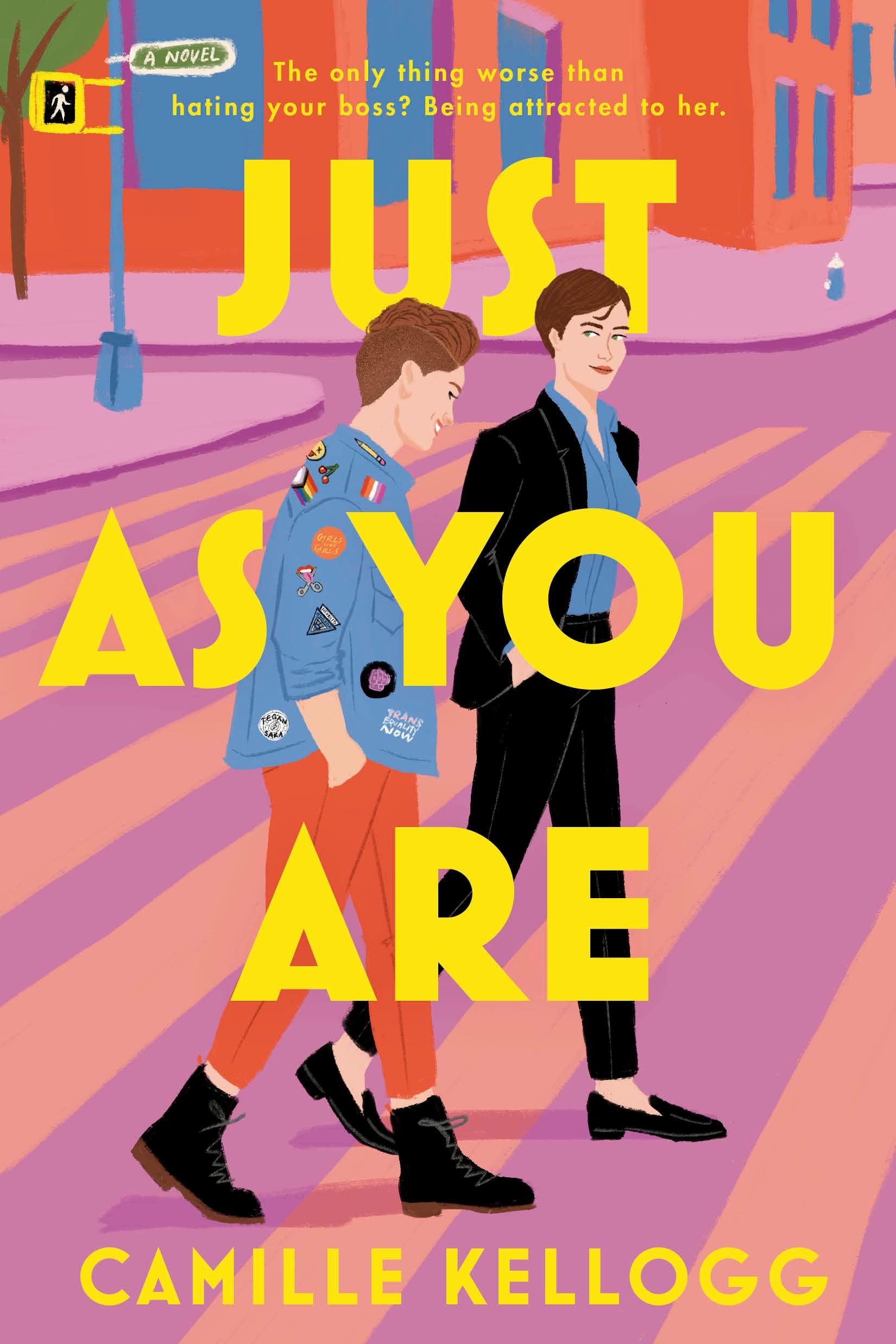
Review (Deutsch/English): "So, wie du bist" / "Just as You Are" by Camille Kellogg

So, wie du bist von Camille Kellogg
So, wie du bist von Camille Kellogg, übersetzt von Sophia Lindsey
Herausgegeben von HarperCollins, November 2023
★★★★


Pride and Prejudice...wenn Elizabeth Bennet eine Lesbe in New York City war. Es hat so lang gedauert, bis ich dieses Buch gelesen habe, aber das war komplett meine eigene Schuld; ich lese nicht genug auf Deutsch und war ein bisschen nervös. Am Ende habe ich entschieden, das Buch auf beide Englisch und Deutsch (ein Kapitel in einer Sprache, danach das gleiche Kapitel in der anderen Sprache) zu lesen—und mein Gott. Das war die beste Entscheidung, die ich dieses Monat gemacht habe. Ich will über das Buch schreiben, na klar, aber meistens will ich über die Übersetzung, und Übersetzung im Allgemeinen, schreiben.

Das Buch: was freut mich ist, dass Kellogg ist mit Pride and Prejudice ganz flexibel. Ich habe viele, viele P&P Varianten gelesen, und es ist mir klar, dass, für eine Variante am besten zu funktionieren, muss es ein bisschen...lose...mit den Detailen sein. Hier, wenn etwas aus dem Original geht nicht, geht es dann nicht: raus gehts! Hier ist Mary nur die Finanzchefin, die keine Rolle spielt; wir haben fast einen Mr. Collins, aber nicht wirklich. (Und die Charaktere sind natürlich fast alle queer.) Das Buch ist folglich interessanter; die Themen bleiben zeitnah, und man weist nicht genau, was mit einem Charakter passieren wird. Mittlerweile ist Liz ein bisschen...chaotisch? Oder vielleicht nur unordentlich (wie übersetzt man "messy"?)—im Original ist Lizzy nicht immer perfekt, aber sie ist selbstbewusst; sie weißt, wer sie ist. In So, wie du bist, Liz weißt das genau nicht—sie hat viel zu lernen.

Aber die Übersetzung: mein Deutsch ist nicht flüssig, aber es ist gut genug, dass die Übersetzungsoptionen sind mir sehr interessant. Ich habe zu viele Sätze hervorgehoben, um hier zu nutzen, aber ein paar Beispiele:

"Which means this is no longer a goodbye party. It's a Get Shitfaced Celebration." // »Und das heißt, dass aus der Abschlussparty eine Abschussparty wird!«

Und—was denkst du? Besser, das gleich, oder...? Ich mag das Wortspiel; mein Partner (nach ich erklärt habe) denkt, dass der Ton fehlt.

Oder hier, wieder auf Englisch: "Oh my gosh, hi!" Jane's voice had taken on a curious Valley Girl–style inflection. "It's so great to see you." // »Oh mein Gott, hi!« Janes Stimme klang auf einmal wie eine seltsame Mischung aus Helium und High Society.

Manche Dinge können nicht übersetzt werden, oder?

It was official. Jane Wilson and Bailey Cox had U-Hauled hard. // Es war offiziell: Das mit Jane Wilson und Bailey Cox war was Ernstes. Die Umzugskisten waren quasi schon gepackt.

Nee. Manche Dinge können nicht übersetzt werden. (Ich hatte eine Mittagsessengespräch mit Kolleg*innen und müsste dieses U-Haul-Witz erklären—die meisten von meinen Kolleg*innen sind weder amerikanisch noch queer. Es ist nicht die Schuld des Buches!)

Ich muss sagen: ich kritisiere hier nichts—es hat mich nur so viele Freude gebracht, diese Unterschieden zu finden. Ich soll so viele übergesetzte Bücher so lesen—Deutsch mit Englisch—es war für mein Deutsch fantastisch und für mein Gehirn ein wunderbares Spiel.

Thanks to the author and publisher for providing a review copy through NetGalley. German quotes are from an ARC and may not be final. Deutsch ist nicht meine Muttersprache, und alle Fehler sind meine eigenen.

Just as You Are by Camille Kellogg
Published April 2023 via The Dial Press
★★★★


It's Pride and Prejudice...but in New York, with a queer cast of characters working at a struggling, and also queer, magazine. I meant to read this only in German, but it took me so long to get going that I resorted to my backup plan: switch back and forth between German and English, and miss less. Just as You Are may have made that my favorite way to read; it was satisfying when I realized that I could actually get through most of the German without missing too much, but it was flipping brilliant fun to see how certain things were translated...and what just doesn't translate. (Spoiler alert: There are at least three U-Haul jokes in the English version...none of which can be easily übersetzt.)

But I digress. I talked more about the translation choices in my German review, but hey! I also read the book in English. I've read piles of Pride and Prejudice retellings and adaptations, and I'm on the record repeatedly as preferring the ones that don't get too precious about the original plot. It's hard to stay true to every single plot point from P&P while also having the plot make sense in the modern world; Jane getting sick and staying at Netherfield is a great example of this, as in the modern world it just...doesn't generally make sense for someone to fall so ill at someone else's house across town that they'd just stay there for weeks on end. Kellogg smartly took plot points like this and noped them right out the window; other plot points have been moved around a bit to make more sense within this contemporary gay New York context. (Also, Liz Baker spends infinitely more time on the New York subway than Lizzy Bennet does.)

I'm not entirely convinced by the conflict and subsequent resolution that crops up toward the end. I could see it coming (but the hints were planted carefully enough that I could hope they were red herrings and that what came to pass...wouldn't), but considering that the characters seem likely to feel the reverberations for some time, it didn't really feel like there was enough time for them to fully resolve...how do I put this without spoilers...the public fallout. But: I love that Liz is kind of a mess in this book. She's good at her job but doesn't want her job to be her forever job; she loves her friends but isn't always there for them in the ways that she should be; she has an idea of who she is but doesn't have the confidence to own it. It also means that while, in the original, Darcy had to do some work on himself before Lizzy could see a future with him, here both Liz and Daria have to take a close look at themselves and think about how to grow into the people they want to be.

I was going to stick to the English here, but can I just throw in one fun translation...? Here's one of Jane's hobbies: TWOCs and Ewoks, her Star Wars–themed D&D group for trans women of color who were also giant dorks. And in German: Trans* Frauen, die Han schauen, ihrer Dungeons-and-Dragons-Gruppe mit Star Wars-Motto für trans* Frauen of Color, die außerdem unfassbare Nerds waren.

I really have to do more parallel reading. Recommend the book; highly recommend the parallel reading experience.

German translation was thanks to the publisher via NetGalley; English original was powered by the magic of my local library.

Sunday, May 26, 2024

Review: "London on My Mind" by Clara Alves

London on My Mind by Clara Alves
Translated by Nina Perrotta
Published June 2024 via Push
★★★


Dayana has always wanted to go to London—but not like this. When her mother dies, she's sent from Rio to live with her father in London...and with her father's wife and stepdaughter, whom Dayana has never met. The one bright spot in her new life is Diana, whom Dayana meets when Diana is climbing over a fence to escape from Buckingham Palace...and who, you can imagine, has a secret or two.

Now, I'm a sucker for princess fantasies and for moving-to-a-different-country stories, so this seemed right up my alley. It's a very quick read (I started it on the way home from work and hit 70% before bed; finished it on the way to the gym the following morning) and something of an alternate-universe story—in this storyline, Princess Diana is alive and well (and royalty in her own right rather than someone who married into a particularly complicated family) and pulling quite a lot of strings. (I think the book is supposed to take place a bit in the future—say another ten years from now—and Dayana is young enough to reference 'the late 1900s', which...I am dead.) I'd probably have preferred a moving-to-Rio book, just because I am so much less familiar with Brazil than with England, but...you take what you can get! (And since I believe the author is Brazilian—and the book is translated from Portuguese—it makes sense that London would be considered the far-off-and-interesting place.)

The description calls this an 'unlikely London romance', though, and that...seems about right. I ended up wishing that the royalty plotline hadn't made it through edits, because it feels the least fleshed-out of the parts, and a lot of things just don't make sense. (Someone climbing over the fence at Buckingham Palace? In heels and a dress? Repeatedly? And not getting caught? Or Dayana thinking that 'staking out' Buckingham Palace to see if someone goes in should involve going to the front, public, swarmed-with-tourists entrance... Or not thinking twice about having a messy make-out session in front of piles of tabloidy press...) I enjoy some fluffy wish fulfillment, but I also want logical underpinnings.

Dayana is a teenager, and she's dealing with messy emotions involving grief and abandonment, and these things inform her character heavily. They don't always make her likeable—one of the first things Dayana does is scream at her stepmother for being well-intentioned but overwhelming—but they do make her feel realistically teenaged. The push-pull of new family dynamics is interesting, and I appreciated that her relationship with her stepmother and stepsister is allowed to be complicated (not always good, not always bad). I did wish Dayana could have a bit more external focus, though: even as the book progresses, she tends to hear someone else's story and make it all about her own story and what she's going through. And those things are valid (and again, very in line with a teenager who still has some growing up to do!), but so are the other characters' stories. Dayana will probably be most relatable to those who experience their emotions as big and bursting.

Thanks to the author and publisher for providing a review copy through NetGalley.

Wednesday, May 22, 2024

Review: "I Am a Bacha Posh" by Ukmina Manoori

I Am a Bacha Posh by Ukmina Manoori
I Am a Bacha Posh by Ukmina Manoori (with Stéphanie Lebrun)
Translated by Peter Chianchiano
English translation published 2014 via Skyhorse
★★★


The concept of bacha posh is fascinating to me: in Afghanistan, a substantial number of girls are raised—temporarily—as boys, filling in the gaps in families where there are no sons. As a stand-in son, a bacha posh can play with the boys, can run errands, can hold jobs and earn money and help support the family, can have a taste of freedom. But when she hits adolescence, the veil goes on, and she is expected to return to the restricted life of a woman. Marry, have children, obey her husband in all things, never leave the house without a chaperone.

Manoori was one of these children—raised as a boy but expected to give up her freedoms when she got older. But she refused: she had grown used to those freedoms and preferred to chart her own path. This would be no small thing in Afghanistan now, and it was no small thing then; although Manoori says that she knew numerous girls in her area who temporarily took on the role of “son”, it was certainly safer to be known as a boy than as a girl who has been asked to be a boy, and it was not socially acceptable to remain as a “son” beyond adolescence. Moreover, although Manoori sees no conflict with Islam, the Taliban’s rise to power made it clear that not everyone felt the same way.

I wondered early on whether the practice of bacha posh would have been able to continue after the Taliban’s takeover in 2021. This book was published in English in 2014, so of course it predates that series of events, but it’s still relevant—because the Taliban first came to power while Manoori was coming of age and, you know, trying to live her life.

As a book, it’s okay but not amazing (I’d recommend The Underground Girls of Kabul for a more comprehensive look); Manoori doesn’t always seem to grasp that other girls and women would be perfectly capable of doing the things that she does and has done with the freedoms afforded by being outside the strict box of “female”, and the focus is really on a chronological story rather than, e.g., scenes and characterization and broader picture. (Also, while I think the cover is striking, after reading the book it mostly just seems strikingly inaccurate.)

That said, it’s a short read into an experience I know very little about, and one that feels important to understand some of the complexities of being born a girl in Afghanistan.

Thursday, May 2, 2024

Review: "The Cursed Friend" by Beatrice Salvioni

The Cursed Friend by Beatrice Salvioni
The Cursed Friend" by Beatrice Salvioni, translated by Elena Pala
English edition published May 2024 via HarperVia
★★★


In 1930s Italy, Francesca is on the cusp of something—though of what, she's not yet sure. But by the time the book opens, she is helping to hide a waterlogged body by the edge of the river.

At the core of the story is a girl Francesca knows initially only as the Cursed One—a girl who, the locals say, was responsible for the death of her brother and the death of her father, a girl whose word or sometimes simply presence can bring about misfortune. Francesca is not so sure, and the more she gets to know the Cursed One the more she wonders whether the norms she thought were set in stone are correct. But this is not a time and place where dissent is encouraged, and the further Francesca strays from what is accepted, the closer she comes to tipping past the point of no return.

I read this largely because the description reminded me of The Unbreakable Heart of Oliva Denaro. It ends up being more of a story about friendship, which I love—I always want more stories about platonic female friendship. Neither Francesca nor Maddalena (the titular cursed friend) was quite as richly characterized as I might have hoped, though Maddalena has a more complicated background—there are, for all that she is something of an outcast, perhaps as many bright spots in her life as in Francesca's.

The placement of the body is also interesting: it opens the story with a bang, at which point we drop back a year or so to see what led up to it—and for crucial details like whose body are they hiding? But part of me wished that the death (and circumstances around it) were able to serve as something to bind the girls together and propel them forward in their friendship rather than as something more climactic.

This is a translation from the Italian, so I'm not always sure whether I'd feel the same way with the original or whether something was lost in translation. Some things feel disconcertingly modern (e.g., a character saying "not gonna lie" (loc. 2556)), and the one needle-scratch thing I found—I'm not sure whether this was a translation choice or an editorial one—was the use of "Mom" and "Dad" rather than whatever a 1930s small-town Italian girl would have been using; "Mom" and "Dad" sound glaringly American and modern, and some creative use of the Google Books Ngram Viewer suggests that it is unlikely that even an American of the 1930s would have been calling her mother "Mom". I like to think that I'm an intelligent enough reader to understand that when a character refers to her "Ma" or her "Mamma" or whatever it would be for the time and place, she means the same thing that I do when I say "Mummy"!

I'd like to read more along these lines, though—dark, heavily anchored in time and place, focused on friendship rather than romance. If there's a book out there that has some version of Maddalena's sister Donatella's story, wherever it goes from here, I'd like to read it.

Thanks to the author and publisher for providing a review copy through NetGalley.

Review: "My Chance to Fly" by Samantha Tonge

My Chance to Fly by Samantha Tonge Published August 2026 via Boldwood Books ★★★ Una's life is regimented, and that's just the way sh...