49 Days by Agnes Lee
Published March 2024 via Levine Querido
★★★★
Kit is on a journey she didn't ask for: in Buddhist tradition, it takes 49 days for the spirit of a recently deceased person to pass over to the next life, but Kit hadn't expected to be on this path anytime soon.
Drawn in spare, black-and-white illustrations, 49 Days proves to be quietly devastating. Alongside Kit's journey, we see the parallel journeys of the people she's left behind—family, mostly, but also some friends—and memories of the time before. What's particularly resonant, I think, is Kit's own grief; just as her family is not ready for her to be gone, she is not ready to leave them behind. I'm not a crier, but I suspect that this will be a tear-jerker for many.
This feels like something new in both graphic novels and books about grief. I'd also recommend Marie Mutsuki Mockett's Where the Dead Pause, and the Japanese Say Goodbye to readers who want a further look at grief in non-Western cultures.
Thanks to the author and publisher for providing a review copy through NetGalley.
Sunday, February 25, 2024
Friday, February 23, 2024
Review: "Don't Want You Like a Best Friend" by Emma Alban
Don't Want You Like a Best Friend by Emma Alban
Published January 2024 via Avon
★★★
Beth's goal for the debutante season is simple—snag a wealthy enough husband to keep her and her mother from the poorhouse. And Gwen's is even simpler—have some fun and avoid being saddled with a husband. It hasn't quite clicked for either of them that there's something else they both desperately want...
I read this for the cover, mostly, and generally it's a fun read. What it's not, though, is historical fiction: only the evil villains (who are evil) have 1800s attitudes, while the 'good' characters are all extremely modern in the way they think; the dialogue and slang is distinctly modern and often American ("Damn, I guess I've got to go" (96)—said nobody, ever, in 1800s Britain). In some ways that makes this an easier read for me, as I'm not all that interested in historical fiction, but at the same time...if I'm going to read historical fiction, I'd rather feel that I can trust the accuracy of, uh, anything within.
Beth and Gwen are both fine, though they don't seem to have much going on beyond worrying about the future (Beth) and drinking a whole lot more hard liquor than would be socially acceptable for teenage girls in the 1800s or...ever, really (Gwen). This will still be a good one for you if you don't mind insta-love and historical inaccuracy—that came out snarkier than I intended—but it ends up feeling more like fantasy to me than historical fiction.
Thursday, February 22, 2024
Review: "The Forgotten Beasts of Eld" by Patricia McKillip
The Forgotten Beasts of Eld by Patricia McKillip
50th Anniversary Edition published February 2024 via Tachyon Publications
★★★★
High on a mountain, far outside the confines of society lives a woman, a wizard—Sybel. Hers is a solitary existence, with only the great magical beasts passed down from her father to keep her company, and it's a life that suits her. But times change, and when she is given charge of an infant to raise, she can no longer predict and shape the path of her life the way she once could.
"Is this all you want? To live here on this mountain, speaking only to animals who live in the dreams of their past, and to Tam, who will have a future that you cannot have? You are bound here by your father's rules, you live his life. You will live, grow old, and die here, living for others who do not need you. Tam one day will not need you. What, in years to come, will you have in your life but a silence that is meaningless, ancient names that are never spoken beyond these walls?" (loc. 581)
I first read The Forgotten Beasts of Eld more than two decades ago—I think I must have been twelve or thirteen. It was and is not my usual reading fare, so it was likely something of my sister's that made its way into the family bookshelves (my family has never been short of books). And I promptly forgot most of it, retaining only the barest outline of a wintery protagonist and the bird named Liralen, which I (also promptly) borrowed for a username and have yet to return.
As long ago as I read this, it's been around longer:The Forgotten Beasts of Eld was first published in 1974, and so 2024 marks its 50th anniversary. And it has held up to the test of time: I understand Sybel and her—not coldness, perhaps, but distance from the world—much better as an adult than I ever could twenty-odd years ago. She's distant from the world and at home in her isolation, yet also drawn to things she cannot name or fully understand; drawn to both a world of men and a world of magical creatures. I don't want to get too much into the plot (or the Liralen—again, I'd forgotten the details, and I am puzzled anew, which pleases me), but this is a classic of the genre for a reason. I'm looking forward to reading it again in another decade or two.
Thanks to the publisher for providing a review copy through NetGalley.
Wednesday, February 21, 2024
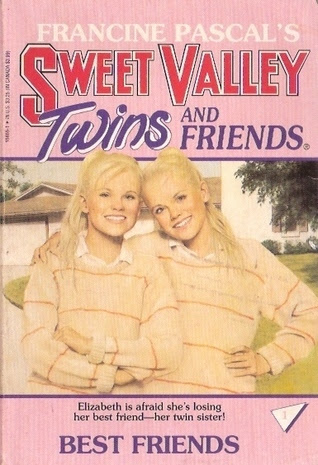
Review: "Best Friends" by Jamie Suzanne (created by Francine Pascal)
Best Friends by Jamie Suzanne (created by Francine Pascal)
First published 1986
★★★
I wondered when I reread the first Sweet Valley Kids book just how long it would take for Jessica's true sociopathic colours to show—and we have a partial answer. In this first book of the middle-school series, Jessica is already wreaking havoc, and not one of the other characters is in the slightest surprised. (Note: There are untagged spoilers below the fold, if you're worried about spoilers for a very outdated, toxic-ideals book published 38 years ago.)
There are yellow sweatsuits in this one as well as in the first SV Kids book, which makes me wonder whether the sweatsuits in the SV Kids book (which was written later) were a nod to the ones here or whether sweatsuits were just really, really popular in the 80s. But mostly it's all about the drama:
The big to-do of the book is Jessica's quest to join the Unicorn club, which is made up of popular girls whose great quest is to maintain their popularity, mostly through putting down anyone who is not a Unicorn themselves. (This is right up Jessica's alley.) Anyway, Jessica's in, but next it's Elizabeth's turn because...twins have to do everything together, right? Right? Wrong. Jessica's hazing tasks have been relatively mild, but—because the Unicorns don't want Elizabeth any more than Elizabeth wants them—Elizabeth is tasked with publicly humiliating Lois, the local Unpopular Girl.
You can guess how this goes. Elizabeth refuses (because, though she doesn't recognise a sociopath when she lives with one, she's not one herself), Jessica is horrified about what Elizabeth's refusal will mean for Jessica's reputation, Jessica decides to take matters into her own hands, Jessica goes forth and humiliates Lois. (The fat-shaming starts early in these books—the first SV High one is full of it too.)
Now...none of this is surprising, because...Jessica. But what's interesting to me is this: When Elizabeth and Lois get revenge, Jessica gets off scot-free. She wouldn't view it that way, of course (if the Unicorns are humiliated, Jessica is humiliated), but to me it looks an awful lot like Jessica doing awful things and then suffering no consequences...which, if I remember correctly, rapidly becomes something of a theme in these books. Suddenly the Jessica of Sweet Valley High makes a lot more sense...
Monday, February 19, 2024
Review: "That's Not My Name" by Megan Lally
That's Not My Name by Megan Lally
Published December 2023 via Sourcebooks Fire
★★★★
When she comes out of the woods, there's only one thing she knows—something is wrong. Everything else, from her name to what is wrong, is missing. At the police station, a man shows up with an ID for her, clothing...proof that she is his daughter, Mary.
Or is she?
Not too far away, Drew is desperate—the longer Lola is missing, the more the town is convinced that he has murdered his girlfriend. He knows he didn't do it...but the police aren't looking elsewhere, and he's more and more convinced that it's up to him to find new clues.
I rarely shelve YA mysteries as 'mystery' on Goodreads because...they often focus too much on romance, I think, and don't usually tingle my scare reflex. But That's Not My Name walks a terrific dual-storyline path, showing us Drew and 'Mary's' stories as they get closer and closer to the truth—keeping the reader guessing. Twists at the end keep this surprising, and the story's villain has enough complexity (...combined with some oh-yikes, but still) to stay interesting too. I swallowed this one pretty much whole and would happily have read more.
Saturday, February 17, 2024
Review: "Trapped in Toyland" by Molly Mia Stewart (created by Francine Pascal)
Trapped in Toyland by Molly Mia Stewart (created by Francine Pascal)
First published 1994
★★★★
I've been rereading a few of the Sweet Valley books, and the description of this one triggered something in my memory, so I thought I'd add it to the pile. In Trapped in Toyland, Elizabeth and Jessica go to the fancy new department store with their parents, eager to spend their collected $15.63 on a Christmas gift for their mother. (Their father and brother get a construction-paper photo frame and a handwritten story, respectively.) Now, if this were one of the SV Twins or SV High books, it seems likely that Jessica would end up spending all the money before they could buy a gift...but instead, because this is a SV Kids book* and Jessica still has some feelings for other people, she's eager and (mostly) focused on finding a gift for their mother. But shenanigans happen, and the girls find themselves locked in the department store overnight...without their purse full of money, but with everything else at their disposal—and with a rather aggressive burglar.
On the whole, this is just adorable. It makes for great wish fulfillment (who hasn't wanted to be locked in somewhere overnight? A toy store, a bookstore, a furniture store with huge floofy beds...), and I love Elizabeth and Jessica's blend of responsibility and kid-ness: when they eat ice cream from the food court (because, naturally, all they have to do is walk behind the counter and open a freezer to access all the junk food they could ever want), they make sure to clean up after themselves...but Elizabeth is readily talked into trying on fancy dresses and makeup (I remember being jealous of the sequined dress Elizabeth tries on), and it's goody-two-shoes Elizabeth who suggests a race in the toy cars. (Older Elizabeth would never.) They create a fair amount of gleeful, well-intentioned kid chaos, and the book is better for it.
There are many, many, many things about the plot that make no sense, or at least make no sense in the 2020s—the Wakefields let their seven-year-old twins wander the eight-story department store with only their brother (who is roughly nine) to provide any kind of supervision; there's no search of the mall when the Wakefields can't find their daughters; there's no accountability from the Wakefields for letting their small children wander around unsupervised; the girls are able to access everything in the department store without minor concerns like keys; they make all sorts of noise without the burglar noticing; they call 911 multiple times and are laughed at; the burglar bothers to steal a second-grader's purse while preparing for his much bigger heist; literally almost everything about the burglar; and on and on it goes. But it's a book for kids and written in the 90s, and what can you do?
*Note that even in the SV Kids books Jessica is not above spending money that isn't hers or cheating to win.
Friday, February 16, 2024
Review: "Surprise! Surprise!" by Molly Mia Stewart (created by Francine Pascal)
Surprise! Surprise! by Molly Mia Stewart (created by Francine Pascal)
First published 1989
★★★
Sometimes I just can't help myself: I read the most recent graphic novel adaptation instalment of the Sweet Valley Twins series, and I knew I had to give the originals a quick whirl. Sweet Valley Kids was the elementary-school version of the series, and in Surprise! Surprise!, the first book of the series, Elizabeth and Jessica are on the cusp of turning 7. The big dilemma: what on earth to get each other?
I didn't read a tonne of the SVK books—I think I moved on pretty quickly to Sweet Valley Twins—but I remember this one pretty well, and the dresses on the cover give me instant nostalgia, so it must have been on the shelves. I didn't remember the illustrations, though! They'd be largely at home in a 1950s children's book, but they're very sweet. It's nice to see that Jessica was not actually born a sociopath; she's already her giggly, gossipy self, but she's at least invested in Elizabeth's happiness as well as her own, and generally a pretty happy-go-lucky kid. (Also, matching yellow sweatsuits!) I don't think I'll read more of this particular series (except Trapped in Toyland, because I also have some vague memories of that), but it'll be interesting to see in the SV Twins and SV High versions just how quickly Jessica lets her true sociopathic colors fly and just how quickly Elizabeth becomes Little Miss Priss. I am so very looking forward to this.
Thursday, February 15, 2024
Review: "Eating Disorders Don't Discriminate" edited by Chukwuemeka Nwuba and Bailey Spinn
Eating Disorders Don't Discriminate edited by Chukwuemeka Nwuba and Bailey Spinn
Published February 2024 via Jessica Kingsley
★★★
Eating Disorders Don't Discriminate pulls together essays from various voices—leaning heavily towards content creators—about, well, eating disorders and some of the misconceptions about them.
As with any collection of essays, some feel stronger than others, and readers' mileage will vary. I found myself wishing that some of the authors of section introductions had been allotted space for full essays, as the introductions tended to be written by professionals in the field, while the essays tended to be written by people with platforms. (Including one of the editors, I counted 11 bios that included the number of followers a given writer has on social media. More than bit odd to me, but maybe something that will go over better with Gen Z?)
One thing that I found disappointing was the emphasis on anorexia over other eating disorders. The focus on anorexia is intentional:
Bailey and I think it's important to mention that there are noticeably more essays for anorexia nervosa. This is not to say that it's more important, or indeed, more common. As already mentioned, it isn't. Far from it. This is intentional, and due to the large amount of attention it receives, there are equally many misconceptions about it, and as a result a lot of dismantling via these stories that we felt needed to happen. (loc. 521*)
But it also seems really odd that this comment comes on the heels of acknowledging that anorexia gets a truly disproportionate amount of attention:
In the world of academia [...] anorexia nervosa assumes a disproportionately large amount of eating disorder research funding. [...] out of 190 studies of eating disorders, 72 (38%) were for anorexia nervosa [...]. This is despite anorexia nervosa making up only 8 per cent of all eating disorders. (loc. 263)
A quick count from the table of contents—4 essays on BED; 5 essays on bulimia; 11 essays on anorexia; 4 essays on ARFID; 3 essays on OSFED; and 2 essays on other ED-related topics. That's a total of 29 essays (plus introductions, interludes, etc.), which puts the proportion of essays about anorexia at...38 percent. Now, it's unusual that the book covers ARFID and OSFED in any detail, and I appreciate that—ARFID in particular is so rarely discussed. But 'there are misconceptions' is true for any of the disorders discussed in this book, and even if anorexia had been skipped altogether there still would have been material for this book plus a sequel plus a few more sequels talking about some of the un-talked-about aspects, and myths vs. reality, of eating disorders. I've read...okay, not everything out there, but a significant proportion of everything out there, on the topic, and I'm not convinced that there's anything so new in here as to claim that the emphasis should remain on anorexia. Very much reads to me as though anorexia is still the most acceptable eating disorder to write about.
It's an interesting book for the mix of topics, but I think the most valuable parts are the in the sections of the book that have been given the least space, such as when someone with atypical anorexia (all the symptoms of anorexia but a bigger body) asks How can I find comfort in a community that has the common fear of looking like me? How can I recover when people automatically assume that I have a binge eating disorder just by looking at me? (loc. 3112)—and in the in-between sections of the book by people who have the credentials to back up their expertise rather than claiming to be an 'expert by experience' (loc. 2029). I loved seeing the essays on ARFID and atypical anorexia in particular, because there's so little out there about them, but if you're looking for something outside the box this book is probably most useful for those few essays.
Thanks to the authors and publisher for providing a review copy through NetGalley.
*Quotes are from an ARC and may not be final.
Published February 2024 via Jessica Kingsley
★★★
Eating Disorders Don't Discriminate pulls together essays from various voices—leaning heavily towards content creators—about, well, eating disorders and some of the misconceptions about them.
As with any collection of essays, some feel stronger than others, and readers' mileage will vary. I found myself wishing that some of the authors of section introductions had been allotted space for full essays, as the introductions tended to be written by professionals in the field, while the essays tended to be written by people with platforms. (Including one of the editors, I counted 11 bios that included the number of followers a given writer has on social media. More than bit odd to me, but maybe something that will go over better with Gen Z?)
One thing that I found disappointing was the emphasis on anorexia over other eating disorders. The focus on anorexia is intentional:
Bailey and I think it's important to mention that there are noticeably more essays for anorexia nervosa. This is not to say that it's more important, or indeed, more common. As already mentioned, it isn't. Far from it. This is intentional, and due to the large amount of attention it receives, there are equally many misconceptions about it, and as a result a lot of dismantling via these stories that we felt needed to happen. (loc. 521*)
But it also seems really odd that this comment comes on the heels of acknowledging that anorexia gets a truly disproportionate amount of attention:
In the world of academia [...] anorexia nervosa assumes a disproportionately large amount of eating disorder research funding. [...] out of 190 studies of eating disorders, 72 (38%) were for anorexia nervosa [...]. This is despite anorexia nervosa making up only 8 per cent of all eating disorders. (loc. 263)
A quick count from the table of contents—4 essays on BED; 5 essays on bulimia; 11 essays on anorexia; 4 essays on ARFID; 3 essays on OSFED; and 2 essays on other ED-related topics. That's a total of 29 essays (plus introductions, interludes, etc.), which puts the proportion of essays about anorexia at...38 percent. Now, it's unusual that the book covers ARFID and OSFED in any detail, and I appreciate that—ARFID in particular is so rarely discussed. But 'there are misconceptions' is true for any of the disorders discussed in this book, and even if anorexia had been skipped altogether there still would have been material for this book plus a sequel plus a few more sequels talking about some of the un-talked-about aspects, and myths vs. reality, of eating disorders. I've read...okay, not everything out there, but a significant proportion of everything out there, on the topic, and I'm not convinced that there's anything so new in here as to claim that the emphasis should remain on anorexia. Very much reads to me as though anorexia is still the most acceptable eating disorder to write about.
It's an interesting book for the mix of topics, but I think the most valuable parts are the in the sections of the book that have been given the least space, such as when someone with atypical anorexia (all the symptoms of anorexia but a bigger body) asks How can I find comfort in a community that has the common fear of looking like me? How can I recover when people automatically assume that I have a binge eating disorder just by looking at me? (loc. 3112)—and in the in-between sections of the book by people who have the credentials to back up their expertise rather than claiming to be an 'expert by experience' (loc. 2029). I loved seeing the essays on ARFID and atypical anorexia in particular, because there's so little out there about them, but if you're looking for something outside the box this book is probably most useful for those few essays.
Thanks to the authors and publisher for providing a review copy through NetGalley.
*Quotes are from an ARC and may not be final.
Wednesday, February 14, 2024
Review: "Waiting for the Flood" by Alexis Hall
Waiting for the Flood by Alexis Hall
Published February 2024 via Sourcebooks Casablanca
★★★
In Oxford, Edwin isn't quite drowning—but he's been treating water for so long that it's hard to remember what it felt like to be on dry land. And not so far away, his ex-husband Marius is floundering too, knowing just what he has lost but powerless to change some of the things most important to him.
This volume contains two novellas—Waiting for the Flood, Edwin's story, and then Chasing the Light, Marius's story. Two love stories, not one; by the time Waiting for the Flood opens their love story together is, well, too deep underwater for rescue. For Edwin, it's about figuring out that that's okay and finding a way to move on, while for Marius, the goal is in part to backtrack and learn to say the things that he never could.
Hall's books have been a bit hit-or-miss for me, which is fine—not every book by an author needs to be a personal hit. This one's somewhere in between: I like that Edwin has a stammer, and that it's just an accepted part of who he is rather than something any of the characters try to change, I like the recurring theme of water-water-everywhere, I like the way Marius's parents barge in as needed, and so on and so forth. I'm not as sold on the writing of Waiting for the Flood in particular; I believe it was one of the earlier books Hall published, and it feels quite overwritten in places. Maybe it's just the way Edwin thinks, but (I'm doomed to say this in half my reviews of Hall's books, I swear) it gives me the impression of a (good) writer who read a lot of angsty fanfiction once upon a time. Chasing the Light still has a fair amount of angst, but—perhaps because it's more recent—the writing feels more streamlined too. I'd say perhaps 3 stars for Waiting and 3.5 for Chasing.
Not sure I'll pick up any of the other books in this world, but I'm still eagerly awaiting book three in Hall's "Winner Bakes All" series.
Thanks to the author and publisher for providing a review copy via NetGalley.
Tuesday, February 13, 2024
Review: "The Still Point" by Tammy Greenwood
The Still Point by Tammy Greenwood
Published February 2024 via Kensington
★★★★
Bea's dancing has been one of few bright spots in her mother Ever's life this past year, which saw the loss of Ever's husband and financial stability—and with a scholarship on the line, suddenly this season of dance matters more than ever. But Ever and Bea aren't the only ones desperate for that scholarship: Bea's onetime best friend Olive dances at the same studio, as does her nemesis Savvy...not to mention the other girls who dream of dancing in Paris. Not to mention their parents.
This is mostly a book about those parents: Ever, of course; and her best friend Lindsay, who might be more invested in Olive's dance prospects than Olive is; and Josie, who dreams of seeing Savvy having an independence—without relying on a man—that she herself never really had.
Greenwood is herself a dance mom—in the author's note, she describes the book as a "love letter" and "also a story of what happens when ambition becomes a dark thing" (loc.152*). But it's fiction, fortunately, a version of dark ambition that neither she nor her daughter experienced.
Ballet books are one of those things that I have no personal stake in but love reading anyway, which means that I've inevitably read my fair share of the darker side of things—ground glass in pointe shoes and all. (You'd better believe that made me nervous when a certain character was gifted some pointe shoes...) But this is the restrained side of dark, and it's better for it: yes, there are characters, numerous characters, who do not always act as stand-up members of society...but even when they're being petty and unkind, jealous and calculating, we can see where they're coming from and why.
A side note: There's a point(e) to be made here about the ways in which people who are successful (or attractive, or confident, or all of the above) in certain spheres are allowed to get away with far more than they should—the way a particular male character is allowed to run rampant through the pages, tossing out small grenades and then smirking to see them land. He is not in himself particularly interesting, but the blind eye that so many other characters turn is.
All round a satisfying read. I believe I've had my eye on one or two of the author's other books for quite some time, so I may have to bump those up the queue.
Thanks to the author and publisher for providing a review copy through NetGalley.
*I read an ARC, and quotes may not be final.
Subscribe to:
Posts (Atom)
Review: "Northern Girls" by Michelle Willms
Northern Girls by Michelle Willms Published April 2026 via Baraka Books ★★★★ A brief memoir-in-essays about growing up in northern Ontario—w...
-
The Ferryman and His Wife by Frode Grytten, translated from the Norwegian by Alison McCullough Published November 2025 via Algonquin Books ★...
-
The Keeper by Tana French Published March 2026 via Viking ★★★★ Book three—of three—in the Cal Hooper series. Time has passed: Trey is growin...
-
The Trad Wife by Carrie Hughes Published May 2026 via Hera ★★★ Melissa's not living the trad wife life, not by a long shot—she's a s...


