Thursday, April 4, 2024

Review: "Every Time You Hear That Song" by Jenna Voris

Every Time You Hear That Song by Jenna Voris
Published April 2024 via Viking Books for Young Readers
★★★★


She told me it was okay to take it slow, that everyone learns at their own pace, but my pace is wildfire. My pace is lightning and luck and all the desperate longing of the universe. (loc. 161*)

In the early 1960s, Decklee has a dream, and she'll do anything to make it come true—even if that means losing everyone she loves.

People never talked about Decklee Cassel being from Mayberry unless it was to compliment her for getting out, because here's the truth: no one cares about towns like this until they're behind you. (loc. 238)

And in the present day, Darren is convinced that she's made for more than Mayberry, the same small town Decklee grew up in. She won't destroy everything in her path to get out...but she will go on a quest to find Decklee's last album, which could be enough to jumpstart her dreams.

I'd just listened to an interview with Dolly Parton when I read this, and so that's the voice that I heard Decklee's sections in (yes, yes, I know that a Tennessee accent is not the same as an Arkansas accent). Decklee is not Dolly Parton, though: she may have faced some of the same barriers—poverty, being a woman in a male-dominated industry in a male-dominated culture, people assuming that a Southern accent means lack of intelligence, people assuming that being blonde means lack of intelligence—but Decklee's stratospheric rise is, by necessity, grasping and calculated. She has the goods—but she needs every advantage to deliver on them.

It keeps Decklee from being an entirely sympathetic character, but that's what I loved most about the book. Darren's story is much more standard YA fare: there's a boy, a minor identity crisis, a journalism dream, some family concerns. Darren is much more easily likeable because we've all been there, one way or another. Decklee, though, raises hard questions about just how much a dream is worth—are there things you would not willingly give up? Is her dream worth it, in the end?

I would have liked to spend more time with Decklee, because there's an extent to which her voice is more distant, less possible to get a full read on. I wouldn't mind a follow-up book about Mickenlee, either—she's far more sympathetic but also less fleshed out, and there is much about her story that remains a mystery in this book. I can hope...

Thanks to the author and publisher for providing a review copy through NetGalley.

*I read an ARC, and quotes may not be final.

Wednesday, April 3, 2024

Review: Short story: "Lovers at the Museum" by Isabel Allende

Lovers at the Museum by Isabel Allende
Published April 2024 via Amazon Original Stories


It's been too long since I read any Isabel Allende. In "Lovers at the Museum", a man and a woman are awoken at (you guessed it) a museum. They've clearly been there overnight, but nobody is sure just how—how did they evade the guards, the alarms? They haven't stolen or broken anything, so is there a crime with which to charge them?

Allende is known for her magical realism, and true to form, there are more questions than answers here. We're left to fill in the blanks, to believe or not believe what BibiƱa and Indar have to say about what happened the night before. The story drifts along, and not all that much happens, but it doesn't really matter because it's so clear that Allende is in control of the narrative (even if the local police wished otherwise). I suspect that if I had a different cultural context or education, I'd make even more connections here, so I'll be curious to see what other readers make of it.

Either way, a reminder to go update my TBR!

Thanks to the author and publisher for providing a review copy through NetGalley.

Tuesday, April 2, 2024

Review: "Fi" by Alexandra Fuller

Fi by Alexandra Fuller
Published April 2024 via Grove Press
★★★★


All parents who hear of Fi's death have told me this: I wouldn't survive the death of my child, as if my child's death must therefore have been a lesser death than the death of their child would be. Or me, as if I must be a less grief-stricken parent than they would be, if it happened to them. I tell them that I didn't survive and also that I did. Both things happened. (loc. 1358*)

Alexandra Fuller was still grieving the loss of her father when the unthinkable happened—her son Fi died suddenly, unexpectedly, still in the prime of his youth. And Fuller came undone, because what else can you do when that happens?

This is a grief memoir—full stop. Fuller is a hell of a writer, which is not news. Here she spills herself broken onto the page: questioning how she can possibly be expected to survive, pulling from book after book and writer after writer to articulate the depths of her loss and apply balm to her soul. She takes to the mountains and the sky, to the ocean and a grief retreat and a meditation retreat, not in some sort of targeted quest but because the only thing she can do is give her life over to grief, and to find new rhythms for it.

It's worse in town, in the condo, my restlessness, my panic. Only the wild—even the scorched, diminished, smoke-hazed wild—seems conducive to my unwieldy grief. Grand enough to be the grief, to soak up the grief, to reflect it back at me, my feelings as thunder, wind, wildfire. In the mountains, I'd understood the warp and weft of my grief; I'd accepted its weather. In the mountains my grief was shouted back at me with praise and with majesty, in the oldest, most sovereign sense of that word. (loc. 1628)

I have not read Travel Light, Move Fast, Fuller's memoir about her father's death, but Fi died when she was partway through writing it, and there's no way on earth that that didn't reset the shape of that book. Someday I'll pick that up too, because I'm curious about how they overlap and how they don't, and also because I don't think it's possible for Fuller to write a book that is anything other than dramatic and sharp and so vivid it hurts.

Thanks to the author and publisher for providing a review copy through NetGalley.

*I read an ARC, and quotes may not be final.

Sunday, March 31, 2024

Review: "Kidnapped!" by Kate William (created by Francine Pascal)

Kidnapped! (Sweet Valley High)
Kidnapped! by Kate William (created by Francine Pascal)
Published 1984
★★


One minute Elizabeth is leaving her volunteer shift at the hospital...and then next she's waking up a prisoner. She's been kidnapped!

I'm not sure if I read this one back in the day, and I'm honestly not sure why I read it now. It's perhaps worth noting that this is only book 13 in a series that ultimately had 140+ books, and already Jessica has run off with any number of Bad Boys, Elizabeth has been in a coma following a motorcycle accident, and a recurring secondary character has been diagnosed with leukemia. I don't think the publisher had heard of pacing themselves...or maybe they just knew from the beginning that this was going to be an absolute soap opera. (I'm still thinking about rereading the miniseries, somewhere deep in the later books, in which an evil lookalike decides to kill Elizabeth and take over her life...)

For all that the book is ostensibly about Elizabeth's kidnap, it's still Jessica who gets...well, if not top billing, prime screentime. It's been fascinating to me to see how aware the writers were of Jessica's...Jessica-ness...even early on in the series. Here's Todd, Elizabeth's boyfriend, thinking about Jessica: While he wouldn't put it past Jessica to engage in a bout of feeling sorry for herself in an attempt to get pity, he wanted to believe she was sincere this time. The only person or thing Jessica truly couldn't live without was her twin, and Todd knew she would fall to pieces if something were to happen to Elizabeth. (42)

Jessica doesn't even like Elizabeth, let alone respect her, half the time, so this feels telling, if not surprising. Later in the book, a boy Jessica has the hots for expresses interest in Elizabeth: There was no way Elizabeth could mistake the look she saw in his eyes, a look that said, "You're the one I want." It made her feel awkward and uncomfortable. She had a strong suspicion that Nicholas hadn't reacted this way with Jessica. And she dreaded what would happen when Jessica found out. (92) And that's it in a nutshell, isn't it? Elizabeth is the only one Jessica really loves...but the limitations run deep. After all, what Jessica wants, Jessica gets...

I originally gave this three stars, but it's not actually better than the first book, just marginally less chaotic.

Saturday, March 30, 2024

Review: "The Mango Tree" by Annabelle Tometich

The Mango Tree by Annabelle Tometich
Published April 2024 via Little, Brown and Company
★★★★


Tometich was not prepared to get a call from her mother telling her that her mother was in jail for shooting at someone who had raided her mango tree—but neither was Tometich entirely surprised. When a person has lost so much, what’s a tree? When a person has lost so much, how can they lose anything more? (loc. 5145*)

The mango-tree misadventures bookend the story, but the bulk of the material is about what came before: Tometich’s upbringing in Florida with her American father and Filipina mother, and her mother’s story more generally. Because: it was in many ways not an easy upbringing for Tometich, but neither was it an easy life for her mother.

When I think of my mother, I don’t see her, I feel her. She’s a stake driven deep into the ground, the kind you see tethering newly planted trees and disaster tarps in place. She has kept our family from toppling sideways while punching a hole clean through the middle. (loc. 136)

If Tometich can’t quite reconcile her two understandings of her mother—one, as someone who slowly unraveled over time; two, as someone who won every academic award possible and thrived on a challenge and systematically set out to ensure that both she and her family members had as many advantages as she could give them—it’s because, for all that the things aren’t mutually exclusive, they’re just…still hard to reconcile.

The story is studded with fleshy, sun-ripened mangoes, not just from the tree at the center of Tometich’s mother’s court case but as something more broadly symbolic. A mango farm isn’t like the apple orchards up north, writes Tometich, or even the citrus groves that speckle the Sunshine State’s inland areas. Mango trees need room to breathe. They require space. If you plant them too close together, the humid air gets caught in their overlapped branches and the trees go soggy with rot. Too close together and their growth will be stunted, the trees will never reach their full potential. (loc. 832) Mangoes that her mother cherishes, mangoes that Tometich’s white acquaintances experience as more nuisance than treat, mangoes that come to represent the injustice of being forced to be a perpetual outsider in your home.

I love memoir for letting me into lives and experiences unlike my own, and The Mango Tree does that in more ways than one. 3.5 stars, and it will be interesting to see the discussion around this one.

*Quotes are from an ARC and may not be final.

Thanks to the author and publisher for providing a review copy through NetGalley.

Thursday, March 28, 2024

Review: "Showdown at the Mall" by Diana Gallagher


Showdown at the Mall by Diana Gallagher
Published 1997
★★★


Picked this up because I thought it was the one in which Sabrina and her aunts get trapped in a magical mall (and I have nostalgic, if vague, feelings about that book), but...nope. Maybe that's book three. (Will have to read further; how sad.)

In Showdown at the Mall, Sabrina and her classmates are given weekend work assignments. Sabrina lucks out and gets her first-choice assignment at a chic store with hilariously awful-sounding clothing, but luck does not stay on her side—among other things, a random cousin of hers is in town and determined to create chaos. It's a test of...well, not epic proportions, but as it turns out, Sabrina has to prove her worth as a witch with a conscience (as opposed to a witch who is happy to wreak havoc in the mortal world, just for the fun of it). Never mind that her cousin, who wants nothing more than to wreak all the havoc and then leave the mortal realms and all the chaos she's created behind, doesn't seem to be held to the same standards...

Anyway, the plot itself is a bit silly and not much to write home about, but the clothing descriptions! It disturbs me that I remember all of this sounding very fashionable when I read it in the 90s/early aughts:

Jenny tugged on her multicolored paisley vest and smoothed her short skirt. (12)

Sabrina sifted through a rack of velour tunic tops and pulled out one in sea-foam green. "This is perfect for you. Especially if you coordinate it with those." Turning abruptly, Sabrina moved down the aisle to get a pair of dark green pants made of a tight stretch knit fabric. (27)

Inspired by the fashions depicted in a recent teen magazine, she had wished up a short, light-brown flared skirt, laced brown shoes with stubby two-inch heels, and a sky-blue Shaker sweater worn over a white knit shirt. (85)

The manager was looking fashionably hot in belted, dark brown, flared pants and a long-sleeved, light green blouse with a dramatically tapered collar. A scarf with a swirling pattern in shades of the same colors was loosely knotted around her neck, and brown platform shoes easily added three inches to her height. (95)

The cheerleader was wearing a stunning, loosely knit beige vest over a stylish light blue blouse tucked into a short, dark blue skirt. (114)

Never mind the plot, that's what I came here for.

Wednesday, March 27, 2024

Review: "Even if We're Broken" by A.M. Weald

Even if We're Broken by A.M. Weald
Published April 2024
★★★★


In Colorado, Kate is reeling: her long-term, live-in girlfriend has just left without warning or explanation, she's turning to alcohol and pills more and more often in order to sleep, and she still has lingering thoughts of what could have been.

In Norway, Ben too is struggling: his marriage being over is one thing, but his teenage daughter slowly rejecting him is another. Add to that an injured back and a changing body that he hasn't made peace with, and his day-to-day existence feels tenuous.

What connects them: decades earlier, they met on an archeological dig; they've stayed very loosely in touch, but both of them have always wondered: what if that was the one? And now, back together on a dig in Newfoundland, they have the chance to explore that.

I read another novel set at an archeology dig a year or so ago, so my interest was piqued when I saw the similar (well—not all that similar—but related) setting here. Kate and Ben both have extensive experience and a genuine love for their jobs, which I appreciate; there's a fair amount of drama and tension within the book, but (almost) none of it has to do with people behaving badly at work. Instead, the story is largely an exploration of two people who are not really young any more, and bringing some baggage to the table, and both determined that even when they cannot make seek the best for themselves, they can help the other seek more positive things.

There are some places where I'm not sold: the exes get a bit unnecessarily evil (which is always a pity in books that are otherwise aiming for character complexity), the proofreading gets a bit shaky, and I would have loved more archeology scenes and details. But I found the dynamic Kate and Ben develop to be really satisfying—like, they're both very clear on the fact that if it comes down to Ben's daughter or his new romance, Ben will pick his daughter; it should be a obvious thing but is something that I don't see come up all that often in fiction. Or: sex is a part of the book (not a huge part), and one of the points there is that these are not twentysomethings who spend hours at a time on every position imaginable; they are humans with human limitations, and that's okay. Or: there are moments of insecurity here (plenty of them), but never the cheap shots of small misunderstandings that rapidly become gulfs.

I'm not sure how best to categorize this: there are elements of romance, but it feels more like a coming-of-(middle)-age story in a lot of ways. Two people growing up and figuring it out. Either way, it made for a satisfying read.

Thanks to the author for providing a review copy through NetGalley.

Tuesday, March 26, 2024

Review: "The Husbands" by Holly Gramazio

The Husbands by Holly Gramazio
Published April 2024 via Doubleday
★★★★

Imagine it: you're living in London in a flat you inherited from your grandmother. You're single, and that's basically fine. And...then you come home one night and find a husband in your flat. A husband you've never met. And when he goes up to the attic for something, a different husband comes down in his place, and the world resets—and again, and again, and again.

That's where Lauren finds herself when this book opens.

I read this for the premise, and oh gosh, it did not disappoint. We've probably all imagined how our lives might have been different if we'd made a different decision here or there, and in The Husbands, Lauren is living it. With each man who clatters down from the attic, not just the husband shifts but also the world around her: different jobs, different friends, different hobbies; sometimes a husband is just fine but in this world her relatives have made different choices that she can't conceive of living with; sometimes she's married into money and sometimes she's deeply in debt. Some things remain basically consistent, but sometimes things are...complicated.

And so the question goes from which husband can I live with for the short term, just until my friend's wedding? to can I live with any of these husbands in the long term? and eventually to which version of my life can I live with?

There's a point at which Lauren's experience with the attic becomes something like Tinder brought to life. This husband is too tall? Send him back. This husband has a hideous moustache? Send him back. Yet another husband wants to watch Mastermind? Send him back. Gramazio keeps things moving, introducing a midway twist or two to keep the book from getting too predictable, but it's worth noting that Lauren's versions of her life are almost all very similar. In some ways the best part of the book is not what happens in it but the impetus to imagine the same version of one's own life. Like, for sensible structural purposes, Lauren's inherited flat keeps her mostly living in London, but I can imagine outcomes of my own life in which I was living in Berkeley or Raleigh or Vancouver or Boston or London or Cologne, to name a few. Oh, or Prague or Eugene or Toronto or...probably some places I've never been in this life. Saskatoon! There's definitely a version of my life in which I moved to Saskatoon.

Three things that I would have liked to see: first, Lauren ends up married to surprisingly few people she knows from real life, and that's kind of odd to me. She never stops to ask herself exactly how far back these possibilities go (is it only about decisions she's made since, say, leaving school, or do decisions her parents made when she was 10 factor in?), and although I don't think that would change things—it's not like she's going back in time—I have to think that there are versions of my own life in which I ended up entangled with someone I first met as a teen.

Second—and I can't actually ding the book for this, because it's clearly an intentional decision, and I understand why—the part of me that enjoys letting my imagination run away with itself wouldn't have minded Lauren's attic being more like Bohai's version of life...though to avoid spoilers, that's all I'll say about that. (But if there's ever a sequel...)

And third, while I again understand that this makes sense within the limitations of what's happening with the attic, I did think it rather a pity that every single outcome here seemed to revolve around which man some version of Lauren has married. And...it would be hard to go from outcome-with-husband to outcome-without-husband and back if sending the husband up to the attic is necessary to reset things, but in that hypothetical sequel, I sort of want to see outcomes (some or all) in which the heroine is living variations on the single life.

But all told, I had a fine old time with this—I loved the concept too much to be plagued by too many questions until I'd finished reading and started thinking more in depth about the what ifs of it all. I'll have to keep an eye out for whatever Gramazio writes next.

Thanks to the author and publisher for providing a review copy through NetGalley.

Monday, March 25, 2024

Review: "The Girls" by Chloe Higgins

The Girls by Chloe Higgins
Published 2019 via Picador Australia
★★★


In 2005, Higgins had a 'normal' life: parents and two sisters, plans for university, day-to-day good and bad. And then the car her father was driving went off the road, and Higgins' sisters—she had stayed home to study—were both killed, and her life's trajectory skidded sharply off course.

In The Girls, Higgins tracks the what came after: the way her father folded into himself with grief and self-blame, and her mother desperately tightened her grip on her one remaining child, and Higgins came unmoored. What interests me most is her commentary on memory and its inconsistencies: this thing happened like this, she'll say, and then she'll check in with a parent or a friend or someone else who was there, and they'll say no, it happened like this. Memory is a fallible thing, made ever more fallible by grief. And then the bigger gaps:

Besides these small details, my mind draws a blank.

I tell my mother about my shame and my lack of memories, and she says, 'But don't you remember? That time Carlie got her foot stuck in the bus door and you helped her and screamed at the bus driver to stop, got the door opened, helped her off and walked her home?'

I nod.

'Don't you remember?'

I don't.
 (52)

This is one of the things that terrifies me about grief, the idea of forgetting what came before. I worry about memories worn smooth with time, memories that you've turned over so many times in your mind that the sharpness of the details is gone, but also about memories that just slip away from disuse (or, as is perhaps more apt in Higgins' case, trauma) with nobody to remind you of them. The memories you don't know are missing.

The scope of the loss described in The Girls is devastating and the grief messy and raw. I'm still working out what I as a reader am looking for in grief memoirs, which I approach with trepidation, but it's hard not to respect Higgins' willingness to unravel it all and stitch it all up again.

Sunday, March 24, 2024

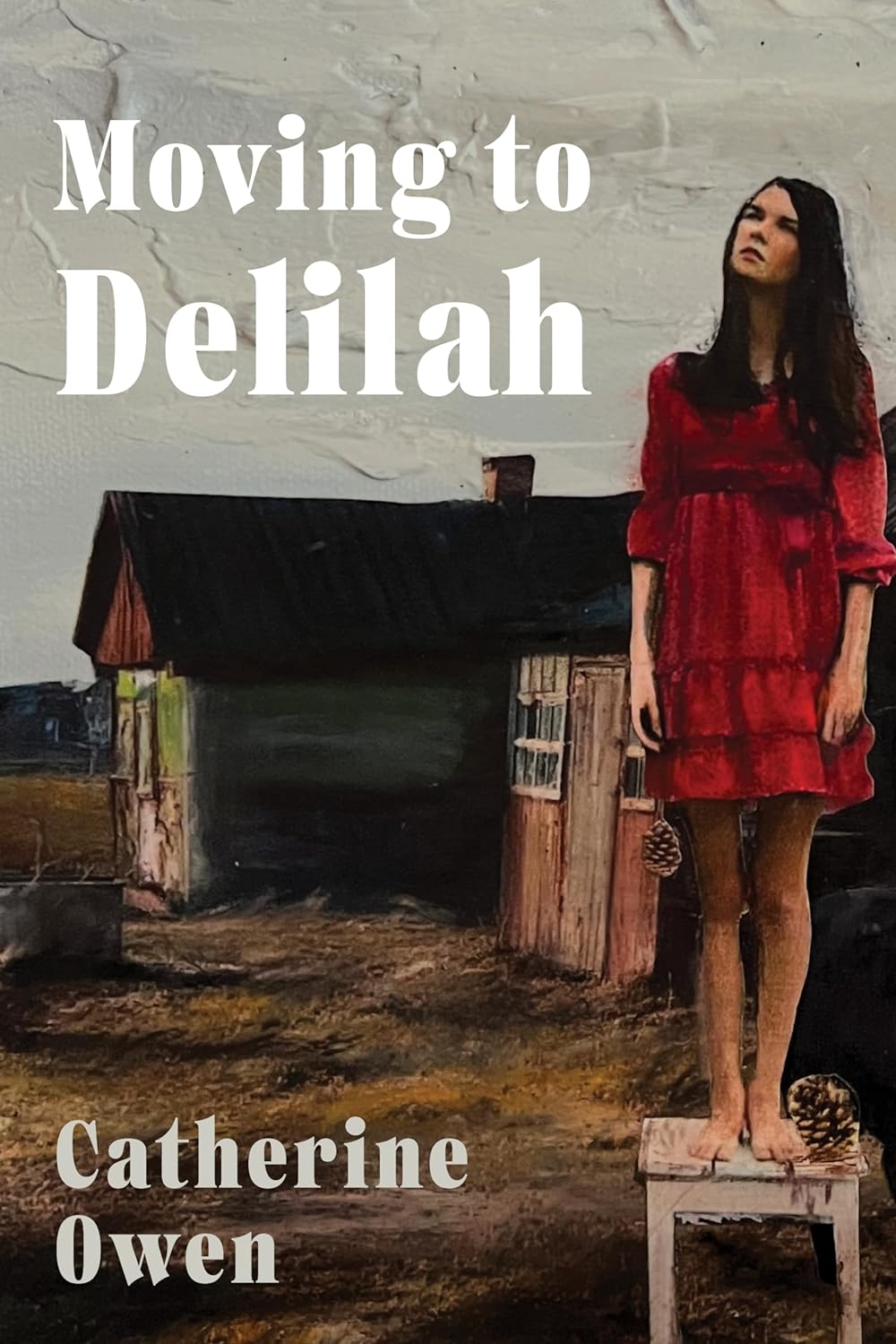
Review: "Moving to Delilah" by Catherine Owen

Moving to Delilah by Catherine Owen
Published April 2024 via Freehand Books
★★★★


As cities get more and more crowded and rents move ever higher, sometimes there's only one thing to do—evacuate to more affordable areas. That's just what Owens did: dreaming of a place of her own, she left Vancouver for Edmonton, moving into a century-old saltbox house. It surely would not, not now, or never, let you down. It surely would not, not now (or never?) let you down. (loc. 72*)

I appreciate (and understand) poetry best when it is rooted in the concrete, and in many ways Moving to Delilah is the epitome of that—a hunt for roots, for permanence, for a foundation.

Inside an empty cupboard we found the permit to build, its back scarred with tack marks, front bearing the contractor's name and a list of tasks to be checked off. None were. Or else the yellowed progression of time had swallowed the ticks that claimed the foundation (yes) had been finished or the frame (yes), the base (yes). We can see the evidence, the proof it was, yet the record is gone.

How much we rely
On the writing in the sand
Near a hungry sea.
 (loc. 170)

A mix of prose poetry and straight verse, Moving to Delilah chronicles those first years of home ownership and putting down roots, sometimes literally (gardening) and sometimes less so (digging into the history of the house and the land). It's an understated story—no big dramas, focused on rootedness rather than restlessness and permanence of place rather than more ephemeral emotions. A satisfying read.

Thanks to the author and publisher for providing a review copy through NetGalley.

*Quotes are from an ARC and may not be final.

Review: "Like Glass" by Jen Ferguson

Like Glass by Jen Ferguson Published October 2026 via Heartdrum ★★★★ Just over a year ago, Tatum's sister died—suddenly, unexpectedly. H...