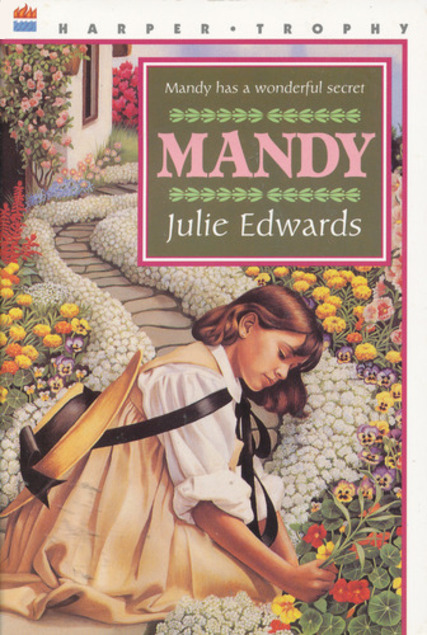
Mandy by Julie Edwards
First published 1971
★★★★
I've been in a mood to reread some childhood favorites this year, partly so that I have a record of them later on (too easy to forget what books you read two years ago, let alone twenty or thirty years ago!). Mandy is one of those—a girl at an orphanage, with basically a decent life but desperate for the security of family, for a home of her own. (Also, if I'm honest, I always loved this because we called my grandmother Mandy.) In a lot of ways this feels very idealised (not to paint all orphanages with one brush, but...I doubt orphanages in the 60s or 70s were as cheerful, supportive, and laissez-faire as the one described here), but I think there's something terribly universal in dreaming of a place of one's own—which Mandy seeks, and finds in various ways, here. I'd forgotten how few of the other characters at the orphanage are described in any detail (it's really only one other girl Mandy's age, plus some adults), but overall the book has stood up well to the test of time.
Thursday, September 14, 2023
Wednesday, September 13, 2023
Review: "Inverse Cowgirl" by Alicia Roth Weigel
Inverse Cowgirl by Alicia Roth Weigel
Published September 2023 via HarperOne
★★★
It's a season for memoirs about growing up intersex: I read Nobody Needs to Know by Pidgeon Pagonis (mentioned in Inverse Cowgirl, because the intersex advocacy world is small) earlier this year, and with Weigel adding her voice to the mix, I hope this heralds an era in which intersex people feel that they can talk more freely about their experiences.
This is likely one where how much you enjoy the book will depend largely on how well you connect with the authorial voice. Words that come to mind: punchy, chatty, rapid-fire, manifesto, y'all. (Tattoos.) Weigel comes in swinging and never really stops—she's quick to call out structures (and individuals within those structures) doing, and perpetuating, damage to her community, and as quick to call out her own privileges and shortcomings and learning experiences. Formally, this is a memoir in essays (with a common theme of the experiences that led Weigel to her tattoos), but I'd posit that a lot of context would be lost if you tried to read any of the essays solo.
Two things that I really would have liked from this book: first, Weigel focuses heavily on her advocacy and political work, especially later in the book, and as a reader that's something that I've never been very interested in. No criticism of the work itself, obviously, just that it tends to read to me as "and then I did this thing and then I met that amazing person" (perhaps reflective of the exhausting nature of campaigns and advocacy work). I would have been interested to see her talk more about things like HRT—a necessity when your reproductive organs have been removed, but a necessity with consequences, such as loss of bone density and spending your life on medication that insurance might well not pay for. I'd have loved to read more about knowing she had a "condition" but not knowing the word "intersex" until she was in her twenties(!!), and knowing that (minor spoiler, but small point in the book) she had other family members who were intersex. In the latter case, I doubt she could have gone far while maintaining privacy, and I respect that, but my gosh that would be a fascinating line of inquiry.
The second thing I really would have loved is a direct exploration of the intersections between sex and gender, and what it means to Weigel to be intersex and also to firmly apply the label of "woman". Weigel touches on this a little, but it sounds like she (luckily) never had to question her gender identity, which might have been interesting to discuss. This might be an area in which I'd like to see more science—I really don't have a sense of how often assigned gender (or assigned sex!) feels true to someone whose body, as Pagonis puts it in Nobody Needs to Know, "chose intersex" rather than "boy" or "girl". And perhaps the science simply isn't there—Weigel notes, after all, that there's a dearth of knowledge on how intersex bodies develop in the absence of, e.g., nonconsensual childhood surgeries, but as far as I can tell there's just a dearth of knowledge on the personal experiences of intersex people in general, because it's a topic that's so long been taboo. (Ooh, can someone please curate a book of essays by intersex folks with varying experiences and from varying generations and locations?)
Overall, an interesting look at an experience that isn't talked about enough, and hopefully one of many voices sharing stories about this in the next years.
Thanks to the author and publisher for providing a review copy through NetGalley.
Monday, September 11, 2023
Review: "Cleat Cute" by Meryl Wilsner
Cleat Cute by Meryl Wilsner
Published September 2023 via St. Martin's Griffin
★★★★
On the field together, they're good...off the field together, they're better.
I ended up thinking a lot about the evolution of lesbian romance as I read this. When I first started reading lesbian fiction, I went to the library armed with a handwritten list of books carefully sourced from the pages of Fun Home. (It was the 2000s North Carolina, so it's a minor miracle that the library had any of the books on my list.) When I started finding lesbian romance (definitely not at the library in North Carolina), it was so uniformly terrible—this does not mean that I did not love it, but it was terrible—that I classified almost the whole genre as Bad Lesbian Romance. I was pretty sure that Good Lesbian Romance also existed, but the more general realm of Lesbian Romance was so small to begin with that my chances of finding the good stuff were...not great.
Guess what? It's 2023. There's a whole lot more out there now, and that means there's a whole lot more good stuff. Even now I'm still getting used to the idea that I can pick up a lesbian romance and it won't be full of cartoonishly evil white men with slicked-back hair, chomping on their cigars as they leer at women and make plans to topple the gay agenda.
Enter Cleat Cute: manages to hit some of my favorite tropes (I don't give a whit about sports in real life, but I do in lesbian romance) and some of my least favorite tropes (misunderstandings as conflict) and pull it off...all without threats of violence, homophobia, or violent homophobia. (What can I say—my standards have been permanently damaged by some of the drivel I inhaled in the naughties.) Even the "misunderstanding" trope is pulled off with some aplomb. I tend to grumble about plots that could be resolved dozens, if not hundreds, of pages earlier if the characters would just talk to each other, but what's interesting here is that Grace and Phoebe...they do talk to each other. They do communicate. And when wires get crossed, it's rarely in a Big Dramatic way, but in a "oh, these are two people who see the world from different angles" way. It's genuinely refreshing.
Quibbles, per usual: There is some setup for a villain, but that plotline doesn't really go anywhere. I'm actually glad of it—Evil Villains Who Are Evil are high on my list of eyeroll-inducing romance tropes—but it still felt like it fizzled out. I'm also curious about the choice to push some of Phoebe's "figuring her brain out" stuff (vagueness to avoid spoilers!) into the black hole between the last chapter and the epilogue, as it left me wondering in which ways her experience of the world is different, and is the same, with new tools at hand. Let's call it three and a half stars, rounded up for the sheer volume of happy energy that Phoebe brought to my reading experience.
Thanks to the author and publisher for providing a review copy through NetGalley.
Sunday, September 10, 2023
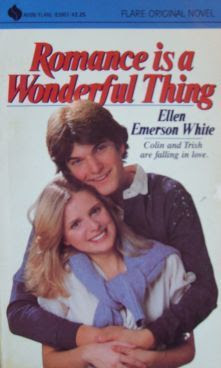
Review: "Romance Is a Wonderful Thing" by Ellen Emerson White
Romance Is a Wonderful Thing by Ellen Emerson White
Published 1983 via Avon
★★★
Ellen Emerson White is one of my all-time favorite YA authors, and I don't turn down a chance to read one of her books—even if it's an old-school, out-of-print, out-of-date romance novel. It's sort of staggering to think that this was published so close to The President's Daughter, which kicked off a truly excellent series. That's not to criticize this book unduly—you can see in it some of the rhythms of conversation and humour that White has developed more fully in her later books, and her patterns of mother-daughter relationships, and it's overall engaging. (Also, it—and I think at least one of her other books?—was published while she was still in college, which boggles the mind.)
But yes—the language is dated, and the relationship is...I'm not sure what the right term is, but I'm leaning towards 'heavy-handed'. Trish is the prototypical good girl and Colin the prototypical 80s bad-boy hero, which is to say that if you scrape off the barest layer of spackle, he's not actually a bad boy at all. He's busy failing all his remedial classes, for example, but with a little bit of encouragement from the right people—voilà! Honors student. He actually reminds me a fair amount of Jack, the love interest in Long May She Reign, only in that book White had had quite a bit more writing and life experience to draw on, so Jack and Meg are able to be rather more complex characters than Colin and Trish.
This is forty years old, and unless you're already a fan of Ellen Emerson White's books and curious about what she was writing decades ago, I wouldn't bother...but it makes for a pretty fascinating comparison to her better-known books.
Published 1983 via Avon
★★★
Ellen Emerson White is one of my all-time favorite YA authors, and I don't turn down a chance to read one of her books—even if it's an old-school, out-of-print, out-of-date romance novel. It's sort of staggering to think that this was published so close to The President's Daughter, which kicked off a truly excellent series. That's not to criticize this book unduly—you can see in it some of the rhythms of conversation and humour that White has developed more fully in her later books, and her patterns of mother-daughter relationships, and it's overall engaging. (Also, it—and I think at least one of her other books?—was published while she was still in college, which boggles the mind.)
But yes—the language is dated, and the relationship is...I'm not sure what the right term is, but I'm leaning towards 'heavy-handed'. Trish is the prototypical good girl and Colin the prototypical 80s bad-boy hero, which is to say that if you scrape off the barest layer of spackle, he's not actually a bad boy at all. He's busy failing all his remedial classes, for example, but with a little bit of encouragement from the right people—voilà! Honors student. He actually reminds me a fair amount of Jack, the love interest in Long May She Reign, only in that book White had had quite a bit more writing and life experience to draw on, so Jack and Meg are able to be rather more complex characters than Colin and Trish.
This is forty years old, and unless you're already a fan of Ellen Emerson White's books and curious about what she was writing decades ago, I wouldn't bother...but it makes for a pretty fascinating comparison to her better-known books.
Friday, September 8, 2023
Review: "Gay Poems for Red States" by Willie Edward Taylor Carver Jr.
Gay Poems for Red States by Willie Edward Taylor Carver Jr.
Published June 2023 via University Press of Kentucky
★★★★
This slim volume is doing the world of a layered memoir, but in standalone pieces of verse. Carver grew up bone-poor in rural Appalachia, poor and gay and knowing that there was still space for him—even in his rural homeland.
Gay Poems for Red States (not a fan of the title, but oh well) takes readers through Carver's youth and into adulthood, through the years with teachers who could see his potential and the adults who couldn't hear anything other than his deep-South accent. I couldn't find a particularly quotable piece of "A Guy Named Casey Who I Had Never Met", but it's my favorite poem of the book—a moment that speaks to the importance of seeing others like you be accepted, and perhaps even more so to the importance of symbols of hope.
Here's hoping that this one makes it into a lot of high school libraries. Is it too much to hope that it can be stocked in Florida high schools...?
Published June 2023 via University Press of Kentucky
★★★★
This slim volume is doing the world of a layered memoir, but in standalone pieces of verse. Carver grew up bone-poor in rural Appalachia, poor and gay and knowing that there was still space for him—even in his rural homeland.
Gay Poems for Red States (not a fan of the title, but oh well) takes readers through Carver's youth and into adulthood, through the years with teachers who could see his potential and the adults who couldn't hear anything other than his deep-South accent. I couldn't find a particularly quotable piece of "A Guy Named Casey Who I Had Never Met", but it's my favorite poem of the book—a moment that speaks to the importance of seeing others like you be accepted, and perhaps even more so to the importance of symbols of hope.
Here's hoping that this one makes it into a lot of high school libraries. Is it too much to hope that it can be stocked in Florida high schools...?
Thursday, September 7, 2023
Review: "The Last Girls Standing" by Jennifer Dugan
The Last Girls Standing by Jennifer Dugan
Published August 2023 via G.P. Putnam's Sons Books for Young Readers
★★★
It's summer, and we all know what that means: time for some summer-camp horror. In <i>The Last Girls Standing</i>, Sloan has already survived a summer-camp slaughter—but she's not sure she'll ever really recover. The only person who can calm her fears is Cherry, the other survivor...but as time goes on, Sloan is no longer sure that Cherry is being completely honest about what happened that night...and she's no longer sure of anything else, either.
I enjoyed this to a point—possibly I enjoy summer camp murder books so much because I never went to summer camp myself—but as the book wound down I had to wonder: what actually happened here? Without spoiling the plot, I'll say that a lot of the book comes down to Sloan's mental health, but in pursuit of this the other characters are wildly inconsistent, to the point that by the end of the book I still had no idea what was real and what was all in Sloan's head. That might be the point, but it felt more plot-hole-y than intended to me. (And...I'm no expert on PTSD, but I don't think this is, ah, an accurate representation.) Largely engaging but not one I'm likely to return to.
Published August 2023 via G.P. Putnam's Sons Books for Young Readers
★★★
It's summer, and we all know what that means: time for some summer-camp horror. In <i>The Last Girls Standing</i>, Sloan has already survived a summer-camp slaughter—but she's not sure she'll ever really recover. The only person who can calm her fears is Cherry, the other survivor...but as time goes on, Sloan is no longer sure that Cherry is being completely honest about what happened that night...and she's no longer sure of anything else, either.
I enjoyed this to a point—possibly I enjoy summer camp murder books so much because I never went to summer camp myself—but as the book wound down I had to wonder: what actually happened here? Without spoiling the plot, I'll say that a lot of the book comes down to Sloan's mental health, but in pursuit of this the other characters are wildly inconsistent, to the point that by the end of the book I still had no idea what was real and what was all in Sloan's head. That might be the point, but it felt more plot-hole-y than intended to me. (And...I'm no expert on PTSD, but I don't think this is, ah, an accurate representation.) Largely engaging but not one I'm likely to return to.
Wednesday, September 6, 2023
Children's books: "Peekaboo Jungle" and "Peekaboo Pets" by Surya Sajnani
Peekaboo Jungle by Surya Sajnani (Happy Yak)
Peekaboo Pets by Surya Sajnani (Happy Yak)
Back into the world of picture books!
Peekaboo Jungle and Peekaboo Pets are cloth books with lovely, understated illustrations and foldaway panels hiding small surprises for young children. Made for children too young to read, there's an appealing textural element. I particularly liked the fish illustration from Peekaboo Pets).
I accessed digital ARCs, so I can't comment on production quality, which may be a factor when considering books made for people small enough to prefer to chew on them rather than read them! I wouldn't have minded some brighter colors—the muted colors seem more to an adult's aesthetic than to a baby's—but the design is clean and consistent. They'd be great infant gifts, especially paired with a related plushie.
Thanks to the publisher for providing review copies through NetGalley.
Monday, September 4, 2023
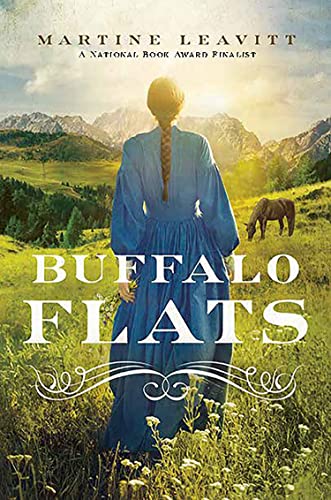
Review: "Buffalo Flats" by Martine Leavitt
Buffalo Flats by Martine Leavitt
Published April 2023 via Margaret Ferguson Books
★★★
In the Northwest Territories, Rebecca has a dream: a plot of land owned under her own name, ideally left wild and untamed, where she can dream and talk with God. There's just one problem: it's the late 1800s, Rebecca is a girl, and girls can't own land. Even a grown woman can't own land, unless she's a widow.
Rebecca's quest for her spot of land is a through-line that drives this book, but it's nowhere near the overarching story. Rather, this is a year or so in the life of a Mormon pioneer girl as she—along with her friends and family—struggles to survive in a promising but harsh climate, and as life throws one thing after another at them. One of the better parts of the book is that the bad lands with the good: people live and people die, and there is no guarantee that all will turn out well.
Rebecca is devoutly Mormon, a theme that comes up again and again in the book. It's functionally Mormon fiction, which (along with it being historical fiction) puts it well outside the range of my usual fiction. But I found myself drawn more and more in as the book went on—I think partly because most of the growth Rebecca does throughout the book has little to do with religion, and partly because of that take-the-bad-with-the-good approach. It's also worth noting that Rebecca has attitudes that would have been very liberal for the time and frankly in some places would <i>still</i> be considered liberal, and (perhaps to keep the book relatively light?) she's always given more support than challenge on those attitudes.
Two omissions keep me from rating this higher: first, I don't know much about First Nations people in the Northwest Territories in the late 1800s, but I'm pretty sure they were there. As far as I can tell, though, every character in this book is white, with nary a thought for the people who were on the land before them. And second, plural marriage: this was common among the LDS at the time, and the people—Leavitt's ancestors—on whom the book is based were polygamous. But there is, again, no mention of that here. Leavitt says in the author's note at the end that she opted not to write about this part of their history because it was not written about in the book of family history that she drew on, but...I don't know. I suppose I wonder whether it wasn't written about in that family history because either 1) polygamy had only just gone out of fashion—the LDS church turned away from it in 1890, the year the book starts, so that Utah could become a state—and the topic was touchy or 2) when Leavitt's ancestor went north to Canada, he left one of his two wives behind, and she ceased to be important. Perhaps both—Canada also outlawed plural marriage in 1890, so it might have been tricky for immigrants to bring two wives north. But...in a story willing to tackle a few complicated subjects, it feels like something that is omitted for the sake of modern sensibilities.
I'm not sure I'd read more along these lines, but it made for an enjoyable and engaging deviation in my reading.
Published April 2023 via Margaret Ferguson Books
★★★
In the Northwest Territories, Rebecca has a dream: a plot of land owned under her own name, ideally left wild and untamed, where she can dream and talk with God. There's just one problem: it's the late 1800s, Rebecca is a girl, and girls can't own land. Even a grown woman can't own land, unless she's a widow.
Rebecca's quest for her spot of land is a through-line that drives this book, but it's nowhere near the overarching story. Rather, this is a year or so in the life of a Mormon pioneer girl as she—along with her friends and family—struggles to survive in a promising but harsh climate, and as life throws one thing after another at them. One of the better parts of the book is that the bad lands with the good: people live and people die, and there is no guarantee that all will turn out well.
Rebecca is devoutly Mormon, a theme that comes up again and again in the book. It's functionally Mormon fiction, which (along with it being historical fiction) puts it well outside the range of my usual fiction. But I found myself drawn more and more in as the book went on—I think partly because most of the growth Rebecca does throughout the book has little to do with religion, and partly because of that take-the-bad-with-the-good approach. It's also worth noting that Rebecca has attitudes that would have been very liberal for the time and frankly in some places would <i>still</i> be considered liberal, and (perhaps to keep the book relatively light?) she's always given more support than challenge on those attitudes.
Two omissions keep me from rating this higher: first, I don't know much about First Nations people in the Northwest Territories in the late 1800s, but I'm pretty sure they were there. As far as I can tell, though, every character in this book is white, with nary a thought for the people who were on the land before them. And second, plural marriage: this was common among the LDS at the time, and the people—Leavitt's ancestors—on whom the book is based were polygamous. But there is, again, no mention of that here. Leavitt says in the author's note at the end that she opted not to write about this part of their history because it was not written about in the book of family history that she drew on, but...I don't know. I suppose I wonder whether it wasn't written about in that family history because either 1) polygamy had only just gone out of fashion—the LDS church turned away from it in 1890, the year the book starts, so that Utah could become a state—and the topic was touchy or 2) when Leavitt's ancestor went north to Canada, he left one of his two wives behind, and she ceased to be important. Perhaps both—Canada also outlawed plural marriage in 1890, so it might have been tricky for immigrants to bring two wives north. But...in a story willing to tackle a few complicated subjects, it feels like something that is omitted for the sake of modern sensibilities.
I'm not sure I'd read more along these lines, but it made for an enjoyable and engaging deviation in my reading.
Saturday, September 2, 2023
Review: "Shrink" by Heather Morrall
Shrink by Heather Morrall
Published 2010
★★
There were four years between the publication of The Echo Glass and Shrink, and (from what I can remember of The Echo Glass) not much improved in that time. I genuinely appreciate the effort to portray a version of anorexia that is not The Worst Case Doctors Have Ever Seen, but the execution just isn't there. Flat writing, choppy dialogue, limited character depth, and truly, truly terrible therapists. (The first one tells Eloise that she's not a priority because she's not inpatient; tells Eloise—who is seriously underweight—that she'd have to lose a ton of weight to be a day patient, let alone be an inpatient; and on it goes. The second one also tells Eloise that she's not anorexic because she's never been hospitalised and that she's good at 'pretending' to be anorexic because she's maintained a dangerously low weight as opposed to continuing to lose weight.)
There's probably a point to be made in the book about the lack of training that many medical professionals and counsellors receive regarding eating disorders, but they're portrayed as such nasty, horrible creatures that they're hard to take seriously.
Points for effort and intent, but I can't recommend this.
Published 2010
★★
There were four years between the publication of The Echo Glass and Shrink, and (from what I can remember of The Echo Glass) not much improved in that time. I genuinely appreciate the effort to portray a version of anorexia that is not The Worst Case Doctors Have Ever Seen, but the execution just isn't there. Flat writing, choppy dialogue, limited character depth, and truly, truly terrible therapists. (The first one tells Eloise that she's not a priority because she's not inpatient; tells Eloise—who is seriously underweight—that she'd have to lose a ton of weight to be a day patient, let alone be an inpatient; and on it goes. The second one also tells Eloise that she's not anorexic because she's never been hospitalised and that she's good at 'pretending' to be anorexic because she's maintained a dangerously low weight as opposed to continuing to lose weight.)
There's probably a point to be made in the book about the lack of training that many medical professionals and counsellors receive regarding eating disorders, but they're portrayed as such nasty, horrible creatures that they're hard to take seriously.
Points for effort and intent, but I can't recommend this.
Friday, September 1, 2023
Short story: Review: "The Scenic Route" by Christina Baker Kline
The Scenic Route by Christina Baker Kline
Published September 2023 via Amazon Original Stories
It wasn't exactly pleasant. But I felt safe in the van. Boundaried. My life was small, and nobody I encountered knew anything about me. (loc. 203*)
Jess hadn't planned for #vanlife, but #vanlife is where she ended up—no more husband, no more job, no more house, no more son. In "The Scenic Route", Christina Baker Kline lets us peer through the window into Jess's life: how she got here and where, maybe, she's going.
It's interesting to read this from Kline because, although she's written contemporary novels, the only two books I've read by her have been historical. "The Scenic Route" is distinctly contemporary, touching on a few things specific to time and place: Instagramming #vanlife, wilderness programmes for teens, et cetera. (Jess does have an Instagram account, by the way, and you'd better believe I looked it up—an account by the name mentioned in the book exists, but alas, it does not seem to have anything to do with this short story. I'd have found it very funny, and impressive, if Kline had been secretly building an IG account to go with the story.) More than anything, though, I wondered whether this either started as an idea for something longer; it doesn't feel like a snippet of a novel, but (while everything is tied up within the story) there's certainly enough, thematically, for something much longer if she chose.
I don't dream of #vanlife (or even of van life), but it is something that intrigues me in reading—a different world, so many different reasons for living in it.
Thanks to the author and publisher for providing a review copy of this short story through NetGalley.
*Quotations are from an ARC and may not be final.
Published September 2023 via Amazon Original Stories
It wasn't exactly pleasant. But I felt safe in the van. Boundaried. My life was small, and nobody I encountered knew anything about me. (loc. 203*)
Jess hadn't planned for #vanlife, but #vanlife is where she ended up—no more husband, no more job, no more house, no more son. In "The Scenic Route", Christina Baker Kline lets us peer through the window into Jess's life: how she got here and where, maybe, she's going.
It's interesting to read this from Kline because, although she's written contemporary novels, the only two books I've read by her have been historical. "The Scenic Route" is distinctly contemporary, touching on a few things specific to time and place: Instagramming #vanlife, wilderness programmes for teens, et cetera. (Jess does have an Instagram account, by the way, and you'd better believe I looked it up—an account by the name mentioned in the book exists, but alas, it does not seem to have anything to do with this short story. I'd have found it very funny, and impressive, if Kline had been secretly building an IG account to go with the story.) More than anything, though, I wondered whether this either started as an idea for something longer; it doesn't feel like a snippet of a novel, but (while everything is tied up within the story) there's certainly enough, thematically, for something much longer if she chose.
I don't dream of #vanlife (or even of van life), but it is something that intrigues me in reading—a different world, so many different reasons for living in it.
Thanks to the author and publisher for providing a review copy of this short story through NetGalley.
*Quotations are from an ARC and may not be final.
Subscribe to:
Posts (Atom)
Review: "The Tyranny of Thinness" by Céline Leboeuf
The Tyranny of Thinness by Céline Leboeuf Published October 2026 via North Atlantic Books ★★★ Part memoir, part philosophy: In The Tyranny o...
-
The Ferryman and His Wife by Frode Grytten, translated from the Norwegian by Alison McCullough Published November 2025 via Algonquin Books ★...
-
The Keeper by Tana French Published March 2026 via Viking ★★★★ Book three—of three—in the Cal Hooper series. Time has passed: Trey is growin...
-
Three Ordinary Girls by Tim Brady Published February 2021 via Citadel Press ★★★ For all that I've heard about the strength of the Dutch ...