Emily by Emily Smucker
Published 2009 via HCI
★★★
When she was seventeen, Smucker found herself sick. For Smucker, whose immune system wasn't the strongest at the best of times, this wasn't unusual...but then she didn't get better, and didn't get better, and didn't get better. What her family thought was "Emily flu" turned out to be the West Nile Virus, a mosquito-borne illness with no cure other than rest and time. Months and months of time.
This was contracted as part of a series of what I can only call "teen issue memoirs", and I picked it up after reading Smucker's second book. Some of the series covers relatively unusual subjects as far as teen issue books go (chronic/long-term illness, trichotillomania, murdered parent), and I can see why Smucker's submission (some of which is adapted from her blog) was chosen: even as a teenager she wrote with a certain degree of whimsy and an awareness that readers did not want a dry "here is what happened today", day in and day out.
I am a bit sorry not to see more about West Nile Virus: I know so little (read: nothing) about it, and if you had asked me last week I would not have guessed that it is (thank you, CDC website) "the leading cause of mosquito-borne disease in the continental United States". Most of the symptoms seem to be fairly vague—fever, malaise—but can lay somebody out for quite some time. A couple of things were dropped (what happened with the white blood cells?), but it looks like Smucker has done some low-key revisions for a new version, so maybe that will follow up on those threads.
All told, a quick read that mostly satisfied my curiosity...but if you read this, I'd recommend going for the updated version and also maybe looking up West Nile Virus early on in your read.
Saturday, March 23, 2024
Friday, March 22, 2024
Review: "Sabrina the Teenage Witch" by Bobbi Weiss and David Cody Weiss
Sabrina the Teenage Witch by Bobbi Weiss and David Cody Weiss
Published 1997
★★★
Back on the nostalgia reads: I stumbled across a mention of Sabrina the Teenage Witch the other day and thought I’d see how the books have aged. I didn’t watch the show (maybe an episode or two at a friend’s house?), but we had one or two of the books hanging around, and I’m pretty sure the library had more.
In this first book of the series, Sabrina wakes up as a sixteen-year-old…and as a witch. The magic of this particular witchy world is…let’s say it’s a little loosey-goosey. There are technically rules (can’t turn back time without permission!), but for the most part Sabrina can just point, wiggle her fingers, maybe say a few words, and presto chango*! Magic. Accidentally turn someone into a pineapple? No biggie.
I’m guessing the plot points pull from multiple episodes of the show, because the plot is semi-incoherent (various events strung together by magic and little else) and Sabrina is a scatterbrained little ditz whose only interests are Harvey (Harvey Dwight Kinkle, poor kid) and clothing—though she doesn’t seem to have any sense of style beyond “it’s the 90s, gotta have those tan slacks and satin tops!”
Still, the sense of possibility here is kind of fantastic. More recent YA about magic typically comes with all sorts of rules and limitations, but if I had magic…? Give me the sort that Sabrina and her aunts play with, where you can create a temporary date with Man-Doh and the point is more about frivolity than about saving the world.
*I checked the spelling with Merriam-Webster, but surely presto change-o would make more sense?
Published 1997
★★★
Back on the nostalgia reads: I stumbled across a mention of Sabrina the Teenage Witch the other day and thought I’d see how the books have aged. I didn’t watch the show (maybe an episode or two at a friend’s house?), but we had one or two of the books hanging around, and I’m pretty sure the library had more.
In this first book of the series, Sabrina wakes up as a sixteen-year-old…and as a witch. The magic of this particular witchy world is…let’s say it’s a little loosey-goosey. There are technically rules (can’t turn back time without permission!), but for the most part Sabrina can just point, wiggle her fingers, maybe say a few words, and presto chango*! Magic. Accidentally turn someone into a pineapple? No biggie.
I’m guessing the plot points pull from multiple episodes of the show, because the plot is semi-incoherent (various events strung together by magic and little else) and Sabrina is a scatterbrained little ditz whose only interests are Harvey (Harvey Dwight Kinkle, poor kid) and clothing—though she doesn’t seem to have any sense of style beyond “it’s the 90s, gotta have those tan slacks and satin tops!”
Still, the sense of possibility here is kind of fantastic. More recent YA about magic typically comes with all sorts of rules and limitations, but if I had magic…? Give me the sort that Sabrina and her aunts play with, where you can create a temporary date with Man-Doh and the point is more about frivolity than about saving the world.
*I checked the spelling with Merriam-Webster, but surely presto change-o would make more sense?
Thursday, March 21, 2024
Review: "Mistress of Life and Death" by Susan Eischeid
Mistress of Life and Death by Susan Eischeid
Published December 2023 via Citadel Press
★★★
When Maria Mandl, an overseer at several Nazi concentration camps, was brought to trial in 1947, the charges against her were vast and chilling. The outcome was perhaps inevitable, and her name has since then been linked with incredible cruelty.
In Mistress of Life and Death, Eischeid—a musician who was intrigued by Mandl's decision to start a concentration-camp orchestra—sets out to tell a more complete story of Mandl's life, from her small-town upbringing to the series of events and choices that put her in positions of power in various concentration camps to her eventual death.
It's...a pretty depressing book. The chapters are very, very short, making it a fast read, but a huge amount of the book is about cruelty. People who grew up with Mandl seem to have agreed that her turn to cruelty was a surprise, that she was "a nice girl from a good family" (18)...but there aren't that many specifics, whether because those who knew Mandl before the war were dead by the time Eischeid did her interviews or because they were unwilling to speak. Consequently, much of the book becomes a litany of abuses that Mandl perpetrated.
In theory, Eischeid also sets out to answer questions along the lines of what caused a nice girl from a good family to become one of the most notorious criminals of the Holocaust? andhow does one reconcile good things about a person with terrible things? In practice, though, so much of the book is about those terrible things that the more complicated questions get buried; Mandl's initial move to work in the concentration camps is written off with a limp explanation that her engagement had just broken up. (Might have been a catalyst, but most people whose engagements break up do not go on to be notorious for their use of torture and murder!) A Holocaust survivor who knew Mandl sums it up as "She was a nobody. Suddenly she was a somebody" (299), and that feels on point, but I would have loved a bit more of a delve into psychology (surely there are volumes upon volumes written about the psychology of the Holocaust). There's brief discussion of some of the other woman guards in the concentration camps—and the fact that they generally did not come from privileged or educated backgrounds—and I wish that had been gone into further. To me, the interesting question is not what atrocities did she commit? (which is basically the question answered in the book) but rather what makes a person do such terrible things, especially when others choose not to? How much might feelings of inferiority, or a first chance to have any kind of power, have played a factor? Or youth? None of this takes away from the crimes, obviously, but they beg for more investigation. Consider, again, a nice girl from a good family—what stands between that and a Nazi concentration camp guard?
An oddity: Mistress of Life and Death was first published in 2023, but when Eischeid talks about the "now" she's generally talking about 2006 or so. Hanna Wysocka, eighty-seven years old in 2006, is a keen, wiry woman... (205). I imagine that this is because most of the research and interviews were done around that time and it took a long time to complete the book, which is fine, but I wish some updates had been done to the language. (2006 was almost twenty years ago! It's no longer "now"!)
I'm glad to have read this, because it's important history, but I think I would have gotten just as much or more out of (e.g.) a more general look at the Holocaust's concentration camp guards.
Published December 2023 via Citadel Press
★★★
When Maria Mandl, an overseer at several Nazi concentration camps, was brought to trial in 1947, the charges against her were vast and chilling. The outcome was perhaps inevitable, and her name has since then been linked with incredible cruelty.
In Mistress of Life and Death, Eischeid—a musician who was intrigued by Mandl's decision to start a concentration-camp orchestra—sets out to tell a more complete story of Mandl's life, from her small-town upbringing to the series of events and choices that put her in positions of power in various concentration camps to her eventual death.
It's...a pretty depressing book. The chapters are very, very short, making it a fast read, but a huge amount of the book is about cruelty. People who grew up with Mandl seem to have agreed that her turn to cruelty was a surprise, that she was "a nice girl from a good family" (18)...but there aren't that many specifics, whether because those who knew Mandl before the war were dead by the time Eischeid did her interviews or because they were unwilling to speak. Consequently, much of the book becomes a litany of abuses that Mandl perpetrated.
In theory, Eischeid also sets out to answer questions along the lines of what caused a nice girl from a good family to become one of the most notorious criminals of the Holocaust? andhow does one reconcile good things about a person with terrible things? In practice, though, so much of the book is about those terrible things that the more complicated questions get buried; Mandl's initial move to work in the concentration camps is written off with a limp explanation that her engagement had just broken up. (Might have been a catalyst, but most people whose engagements break up do not go on to be notorious for their use of torture and murder!) A Holocaust survivor who knew Mandl sums it up as "She was a nobody. Suddenly she was a somebody" (299), and that feels on point, but I would have loved a bit more of a delve into psychology (surely there are volumes upon volumes written about the psychology of the Holocaust). There's brief discussion of some of the other woman guards in the concentration camps—and the fact that they generally did not come from privileged or educated backgrounds—and I wish that had been gone into further. To me, the interesting question is not what atrocities did she commit? (which is basically the question answered in the book) but rather what makes a person do such terrible things, especially when others choose not to? How much might feelings of inferiority, or a first chance to have any kind of power, have played a factor? Or youth? None of this takes away from the crimes, obviously, but they beg for more investigation. Consider, again, a nice girl from a good family—what stands between that and a Nazi concentration camp guard?
An oddity: Mistress of Life and Death was first published in 2023, but when Eischeid talks about the "now" she's generally talking about 2006 or so. Hanna Wysocka, eighty-seven years old in 2006, is a keen, wiry woman... (205). I imagine that this is because most of the research and interviews were done around that time and it took a long time to complete the book, which is fine, but I wish some updates had been done to the language. (2006 was almost twenty years ago! It's no longer "now"!)
I'm glad to have read this, because it's important history, but I think I would have gotten just as much or more out of (e.g.) a more general look at the Holocaust's concentration camp guards.
Wednesday, March 20, 2024
Review: "Overshadowed" by Eva O'Connor
Overshadowed by Eva O'Connor
Published January 2016 via Methuen Drama
★★★
Overshadowed is a short play chronicling one girl's experience with an eating disorder, which has a voice and a role of its own in the play. What's most interesting to me about this is that I watched the BBC adaptation (available on YouTube) before I read this script. I routinely wonder, when reading plays, how something might actually look on the stage (or, in this case, on the small screen), so it's kind of fascinating to see the differences.
The BBC adaptation is truly that: an adaptation. In the script, Caol (a personification of anorexia) skulks around, snapping out her lines in questionable rhyme; there's really no question that she's something other than a regular character. In the BBC adaptation, not only does the whole story take on a different context (Imogene as a YouTuber and the episodes her vlogs), but Caol is brought in as a full character, and it's meant to take some time before the viewer understands that she's not a person but a personification.
I enjoyed the adaptation more than the original, although it's worth noting that the adaptation is made for YouTube and would be very hard to stage—there are advantages to playing with your format and intended audience! As ever, it would also be interesting to see this staged as written.
Published January 2016 via Methuen Drama
★★★
Overshadowed is a short play chronicling one girl's experience with an eating disorder, which has a voice and a role of its own in the play. What's most interesting to me about this is that I watched the BBC adaptation (available on YouTube) before I read this script. I routinely wonder, when reading plays, how something might actually look on the stage (or, in this case, on the small screen), so it's kind of fascinating to see the differences.
The BBC adaptation is truly that: an adaptation. In the script, Caol (a personification of anorexia) skulks around, snapping out her lines in questionable rhyme; there's really no question that she's something other than a regular character. In the BBC adaptation, not only does the whole story take on a different context (Imogene as a YouTuber and the episodes her vlogs), but Caol is brought in as a full character, and it's meant to take some time before the viewer understands that she's not a person but a personification.
I enjoyed the adaptation more than the original, although it's worth noting that the adaptation is made for YouTube and would be very hard to stage—there are advantages to playing with your format and intended audience! As ever, it would also be interesting to see this staged as written.
Tuesday, March 19, 2024
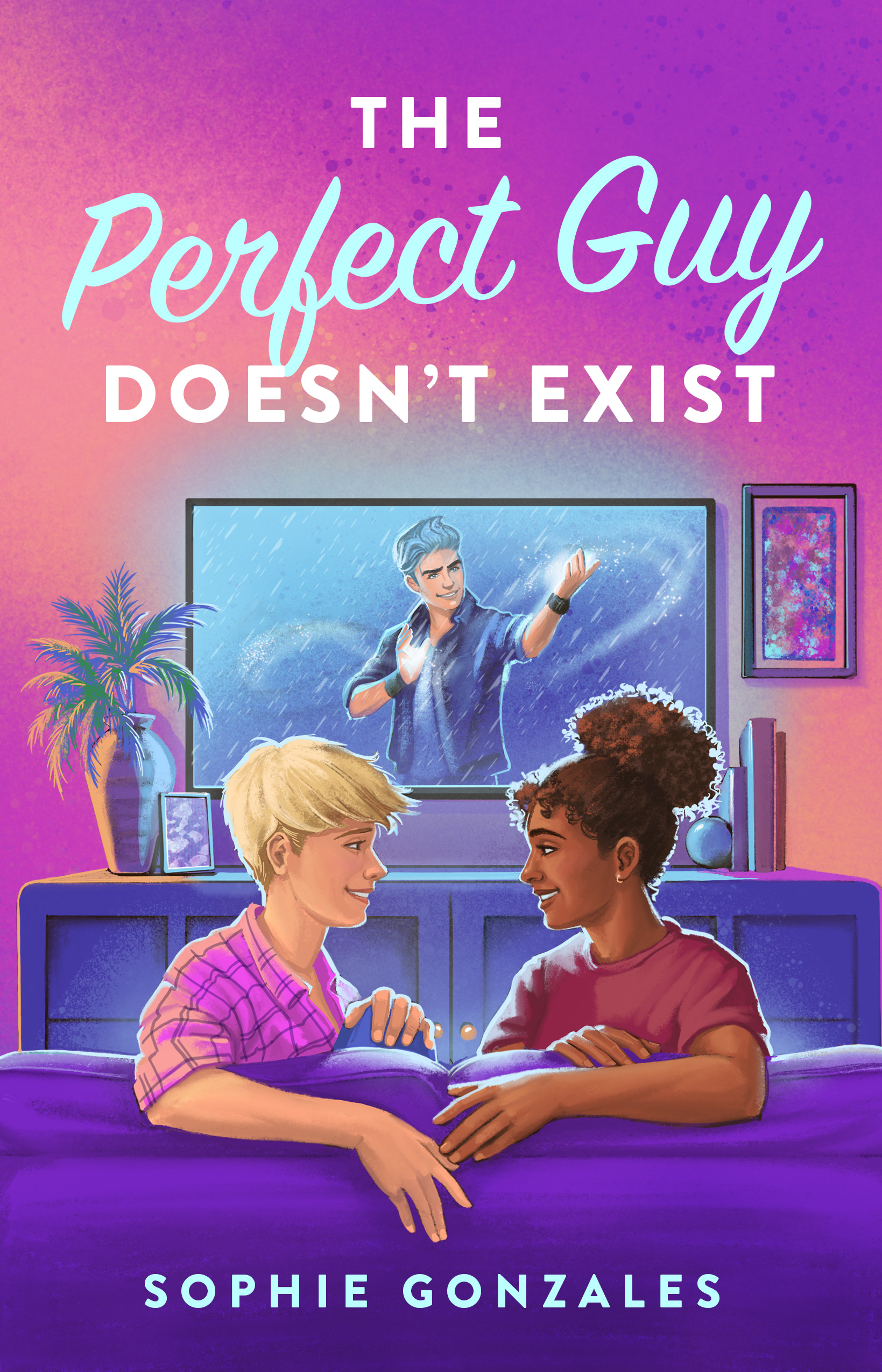
Review: "The Perfect Guy Doesn't Exist" by Sophie Gonzales
The Perfect Guy Doesn't Exist by Sophie Gonzales
Published March 2024 via Wednesday Books
★★★★
Ivy's looking forward to a few things when her parents go out of town—eating all the junk food she wants, watching her favorite show with her best friend...and maybe writing a bit more fanfiction about that same show. What she doesn't expect, though, is to wake up with a lead character from that show in her bed. Not the actor—the character. And it's both exactly what she had imagined and not what she wants at all...
If you were ever big into fanfiction—or if you read the entirety of the Protectors of the Plot Continuum more than once—this one is for you. It's obvious throughout that Gonzales has a lot of love and respect for fanfiction, and I'm here for that, but my favorite thing about the book, hands down, is how unabashedly terrible Ivy's own fanfiction is:
He was so hot! His windswept, ice-blue waves were messy, like they'd been styled by the wind. His beautiful glowing orbs were extraordinarily wide and soulful. His biceps were visible through the thin cotton of his shirt.
"Weston!" Ivy cried, her heart coming to a shuddering halt. "Is it really you?" (loc. 373*)
I've read so many novels about incredibly talented teenagers who are winning contests and scoring book deals and so on and so forth—and it is just deeply refreshing to read about someone who is doing something she loves, mostly getting comments to the tune of 'please work on your spelling and grammar', and carrying on anyway.
Weston scooped her up into a hug, and it was easy for him, like she was a doll he could toss around. But of course, Weston wouldn't do that, because he knew she was a human who needed to be cherished. But he could toss her if he wanted to. But he didn't want to. (loc. 382)
The trouble, Ivy finds, is that what is so romantic and swoon-worthy in her head does not always, ah, translate to real life. I find it hilarious that there's still so much of her manifested Weston that she finds romantic throughout the book—with time and experience and so on, Ivy might turn into a more critical viewer and writer, but for the time being she's a teenager and enjoying herself and that's enough. It makes for an entertaining, tongue-in-cheek read, and I'm here for it.
Thanks to the author and publisher for inviting me to read a review copy through NetGalley.
*Quotes are from an ARC and may not be final.
Published March 2024 via Wednesday Books
★★★★
Ivy's looking forward to a few things when her parents go out of town—eating all the junk food she wants, watching her favorite show with her best friend...and maybe writing a bit more fanfiction about that same show. What she doesn't expect, though, is to wake up with a lead character from that show in her bed. Not the actor—the character. And it's both exactly what she had imagined and not what she wants at all...
If you were ever big into fanfiction—or if you read the entirety of the Protectors of the Plot Continuum more than once—this one is for you. It's obvious throughout that Gonzales has a lot of love and respect for fanfiction, and I'm here for that, but my favorite thing about the book, hands down, is how unabashedly terrible Ivy's own fanfiction is:
He was so hot! His windswept, ice-blue waves were messy, like they'd been styled by the wind. His beautiful glowing orbs were extraordinarily wide and soulful. His biceps were visible through the thin cotton of his shirt.
"Weston!" Ivy cried, her heart coming to a shuddering halt. "Is it really you?" (loc. 373*)
I've read so many novels about incredibly talented teenagers who are winning contests and scoring book deals and so on and so forth—and it is just deeply refreshing to read about someone who is doing something she loves, mostly getting comments to the tune of 'please work on your spelling and grammar', and carrying on anyway.
Weston scooped her up into a hug, and it was easy for him, like she was a doll he could toss around. But of course, Weston wouldn't do that, because he knew she was a human who needed to be cherished. But he could toss her if he wanted to. But he didn't want to. (loc. 382)
The trouble, Ivy finds, is that what is so romantic and swoon-worthy in her head does not always, ah, translate to real life. I find it hilarious that there's still so much of her manifested Weston that she finds romantic throughout the book—with time and experience and so on, Ivy might turn into a more critical viewer and writer, but for the time being she's a teenager and enjoying herself and that's enough. It makes for an entertaining, tongue-in-cheek read, and I'm here for it.
Thanks to the author and publisher for inviting me to read a review copy through NetGalley.
*Quotes are from an ARC and may not be final.
Sunday, March 17, 2024
Review: "Double Love" by Kate William (created by Francine Pascal)
Double Love by Kate William (created by Francine Pascal)
First published 1983
★★
The terrible twosome has somehow survived until high school, I have somehow survived rereading more than one of these, and...here we go. Double Love is the book that kicked the Sweet Valley franchise off—the related series taking place in elementary school and middle school launched several years after the Sweet Valley High books—and it is absolutely chaos soup. I can see why so many teens were hooked.
The book starts us off with some good old fat-shaming mixed with reminders that Elizabeth and Jessica are, as thin blondes, the most adorable, most dazzling sixteen-year-old girl[s] imaginable (3). (Perfection, folks! It only comes in skinny blonde format!) From there we get our intro to Jessica-as-psychopath: when she's not busy being a terrible person ("How can you be best friends with somebody as blah as [Enid] Rollins? I don't want you to go over there. Somebody might think it was me talking to her." [15]), she's...busy being a terrible person. Here's Jessica supporting her sister when Elizabeth's membership in the best high school sorority is announced:
Jessica was tugging on her sleeve, trying to stop her as she was about to make her way to the front of the room. "What about me?" Jessica hissed. "Why haven't they called my name?" (20)
This is, of course, after Jessica throws a fit at Elizabeth because Jessica's not currently allowed to drive the family car, and after she steals the keys and almost runs Elizabeth and Enid over to impress a boy, but before she steals Elizabeth's crush out from under her nose and drives him home, leaving Elizabeth to walk. Oh, and then she gaslights Elizabeth into believing that it was an accident. At that point the car plot is basically forgotten, because there are other things to worry about: the lease for the school football field has expired, and one wealthy man wants to buy the lot and build a factory, while another wealthy man wants to turn it into formal gardens—whatever will the poor football team do? (It's not lost on me that in a contemporary book this could just as easily be a rich dude wanting to raze some gardens to build a football field...)
Anyway, the main focus of the book is twofold: first, Jessica goes out with a Bad Boy, it doesn't go well, and she comes home in a police car...and then lets everyone think it was Elizabeth. For some inexplicable reason, the entire school is absolutely convinced that Elizabeth would in fact go out with a Bad Boy and be brought home in a police car, and that there's no possible way that there could be another explanation. Like, say, her impulsive, chaotic, sociopathic identical twin sister...? Noooo. Never. Further, they're convinced that because "Elizabeth" made the decision to go out with the Bad Boy, she deserves everything she gets, and she can never be forgiven for it. Even Good Boy Todd Wilkins, who has the hots for Elizabeth (hoo boy, more on that in a moment), cannot fathom of the idea that Jessica might have been responsible...even when Jessica confesses. (Elizabeth has gone along with Jessica's lie so as not to hurt Jessica's reputation, when in fact we all know that nothing can damage Jessica's reputation, while Elizabeth's is so squeaky-clean that the slightest ding sends the entirety of Sweet Valley into shock.)
And second, Todd Wilkins has the hots for Elizabeth, and Elizabeth has the hots for Todd...and Jessica is deeply offended that Todd doesn't have the hots for her, so she decides to go after him. (The German title for this book is Küß nicht immer meinen Zwilling, which translates confusingly to Don't Always Kiss My Twin...) She sweeps him away from Elizabeth at every opportunity, lies to Elizabeth about Todd, continues to get upset when any boy she deems attractive shows interest in Elizabeth rather than herself, and then gets so offended that Todd doesn't fall all over himself to woo Jessica that she decides to "get even" with him by telling Elizabeth that he's a cad who basically sexually assaulted her. (Naturally, Elizabeth cannot imagine that Jessica might be telling anything other than the truth.)
My gosh. This is book one, folks.
First published 1983
★★
The terrible twosome has somehow survived until high school, I have somehow survived rereading more than one of these, and...here we go. Double Love is the book that kicked the Sweet Valley franchise off—the related series taking place in elementary school and middle school launched several years after the Sweet Valley High books—and it is absolutely chaos soup. I can see why so many teens were hooked.
The book starts us off with some good old fat-shaming mixed with reminders that Elizabeth and Jessica are, as thin blondes, the most adorable, most dazzling sixteen-year-old girl[s] imaginable (3). (Perfection, folks! It only comes in skinny blonde format!) From there we get our intro to Jessica-as-psychopath: when she's not busy being a terrible person ("How can you be best friends with somebody as blah as [Enid] Rollins? I don't want you to go over there. Somebody might think it was me talking to her." [15]), she's...busy being a terrible person. Here's Jessica supporting her sister when Elizabeth's membership in the best high school sorority is announced:
Jessica was tugging on her sleeve, trying to stop her as she was about to make her way to the front of the room. "What about me?" Jessica hissed. "Why haven't they called my name?" (20)
This is, of course, after Jessica throws a fit at Elizabeth because Jessica's not currently allowed to drive the family car, and after she steals the keys and almost runs Elizabeth and Enid over to impress a boy, but before she steals Elizabeth's crush out from under her nose and drives him home, leaving Elizabeth to walk. Oh, and then she gaslights Elizabeth into believing that it was an accident. At that point the car plot is basically forgotten, because there are other things to worry about: the lease for the school football field has expired, and one wealthy man wants to buy the lot and build a factory, while another wealthy man wants to turn it into formal gardens—whatever will the poor football team do? (It's not lost on me that in a contemporary book this could just as easily be a rich dude wanting to raze some gardens to build a football field...)
Anyway, the main focus of the book is twofold: first, Jessica goes out with a Bad Boy, it doesn't go well, and she comes home in a police car...and then lets everyone think it was Elizabeth. For some inexplicable reason, the entire school is absolutely convinced that Elizabeth would in fact go out with a Bad Boy and be brought home in a police car, and that there's no possible way that there could be another explanation. Like, say, her impulsive, chaotic, sociopathic identical twin sister...? Noooo. Never. Further, they're convinced that because "Elizabeth" made the decision to go out with the Bad Boy, she deserves everything she gets, and she can never be forgiven for it. Even Good Boy Todd Wilkins, who has the hots for Elizabeth (hoo boy, more on that in a moment), cannot fathom of the idea that Jessica might have been responsible...even when Jessica confesses. (Elizabeth has gone along with Jessica's lie so as not to hurt Jessica's reputation, when in fact we all know that nothing can damage Jessica's reputation, while Elizabeth's is so squeaky-clean that the slightest ding sends the entirety of Sweet Valley into shock.)
And second, Todd Wilkins has the hots for Elizabeth, and Elizabeth has the hots for Todd...and Jessica is deeply offended that Todd doesn't have the hots for her, so she decides to go after him. (The German title for this book is Küß nicht immer meinen Zwilling, which translates confusingly to Don't Always Kiss My Twin...) She sweeps him away from Elizabeth at every opportunity, lies to Elizabeth about Todd, continues to get upset when any boy she deems attractive shows interest in Elizabeth rather than herself, and then gets so offended that Todd doesn't fall all over himself to woo Jessica that she decides to "get even" with him by telling Elizabeth that he's a cad who basically sexually assaulted her. (Naturally, Elizabeth cannot imagine that Jessica might be telling anything other than the truth.)
My gosh. This is book one, folks.
Saturday, March 16, 2024
Review: "The Woman They Wanted" by Shannon Harris
The Woman They Wanted by Shannon Harris
Published August 2023 via Broadleaf Books
★★★
Harris held, for years, a very specific role within conservative Christiandom: she was the wife of Joshua Harris, who rose to prominence with his book I Kissed Dating Goodbye and was groomed to lead a powerful church himself. He'd grown up within that structure, and Shannon Harris had not, but when they met and mutual interest was apparent, a match was quickly made—because, having literally written the book on chaste courtship, Joshua Harris was under a fair amount of pressure to do everything by that book, avoid even a hint of crossing the strict boundaries he'd laid out for a generation of followers, and marry quickly to prove that it worked.
But all that came at a cost—one that Shannon Harris, not Joshua Harris, paid the bulk of. That she didn't grow up within this particular subculture fascinates me; I suspect that within the church there was a fair amount of trepidation about that (e.g., was she sufficiently indoctrinated to live up to the role?), but she seemed to fit the bill well enough. Since then, though, Shannon Harris has walked away from it all, and Joshua Harris has walked back his convictions and tried to rebrand himself as someone who, having been the fuel for that generation of young conservative Christians to follow his lead, can now help them deconstruct. (Reactions have been mixed.)
This was a heavily anticipated book for me, because although it has very little to do with my own life it is right in line with some of my more specific reading interests. The outcome felt somewhat hit and miss for me, though. Harris does a fantastic job of expressing how she now views her time in this conservative, restrictive church. But I had a much harder time grasping how she felt about it then: what drew in, and what convinced her to stay so long, especially when it went against so much that she'd been raised with? She can see the holes in the stories now, and for her sake I'm glad of that, but I struggled to see the journey she went through rather than just where it has, in the end, taken her.
As an aside—Harris is now going by Shannon Bonne and pursuing the things she was told she couldn't do as the wife of a Christian celebrity. I wonder how frustrating it must be to need to, for publicity purposes, continue to go by a name that is so tied to a life you're trying to leave behind.
Published August 2023 via Broadleaf Books
★★★
Harris held, for years, a very specific role within conservative Christiandom: she was the wife of Joshua Harris, who rose to prominence with his book I Kissed Dating Goodbye and was groomed to lead a powerful church himself. He'd grown up within that structure, and Shannon Harris had not, but when they met and mutual interest was apparent, a match was quickly made—because, having literally written the book on chaste courtship, Joshua Harris was under a fair amount of pressure to do everything by that book, avoid even a hint of crossing the strict boundaries he'd laid out for a generation of followers, and marry quickly to prove that it worked.
But all that came at a cost—one that Shannon Harris, not Joshua Harris, paid the bulk of. That she didn't grow up within this particular subculture fascinates me; I suspect that within the church there was a fair amount of trepidation about that (e.g., was she sufficiently indoctrinated to live up to the role?), but she seemed to fit the bill well enough. Since then, though, Shannon Harris has walked away from it all, and Joshua Harris has walked back his convictions and tried to rebrand himself as someone who, having been the fuel for that generation of young conservative Christians to follow his lead, can now help them deconstruct. (Reactions have been mixed.)
This was a heavily anticipated book for me, because although it has very little to do with my own life it is right in line with some of my more specific reading interests. The outcome felt somewhat hit and miss for me, though. Harris does a fantastic job of expressing how she now views her time in this conservative, restrictive church. But I had a much harder time grasping how she felt about it then: what drew in, and what convinced her to stay so long, especially when it went against so much that she'd been raised with? She can see the holes in the stories now, and for her sake I'm glad of that, but I struggled to see the journey she went through rather than just where it has, in the end, taken her.
As an aside—Harris is now going by Shannon Bonne and pursuing the things she was told she couldn't do as the wife of a Christian celebrity. I wonder how frustrating it must be to need to, for publicity purposes, continue to go by a name that is so tied to a life you're trying to leave behind.
Friday, March 15, 2024
Review: "Where Rivers Part" by Kao Kalia Yang
Where Rivers Part by Kao Kalia Yang
Published March 2024 via Atria
★★★★
Yang was six when she came with her family to the US. Born in a refugee camp in Thailand—where her parents lived for almost a decade—she did not know her family's native Laos, but she is clearly determined to not let her family's Hmong history be forgotten. She's previously told her father's story and more broadly her family's (as well as other books about refugee and immigrant life); now, in Where Rivers Part, Yang turns her lens to her mother, Tswb's, story.
My mom is afraid that no one will be interested in a story about her life. She and my father tell me that just because they have lived hard lives doesn't mean they are incredible; they both remind me that the hardness in their lives is nothing more than the sorrow they share with those who have been through wars, who know poverty, who understand what it's like to live without power or belonging on your side. My mom is afraid that I have wasted my time in writing the story of her life. (loc. 28*)
And, well. I'm glad Yang didn't listen. Her mother's story might be similar to that of other refugees, but if anything that makes it more powerful rather than less. It's a hell of a book, with a hell of a through-line: in the wilds of Laos, fleeing the violence that had turned their quiet lives upside-down, Tswb made the decision to marry, to leave her family for another. The act of leaving her mother would haunt her for decades to come.
By the light of the moon, I [Tswb] dug a hole big enough to bury the photographs I had kept with me of my mother, my father, myself, my sisters, and my brothers. I wished I had a plastic bag to keep the photographs in. One day, I wanted to return for the photographs, old black-and-white images that blossomed and bloomed with color in my memories of what we had shared. (loc. 1679)
Either Yang and her mother had some incredibly detailed conversations and interviews about Tswb's life, or Yang has an incredibly empathetic imagination; either way, the complexity of emotion and experience that Tswb goes through in the course of this book is devastating. (I'd love to know more about the process of writing the book, because even if Tswb didn't think her story worth telling, she clearly trusted her daughter to do it right.) It's not just the obvious losses—home and homeland, deaths, loss of a known or at least expected future—but things like having to leave behind the graves of loved ones; having to leave behind the only pictures you have of those loved ones; not knowing when or if you'll ever see any of those people and things again. And: the moment Twsb says I had known your [her children's] father's mother for longer than I had known mine. (loc. 3575) There are moments of beauty in here too, and of joy, but it's the wrestling with loss and grief that hits the hardest.
The Latehomecomer was already on my TBR, but I'm even more eager to read it now...and then I may have to add The Song Poet to the mix as well.
*Quotes are from an ARC and may not be final.
Thanks to the author and publisher for providing a review copy through NetGalley.
Published March 2024 via Atria
★★★★
Yang was six when she came with her family to the US. Born in a refugee camp in Thailand—where her parents lived for almost a decade—she did not know her family's native Laos, but she is clearly determined to not let her family's Hmong history be forgotten. She's previously told her father's story and more broadly her family's (as well as other books about refugee and immigrant life); now, in Where Rivers Part, Yang turns her lens to her mother, Tswb's, story.
My mom is afraid that no one will be interested in a story about her life. She and my father tell me that just because they have lived hard lives doesn't mean they are incredible; they both remind me that the hardness in their lives is nothing more than the sorrow they share with those who have been through wars, who know poverty, who understand what it's like to live without power or belonging on your side. My mom is afraid that I have wasted my time in writing the story of her life. (loc. 28*)
And, well. I'm glad Yang didn't listen. Her mother's story might be similar to that of other refugees, but if anything that makes it more powerful rather than less. It's a hell of a book, with a hell of a through-line: in the wilds of Laos, fleeing the violence that had turned their quiet lives upside-down, Tswb made the decision to marry, to leave her family for another. The act of leaving her mother would haunt her for decades to come.
By the light of the moon, I [Tswb] dug a hole big enough to bury the photographs I had kept with me of my mother, my father, myself, my sisters, and my brothers. I wished I had a plastic bag to keep the photographs in. One day, I wanted to return for the photographs, old black-and-white images that blossomed and bloomed with color in my memories of what we had shared. (loc. 1679)
Either Yang and her mother had some incredibly detailed conversations and interviews about Tswb's life, or Yang has an incredibly empathetic imagination; either way, the complexity of emotion and experience that Tswb goes through in the course of this book is devastating. (I'd love to know more about the process of writing the book, because even if Tswb didn't think her story worth telling, she clearly trusted her daughter to do it right.) It's not just the obvious losses—home and homeland, deaths, loss of a known or at least expected future—but things like having to leave behind the graves of loved ones; having to leave behind the only pictures you have of those loved ones; not knowing when or if you'll ever see any of those people and things again. And: the moment Twsb says I had known your [her children's] father's mother for longer than I had known mine. (loc. 3575) There are moments of beauty in here too, and of joy, but it's the wrestling with loss and grief that hits the hardest.
The Latehomecomer was already on my TBR, but I'm even more eager to read it now...and then I may have to add The Song Poet to the mix as well.
*Quotes are from an ARC and may not be final.
Thanks to the author and publisher for providing a review copy through NetGalley.
Thursday, March 14, 2024
Review: "How to Make Herself Agreeable to Everyone" by Cameron Russell
How to Make Herself Agreeable to Everyone by Cameron Russell
Published March 2024 via Random House
★★★★
Russell had the sort of trajectory that aspiring models dream of—fast, meteoric. But it was a career that she stumbled into rather than one that she sought out, and the longer she spent in front of cameras and in modelling agencies—to say nothing of being in bars with men twice her age, or in photographers' cars, or generally at the whim of men with some degree of power—the better she understood the unspoken costs and imbalances, and the more complicit she started to feel.
On the surface this is a book about modelling, but dig down a very thin layer and it becomes something about power, and abuse of power, and an industry—and society—hell-bent on keeping that power in the hands of White men. Throughout the book, as Russell learns more and more about the industry in which she has found herself, she is taught that innocence is so sexy that it must be destroyed, and she might be getting paid tens of thousands of dollars but her worth is such that she can be thrown away at any moment, and that the only things about her that matters are the ideals that men project upon her. And: that if you're successful enough, and smart enough, and keep your eyes open enough, you might be able to open some other eyes as well.
Russell has made waves before, and this book feels like something that will reverberate. She doesn't name names (although in some cases it's very easy to go run a quick search or two), but she's not pulling punches, either. Photographers call me jailbait. One invites me to drinks. Eventually, I find my body in a bed next to him. Not myself: A lot of myself will be surprisingly gone by then. (loc. 112*) She employs a number of structural choices that can easily fall flat (lists, sections addressed to certain real-life people), but she's more than enough of a writer to pull them off. I expect to hear this one talked about, to see it on a lot of lists this year.
Published March 2024 via Random House
★★★★
Russell had the sort of trajectory that aspiring models dream of—fast, meteoric. But it was a career that she stumbled into rather than one that she sought out, and the longer she spent in front of cameras and in modelling agencies—to say nothing of being in bars with men twice her age, or in photographers' cars, or generally at the whim of men with some degree of power—the better she understood the unspoken costs and imbalances, and the more complicit she started to feel.
On the surface this is a book about modelling, but dig down a very thin layer and it becomes something about power, and abuse of power, and an industry—and society—hell-bent on keeping that power in the hands of White men. Throughout the book, as Russell learns more and more about the industry in which she has found herself, she is taught that innocence is so sexy that it must be destroyed, and she might be getting paid tens of thousands of dollars but her worth is such that she can be thrown away at any moment, and that the only things about her that matters are the ideals that men project upon her. And: that if you're successful enough, and smart enough, and keep your eyes open enough, you might be able to open some other eyes as well.
Russell has made waves before, and this book feels like something that will reverberate. She doesn't name names (although in some cases it's very easy to go run a quick search or two), but she's not pulling punches, either. Photographers call me jailbait. One invites me to drinks. Eventually, I find my body in a bed next to him. Not myself: A lot of myself will be surprisingly gone by then. (loc. 112*) She employs a number of structural choices that can easily fall flat (lists, sections addressed to certain real-life people), but she's more than enough of a writer to pull them off. I expect to hear this one talked about, to see it on a lot of lists this year.
*Quotes are from an ARC and may not be final.
Thanks to the author and publisher for inviting me to read an advance copy through NetGalley.
Tuesday, March 12, 2024
Review: Short story: "The Havana Run" by Ace Atkins
The Havana Run by Ace Atkins
Published March 2024 via Amazon Original Stories
In Florida, George and Jay have been given a task: fly down to Cuba and recover a buried treasure. They'll get some cash and an adventure out of the deal, and their sense of self-importance will get the sort of bump they haven't had since losing their jobs.
That is, of course, if everything goes to plan. And it should go without saying that there are red flags from the beginning...
This was a quick read, and it's always interesting to see something about Cuba. It felt rather pulpy to me, though (e.g., the only female character is a sexpot who does not keep all her clothes on, and George and Jay are awfully blasé about the possibility that they'll end up dead in a ditch somewhere). It's not a genre that I read a lot of, but I'm left with the impression that the author had considered this premise as the plot for a full-length book but couldn't quite make it ackle. Very much plot-based rather than character-based, and I struggled to stay invested in the external lives of these men when they don't seem to have all that much inner life going on, and don't seem to give that much thought to who else might be affected by their actions.
Will probably hit with a particular demographic, but not really my thing.
Thanks to the author and publisher for providing a review copy through NetGalley.
Published March 2024 via Amazon Original Stories
In Florida, George and Jay have been given a task: fly down to Cuba and recover a buried treasure. They'll get some cash and an adventure out of the deal, and their sense of self-importance will get the sort of bump they haven't had since losing their jobs.
That is, of course, if everything goes to plan. And it should go without saying that there are red flags from the beginning...
This was a quick read, and it's always interesting to see something about Cuba. It felt rather pulpy to me, though (e.g., the only female character is a sexpot who does not keep all her clothes on, and George and Jay are awfully blasé about the possibility that they'll end up dead in a ditch somewhere). It's not a genre that I read a lot of, but I'm left with the impression that the author had considered this premise as the plot for a full-length book but couldn't quite make it ackle. Very much plot-based rather than character-based, and I struggled to stay invested in the external lives of these men when they don't seem to have all that much inner life going on, and don't seem to give that much thought to who else might be affected by their actions.
Will probably hit with a particular demographic, but not really my thing.
Thanks to the author and publisher for providing a review copy through NetGalley.
Subscribe to:
Posts (Atom)
Children's books: Deutsch II: "Ein Herz für Elefanten", "Sturmgefühle, Schattenbilder", und "Bagger Bens Tag am Meer"
Ein Herz für Elefanten von R.G. de Rouen Sturmgefühle, Schattenbilder von Michelle Müller-Nagy (Verlag Monika Fuchs) Bagger Bens Tag am Me...
-
The Ferryman and His Wife by Frode Grytten, translated from the Norwegian by Alison McCullough Published November 2025 via Algonquin Books ★...
-
The Keeper by Tana French Published March 2026 via Viking ★★★★ Book three—of three—in the Cal Hooper series. Time has passed: Trey is growin...
-
Three Ordinary Girls by Tim Brady Published February 2021 via Citadel Press ★★★ For all that I've heard about the strength of the Dutch ...