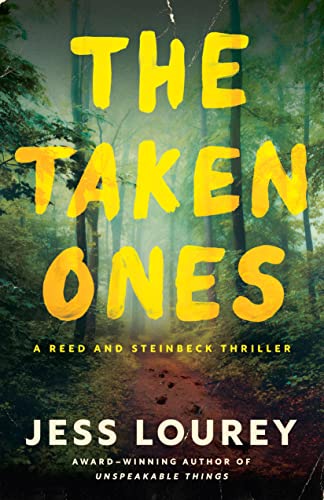
The Taken Ones by Jess Lourey
Published September 2023 via Thomas & Mercer
★★★
Three girls go into the woods—but only one comes out. Decades later, a woman is discovered—minutes too late—buried alive. The cases shouldn't be connected...but it's clear immediately that they are. On the case is Van Reed, a cold case detective with a lot to prove, and things will get messy before they start to make sense...
I find cold cases fascinating—both real-life and fictional—so I'm fond of them in mysteries. This story felt like it had a layer too many, though: Van has a childhood trauma backstory (practically de rigeur in mystery series these days), and there's that thing she did as an adult, and there's the way she was run out of her previous department. Oh, and she's psychic.
Paranormal twists never really do it for me (they take me right out of the story), and I probably wouldn't have read this if I'd known there was the psychic angle. As it is, I think I'll pass on further books in the series; the multiple tragic backstories would have been more than enough, but the psychic thing is just a bridge too far for me. Add to that my dislike of chapters by Evil Villains Who Are Evil, to say nothing of Evil Villains Who Are Evil And Also Clearly Deranged, and this is just not the series for me.
Friday, April 12, 2024
Thursday, April 11, 2024
Review: "The Limits" by Nell Freudenberger
The Limits by Nell Freudenberger
Published April 2024 via Knopf
★★★
It's 2020 in New York, and things are not going especially well. Kate is preparing to parent a baby but not especially prepared to suddenly parent a stepdaughter she's never met. Pia, said stepdaughter, would rather be back in Polynesia. Across town, Athyna is logging in to Kate's English class when she can, but her attention is divided, as she's suddenly been given most of the care duties for her young nephew. And half a world away, in Mo’orea, COVID has barely registered for Nathalie, Pia’s mother, other than to help determine which part of the world Pia will be living in.
The Limits is set during the relatively early days of COVID, partly as a plot device (among other things, COVID gets Stephen out of the apartment and makes Athyna's walls close in on her) and partly as a reminder of different shades of privilege. (It is not lost on me that it is lost on Stephen that his surprise at Athyna being so quiet is—in the context of the scene—implicit racism; nor is it lost on me that it is, again, lost on Stephen that a teenage girl might be uncomfortable being told to spend the night in the house of a man she’s never met.) It’s well written and thoroughly thought out, though readers should go in expecting a relatively slow read. I was a little surprised by how little interaction Kate in particular ends up having with the rest of the characters—they’re all operating, on some level, on their own planes. But I love the push-pull between how we see Kate and how we see Nathalie: neither is the villain in the other’s story, but they’re each a little skeptical of the other, and the way they perceive themselves is contrasted by the way they see each other.
I read this for the description, but rereading that description now, I'm not sure how well the content of the book actually matches it. The description feels aspirational, maybe, in retrospect? Or perhaps like a "find the six items that are different in these pictures" game. The description calls Athyna's nephew a toddler, but in the book he's four (still in need of a ton of attention, but no longer a toddler); in the description, Pia and Kate are in "near total isolation" together, except book-Pia spends as much time as possible outside the apartment, so they rarely interact; and so on. Not quite wrong, and not bad, just...a little off-kilter.
This is a book in which not all that much changes for the characters as they make their way through a few months of COVID-induced uncertainty and events both predictable and unpredictable in their own lives. Maybe they come out a little more jaded or with their eyes a little wider open, but on the whole of it the characters come out of the book as the same people with the same views that they went in with, just with an extra few months of experience. A solid read, if not one that left me deeply invested in what becomes of the characters after the end of the book.
Thanks to the author and publisher for providing a review copy through NetGalley.
Published April 2024 via Knopf
★★★
It's 2020 in New York, and things are not going especially well. Kate is preparing to parent a baby but not especially prepared to suddenly parent a stepdaughter she's never met. Pia, said stepdaughter, would rather be back in Polynesia. Across town, Athyna is logging in to Kate's English class when she can, but her attention is divided, as she's suddenly been given most of the care duties for her young nephew. And half a world away, in Mo’orea, COVID has barely registered for Nathalie, Pia’s mother, other than to help determine which part of the world Pia will be living in.
The Limits is set during the relatively early days of COVID, partly as a plot device (among other things, COVID gets Stephen out of the apartment and makes Athyna's walls close in on her) and partly as a reminder of different shades of privilege. (It is not lost on me that it is lost on Stephen that his surprise at Athyna being so quiet is—in the context of the scene—implicit racism; nor is it lost on me that it is, again, lost on Stephen that a teenage girl might be uncomfortable being told to spend the night in the house of a man she’s never met.) It’s well written and thoroughly thought out, though readers should go in expecting a relatively slow read. I was a little surprised by how little interaction Kate in particular ends up having with the rest of the characters—they’re all operating, on some level, on their own planes. But I love the push-pull between how we see Kate and how we see Nathalie: neither is the villain in the other’s story, but they’re each a little skeptical of the other, and the way they perceive themselves is contrasted by the way they see each other.
I read this for the description, but rereading that description now, I'm not sure how well the content of the book actually matches it. The description feels aspirational, maybe, in retrospect? Or perhaps like a "find the six items that are different in these pictures" game. The description calls Athyna's nephew a toddler, but in the book he's four (still in need of a ton of attention, but no longer a toddler); in the description, Pia and Kate are in "near total isolation" together, except book-Pia spends as much time as possible outside the apartment, so they rarely interact; and so on. Not quite wrong, and not bad, just...a little off-kilter.
This is a book in which not all that much changes for the characters as they make their way through a few months of COVID-induced uncertainty and events both predictable and unpredictable in their own lives. Maybe they come out a little more jaded or with their eyes a little wider open, but on the whole of it the characters come out of the book as the same people with the same views that they went in with, just with an extra few months of experience. A solid read, if not one that left me deeply invested in what becomes of the characters after the end of the book.
Thanks to the author and publisher for providing a review copy through NetGalley.
Tuesday, April 9, 2024
Review: "Between Two Trailers" by J. Dana Trent
Between Two Trailers by J. Dana Trent
Published April 2024 via Convergent Books
★★★★
A preschooler's hands are the perfect size for razor blades, begins Trent. I know because I helped my schizophrenic drug-lord father chop, drop, and traffic kilos in kiddie-ride carcasses across flyover country. (loc. 88*)
There's an opening to capture the attention if ever there was one. Growing up in Indiana, Trent was schooled from a young age in life lessons: if you kill somebody, do it in Vermillion County; there's only so much sugar in the sack; natural elements are the best weapons; never trust a liar. Her father was convinced that these lessons would not just keep her safe but make her strong, and her mother's focus was primarily on ruling the trailer from the nest of sheets and blankets she built up in bed. They loved her—but theirs was not a conventional love.
Dad, too busy to bother with me before I could walk, used duct tape to fasten my hands to my baby bottle filled with chocolate milk. I sat on the kitchen counter by him all day, lifting that duct-taped bottle to my mouth and catching his marijuana exhales as weed ash fell onto his open King James Bible. (loc. 113)
Between Two Trailers sees Trent through those young years of drug-running in Indiana (the right age for those kiddie rides: "That ain't no toy!" her father yelled (loc. 1033)) and off to North Carolina, where her mother relocated the two of them on a whim. A trailer her mother called a shotgun house because if our enemies sent twelve-gauge buckshot through the kitchen window, we'd drop like dominoes (loc. 103); ceiling tiles razored to pieces as her father searched for government bugs; apartments in North Carolina subsidized by the extended family as her mother's fortunes—and get-up-and-go—fluctuated.
It is King and the Lady, as Trent refers to her parents throughout the book, who set the scene and rule the roost throughout the book. King and the Lady who define what normal is throughout Trent's childhood and King and the Lady who compete for Trent's affections and future. The book slows down a bit as Trent gets older and dives headfirst into as ordinary a life as she can create for herself and as she moves away from the lessons of her childhood. It's clear, though, that however complicated a childhood it was (and oh man—it was complicated), Trent has come to make peace with that childhood and to embrace her parents for who they were.
Thanks to the author and publisher for inviting me to review this title through NetGalley.
*Quotes are from an ARC and pay not be final.
Published April 2024 via Convergent Books
★★★★
A preschooler's hands are the perfect size for razor blades, begins Trent. I know because I helped my schizophrenic drug-lord father chop, drop, and traffic kilos in kiddie-ride carcasses across flyover country. (loc. 88*)
There's an opening to capture the attention if ever there was one. Growing up in Indiana, Trent was schooled from a young age in life lessons: if you kill somebody, do it in Vermillion County; there's only so much sugar in the sack; natural elements are the best weapons; never trust a liar. Her father was convinced that these lessons would not just keep her safe but make her strong, and her mother's focus was primarily on ruling the trailer from the nest of sheets and blankets she built up in bed. They loved her—but theirs was not a conventional love.
Dad, too busy to bother with me before I could walk, used duct tape to fasten my hands to my baby bottle filled with chocolate milk. I sat on the kitchen counter by him all day, lifting that duct-taped bottle to my mouth and catching his marijuana exhales as weed ash fell onto his open King James Bible. (loc. 113)
Between Two Trailers sees Trent through those young years of drug-running in Indiana (the right age for those kiddie rides: "That ain't no toy!" her father yelled (loc. 1033)) and off to North Carolina, where her mother relocated the two of them on a whim. A trailer her mother called a shotgun house because if our enemies sent twelve-gauge buckshot through the kitchen window, we'd drop like dominoes (loc. 103); ceiling tiles razored to pieces as her father searched for government bugs; apartments in North Carolina subsidized by the extended family as her mother's fortunes—and get-up-and-go—fluctuated.
It is King and the Lady, as Trent refers to her parents throughout the book, who set the scene and rule the roost throughout the book. King and the Lady who define what normal is throughout Trent's childhood and King and the Lady who compete for Trent's affections and future. The book slows down a bit as Trent gets older and dives headfirst into as ordinary a life as she can create for herself and as she moves away from the lessons of her childhood. It's clear, though, that however complicated a childhood it was (and oh man—it was complicated), Trent has come to make peace with that childhood and to embrace her parents for who they were.
Thanks to the author and publisher for inviting me to review this title through NetGalley.
*Quotes are from an ARC and pay not be final.
Monday, April 8, 2024
Review: "Sisters of the Sky" by Lana Kortchik
Sisters of the Sky by Lana Kortchik
Published February 2024 via HQ Digital
★★★
War is upon the Soviet Union, and there’s nothing Nina can do about it—until a women’s aviation regiment is formed, and she has the chance to join. War was personal before, but now it is desperately, painfully close, with not only Nina’s family to worry about but also her new regiment.
I’m familiar with Raskova’s regiment because of other books, and I’ve always found it fascinating—there were so many problems with the Soviet Union, but they were also the only major player in WWII (I don’t know about minor players) allowing women to fly in combat (or just more generally to take combat roles).
Plot-wise, the book does sometimes feel like it’s trying to hit all of the known key points from this regiment rather than focusing more closely on a specific experience. Nina is right in the thick of things, learning to respect (and earning the respect of) Raskova and staunchly optimistic about the importance of their flights even as her best friend’s courage crumbles. In some ways I think Katya’s experience is more relatable, and more interesting: it’s not exactly uncommon to see stories of people who are heroic and brave and willing to put it all on the line; Katya, meanwhile, is so clearly miserable to be away from her young daughter, to say nothing of her peacetime life, and while she’s treated as less brave (and certainly less fun to be around), I have to say that I…can’t blame her. Even as a non-parent I have to think that the decision to leave your child in the middle of a devastating war (with not just violence to worry about but also starvation, etc.) to go fly perilously dangerous missions (with no guarantee of return, or time frame for return) would be…difficult. Katya’s not a particularly sympathetic character, and hers is not a story that usually gets told, but hers is the story that might resonate most.
The book is more about friendship than about romance, but there is a romance thread. I ended up wishing that instead of that thread, and all its messy tangles, we’d had more about the other women in Nina’s squadron. We get a bit about them, of course, but other than Katya they largely stay out of focus. Still, I always love seeing more about this bit of history and the stories that don’t always make it out of the footnotes of history books.
Published February 2024 via HQ Digital
★★★
War is upon the Soviet Union, and there’s nothing Nina can do about it—until a women’s aviation regiment is formed, and she has the chance to join. War was personal before, but now it is desperately, painfully close, with not only Nina’s family to worry about but also her new regiment.
I’m familiar with Raskova’s regiment because of other books, and I’ve always found it fascinating—there were so many problems with the Soviet Union, but they were also the only major player in WWII (I don’t know about minor players) allowing women to fly in combat (or just more generally to take combat roles).
Plot-wise, the book does sometimes feel like it’s trying to hit all of the known key points from this regiment rather than focusing more closely on a specific experience. Nina is right in the thick of things, learning to respect (and earning the respect of) Raskova and staunchly optimistic about the importance of their flights even as her best friend’s courage crumbles. In some ways I think Katya’s experience is more relatable, and more interesting: it’s not exactly uncommon to see stories of people who are heroic and brave and willing to put it all on the line; Katya, meanwhile, is so clearly miserable to be away from her young daughter, to say nothing of her peacetime life, and while she’s treated as less brave (and certainly less fun to be around), I have to say that I…can’t blame her. Even as a non-parent I have to think that the decision to leave your child in the middle of a devastating war (with not just violence to worry about but also starvation, etc.) to go fly perilously dangerous missions (with no guarantee of return, or time frame for return) would be…difficult. Katya’s not a particularly sympathetic character, and hers is not a story that usually gets told, but hers is the story that might resonate most.
The book is more about friendship than about romance, but there is a romance thread. I ended up wishing that instead of that thread, and all its messy tangles, we’d had more about the other women in Nina’s squadron. We get a bit about them, of course, but other than Katya they largely stay out of focus. Still, I always love seeing more about this bit of history and the stories that don’t always make it out of the footnotes of history books.
Sunday, April 7, 2024
Review: "The Morning After" by Kate William (created by Francine Pascal)
The Morning After by Kate William (created by Francine Pascal)
Published 1993
★★★
Well. I've jumped back in eighty or ninety books down the line, because I remember this mini-series about Margot the Psychopath (as opposed to Jessica the Sociopath), and...I don't have a lot of readerly self-control. So here we are. Spoilers below, if you're worried about, you know, spoilers for book 95 of a series published thirty years ago.
The Morning After opens not too long after a terrible prom-night car accident that may or may not have taken place in a previous book. (I can't find mention of it in the previous books' descriptions, but you never know—Sweet Valley is absolutely enough of a soap opera setting that it's possible that a new-stepsister-for-a-side-character could be a main plot and a car accident that kills Jessica's One True Love could be the B plot.) It's not entirely clear what happened, just that Elizabeth might or might not have been driving, and now Sam is dead, and Jessica blames Elizabeth wholeheartedly...even though Jessica knows things about that night that even Elizabeth doesn't know.
No, Jessica told herself. Don't think about Liz. Elizabeth had been driving the Jeep that night. What happened before they got in the car didn't make any difference. It was Elizabeth who killed him. (107)
Guys. Jessica does not even speak up to tell the truth when Elizabeth is arrested for manslaughter. Partly because she's scared of the consequences, but also because she's still mad at Elizabeth for "stealing" Jessica's boyfriend—read: for leaving the dance with him. Is there any evidence that Elizabeth and Sam were romantically involved? Nope. Would anyone who's ever met Elizabeth reasonably think her capable of trying to "steal" Jessica's boyfriend without perishing of guilt? Nope. Would anyone, including Elizabeth, doubt that trying to do so anyway would result in Jessica promptly shoving Elizabeth into a busy highway? Nope. Has Jessica repeatedly tried to steal Elizabeth's boyfriend? Of course. (Elizabeth's boyfriend Todd, incidentally, is as usual inclined to believe the worst of Elizabeth and has been avoiding her instead of, oh, showing any sympathy for the fact that she was just in a deadly car accident and may or may not have been behind the wheel.)
Anyway. Side plots abound: Lila is still very traumatized from attempted rape in what looks like book 90, but when she is further traumatized, the general opinion at school is...well. Bruce suspected she had made the whole thing up; Lila had always been a tease (9). Honestly, the slut-shaming and trauma-shaming in this series is unreal; later, when Amy hears who Bruce is "in love" (in the most 1990s teenaged sense of the word) with, this is her reaction: "Do I know her? Everybody knows Pamela, if you know what I mean!" She winked at Maria, who rolled her eyes (93). This is extremely on-brand for the series (remember book 1, when Jessica let everyone think that Elizabeth had gone out with a Bad Boy and come home in a police car, and everyone—including Todd—decided Elizabeth was a slutty slut who deserved every bad thing that came her way?), but good god. Never mind that Bruce is perfectly happy to sleep around himself, or that he has only been on about two dates with this girl—when he hears that she's not pure as driven snow, he casts her off as another slutty slut and spends the rest of the book (and at least half of the next one; stay tuned) feeling butt-hurt about it.
Sigh.
And then we get Margot. Margot, who is a pretty minor part of the book but the whole reason I am rereading this little mini-series. I'd actually forgotten that the A plot here is about Elizabeth being arrested for manslaughter—what I remember is Margot smirking as she encourages her foster sister to dig a butter knife into the toaster and thus set the house on fire. This is not a girl you want to mess with, because Margot wants what she wants...and she's willing (nay, happy) to kill to get it.
Published 1993
★★★
Well. I've jumped back in eighty or ninety books down the line, because I remember this mini-series about Margot the Psychopath (as opposed to Jessica the Sociopath), and...I don't have a lot of readerly self-control. So here we are. Spoilers below, if you're worried about, you know, spoilers for book 95 of a series published thirty years ago.
The Morning After opens not too long after a terrible prom-night car accident that may or may not have taken place in a previous book. (I can't find mention of it in the previous books' descriptions, but you never know—Sweet Valley is absolutely enough of a soap opera setting that it's possible that a new-stepsister-for-a-side-character could be a main plot and a car accident that kills Jessica's One True Love could be the B plot.) It's not entirely clear what happened, just that Elizabeth might or might not have been driving, and now Sam is dead, and Jessica blames Elizabeth wholeheartedly...even though Jessica knows things about that night that even Elizabeth doesn't know.
No, Jessica told herself. Don't think about Liz. Elizabeth had been driving the Jeep that night. What happened before they got in the car didn't make any difference. It was Elizabeth who killed him. (107)
Guys. Jessica does not even speak up to tell the truth when Elizabeth is arrested for manslaughter. Partly because she's scared of the consequences, but also because she's still mad at Elizabeth for "stealing" Jessica's boyfriend—read: for leaving the dance with him. Is there any evidence that Elizabeth and Sam were romantically involved? Nope. Would anyone who's ever met Elizabeth reasonably think her capable of trying to "steal" Jessica's boyfriend without perishing of guilt? Nope. Would anyone, including Elizabeth, doubt that trying to do so anyway would result in Jessica promptly shoving Elizabeth into a busy highway? Nope. Has Jessica repeatedly tried to steal Elizabeth's boyfriend? Of course. (Elizabeth's boyfriend Todd, incidentally, is as usual inclined to believe the worst of Elizabeth and has been avoiding her instead of, oh, showing any sympathy for the fact that she was just in a deadly car accident and may or may not have been behind the wheel.)
Anyway. Side plots abound: Lila is still very traumatized from attempted rape in what looks like book 90, but when she is further traumatized, the general opinion at school is...well. Bruce suspected she had made the whole thing up; Lila had always been a tease (9). Honestly, the slut-shaming and trauma-shaming in this series is unreal; later, when Amy hears who Bruce is "in love" (in the most 1990s teenaged sense of the word) with, this is her reaction: "Do I know her? Everybody knows Pamela, if you know what I mean!" She winked at Maria, who rolled her eyes (93). This is extremely on-brand for the series (remember book 1, when Jessica let everyone think that Elizabeth had gone out with a Bad Boy and come home in a police car, and everyone—including Todd—decided Elizabeth was a slutty slut who deserved every bad thing that came her way?), but good god. Never mind that Bruce is perfectly happy to sleep around himself, or that he has only been on about two dates with this girl—when he hears that she's not pure as driven snow, he casts her off as another slutty slut and spends the rest of the book (and at least half of the next one; stay tuned) feeling butt-hurt about it.
Sigh.
And then we get Margot. Margot, who is a pretty minor part of the book but the whole reason I am rereading this little mini-series. I'd actually forgotten that the A plot here is about Elizabeth being arrested for manslaughter—what I remember is Margot smirking as she encourages her foster sister to dig a butter knife into the toaster and thus set the house on fire. This is not a girl you want to mess with, because Margot wants what she wants...and she's willing (nay, happy) to kill to get it.
Saturday, April 6, 2024
Children's books: Parents: "Always Carry Me with You", "I Love You", and "Call Your Mother"
Always Carry Me with You by Hervé Éparvier, illustrated by Fred Benaglia (Ivy Kids Echo)
I Love You by Mary Murphy (Happy Yak)
Call Your Mother by Tracy C. Gold, illustrated by Vivian Mineker (Familius)
Always Carry Me with You
I'm not sure if this is a science lesson hidden within a love letter or a love letter hidden within a science lesson, but either way, it works. In Always Carry Me with You, a father tells his daughter all sorts of cool things about rocks...and then compares his love for her to a rock, something she can carry in her pocket as a reminder that it's there.
It's sweet any way you slice it, but honestly, the first audience I thought about for this was children whose parents are terminally ill or otherwise facing an uncertain future. I don't mean this in a maudlin way (and obviously the book is perfectly appropriate in happier contexts!), but I imagine that one thing you'd want to do in that scenario is find ways to support your kid even after you're gone...which might include giving them a way to carry your love with them. (Just, uh. Make sure they know that it's not just one specific pebble that'll do the job. Kids lose things. Adults lose things.)
The drawings are playful (and somehow feel very French?), with more than enough whimsy to keep kids looking. The font feels like an afterthought, but that seems like a pretty minor objection, all things considered.
I Love You
What a sweet book. Reminiscent of "My Favorite Things" from "The Sound of Music", I Love You shows an adult and a baby panda romping through fun activities—each of which is a new way to tell the baby panda that it is loved. I love you like / a crayon drawing dragons, promises the book, and in turn I love the creativity that has gone into each choice.
The illustrations here are simple but high-contrast, with enough detail to keep readers entertained...and pandas that look truly snuggly. This is definitely one to be read aloud—young readers might enjoy it alone, of course, but it'll be at its best when it's not a solo endeavor; I'm willing to bet that the author made a point to read this aloud throughout the process of writing to check the flow and rhythm of the book. An excellent addition to an early reader's bookshelf.
Call Your Mother
You know the refrain here already: Call Your Mother. This deceptively simple picture book takes readers through a series of times a child might call its mother—from infancy (I don't have kids, but the exhausted mother stumbling in in the wee hours of the morning made me laugh with sympathy) through to schoolday nerves (my gosh that hug looks cozy) and into adulthood.
I think parts of this will resonate better with adults, who can perhaps remember each of these sorts of incidents better than a young reader can imagine, but I can also easily see it as a way to remind an anxious kid that their parent(s) will (...barring the unexpected, but maybe an anxious five-year-old doesn't need to hear that...) be there for them as they grow and age, in good times and in bad. My favorite illustration, far and away, is a variation on the cover illustration, but the whole thing is neatly done, with clean and soft lines. Would absolutely put this one on a young kid's shelves.
Thanks to the authors and publishers for providing review copies through NetGalley.
I Love You by Mary Murphy (Happy Yak)
Call Your Mother by Tracy C. Gold, illustrated by Vivian Mineker (Familius)
Always Carry Me with You
I'm not sure if this is a science lesson hidden within a love letter or a love letter hidden within a science lesson, but either way, it works. In Always Carry Me with You, a father tells his daughter all sorts of cool things about rocks...and then compares his love for her to a rock, something she can carry in her pocket as a reminder that it's there.
It's sweet any way you slice it, but honestly, the first audience I thought about for this was children whose parents are terminally ill or otherwise facing an uncertain future. I don't mean this in a maudlin way (and obviously the book is perfectly appropriate in happier contexts!), but I imagine that one thing you'd want to do in that scenario is find ways to support your kid even after you're gone...which might include giving them a way to carry your love with them. (Just, uh. Make sure they know that it's not just one specific pebble that'll do the job. Kids lose things. Adults lose things.)
The drawings are playful (and somehow feel very French?), with more than enough whimsy to keep kids looking. The font feels like an afterthought, but that seems like a pretty minor objection, all things considered.
I Love You
What a sweet book. Reminiscent of "My Favorite Things" from "The Sound of Music", I Love You shows an adult and a baby panda romping through fun activities—each of which is a new way to tell the baby panda that it is loved. I love you like / a crayon drawing dragons, promises the book, and in turn I love the creativity that has gone into each choice.
The illustrations here are simple but high-contrast, with enough detail to keep readers entertained...and pandas that look truly snuggly. This is definitely one to be read aloud—young readers might enjoy it alone, of course, but it'll be at its best when it's not a solo endeavor; I'm willing to bet that the author made a point to read this aloud throughout the process of writing to check the flow and rhythm of the book. An excellent addition to an early reader's bookshelf.
Call Your Mother
You know the refrain here already: Call Your Mother. This deceptively simple picture book takes readers through a series of times a child might call its mother—from infancy (I don't have kids, but the exhausted mother stumbling in in the wee hours of the morning made me laugh with sympathy) through to schoolday nerves (my gosh that hug looks cozy) and into adulthood.
I think parts of this will resonate better with adults, who can perhaps remember each of these sorts of incidents better than a young reader can imagine, but I can also easily see it as a way to remind an anxious kid that their parent(s) will (...barring the unexpected, but maybe an anxious five-year-old doesn't need to hear that...) be there for them as they grow and age, in good times and in bad. My favorite illustration, far and away, is a variation on the cover illustration, but the whole thing is neatly done, with clean and soft lines. Would absolutely put this one on a young kid's shelves.
Thanks to the authors and publishers for providing review copies through NetGalley.
Friday, April 5, 2024
Review: "Just Perfect" by Hanne Arts
Just Perfect by Hanne Arts
Published 2014 via CreateSpace
★★
A valiant effort but the work of a relatively new writer. Just Perfect is trying to cover a lot of topics—bullying; family dysfunction and alcoholism; teenage relationships; anorexia. Unfortunately it struggles to hold on to more than one of these threads at a time, leaving the work feeling full of loose ends. Christina's eating disorder (which appears more or less out of nowhere, with her feeling no effects and attracting no attention until she is at a heart-could-stop-any-minute low weight) is a mix of On Death's Door and wildly incompetent care à la 'Well, you're perilously unwell but you can probably handle this at home on your own, hmm?' Consistent with a lot of teenage writing (consistent with my writing when I was a teenager), Christina's voice leans heavily into angst.
I see that there's a sequel—I will not be seeking it out, but hopefully it has a bit more balance.
Published 2014 via CreateSpace
★★
A valiant effort but the work of a relatively new writer. Just Perfect is trying to cover a lot of topics—bullying; family dysfunction and alcoholism; teenage relationships; anorexia. Unfortunately it struggles to hold on to more than one of these threads at a time, leaving the work feeling full of loose ends. Christina's eating disorder (which appears more or less out of nowhere, with her feeling no effects and attracting no attention until she is at a heart-could-stop-any-minute low weight) is a mix of On Death's Door and wildly incompetent care à la 'Well, you're perilously unwell but you can probably handle this at home on your own, hmm?' Consistent with a lot of teenage writing (consistent with my writing when I was a teenager), Christina's voice leans heavily into angst.
I see that there's a sequel—I will not be seeking it out, but hopefully it has a bit more balance.
Thursday, April 4, 2024
Review: "Every Time You Hear That Song" by Jenna Voris
Every Time You Hear That Song by Jenna Voris
Published April 2024 via Viking Books for Young Readers
★★★★
She told me it was okay to take it slow, that everyone learns at their own pace, but my pace is wildfire. My pace is lightning and luck and all the desperate longing of the universe. (loc. 161*)
In the early 1960s, Decklee has a dream, and she'll do anything to make it come true—even if that means losing everyone she loves.
People never talked about Decklee Cassel being from Mayberry unless it was to compliment her for getting out, because here's the truth: no one cares about towns like this until they're behind you. (loc. 238)
And in the present day, Darren is convinced that she's made for more than Mayberry, the same small town Decklee grew up in. She won't destroy everything in her path to get out...but she will go on a quest to find Decklee's last album, which could be enough to jumpstart her dreams.
I'd just listened to an interview with Dolly Parton when I read this, and so that's the voice that I heard Decklee's sections in (yes, yes, I know that a Tennessee accent is not the same as an Arkansas accent). Decklee is not Dolly Parton, though: she may have faced some of the same barriers—poverty, being a woman in a male-dominated industry in a male-dominated culture, people assuming that a Southern accent means lack of intelligence, people assuming that being blonde means lack of intelligence—but Decklee's stratospheric rise is, by necessity, grasping and calculated. She has the goods—but she needs every advantage to deliver on them.
It keeps Decklee from being an entirely sympathetic character, but that's what I loved most about the book. Darren's story is much more standard YA fare: there's a boy, a minor identity crisis, a journalism dream, some family concerns. Darren is much more easily likeable because we've all been there, one way or another. Decklee, though, raises hard questions about just how much a dream is worth—are there things you would not willingly give up? Is her dream worth it, in the end?
I would have liked to spend more time with Decklee, because there's an extent to which her voice is more distant, less possible to get a full read on. I wouldn't mind a follow-up book about Mickenlee, either—she's far more sympathetic but also less fleshed out, and there is much about her story that remains a mystery in this book. I can hope...
Thanks to the author and publisher for providing a review copy through NetGalley.
*I read an ARC, and quotes may not be final.
Published April 2024 via Viking Books for Young Readers
★★★★
She told me it was okay to take it slow, that everyone learns at their own pace, but my pace is wildfire. My pace is lightning and luck and all the desperate longing of the universe. (loc. 161*)
In the early 1960s, Decklee has a dream, and she'll do anything to make it come true—even if that means losing everyone she loves.
People never talked about Decklee Cassel being from Mayberry unless it was to compliment her for getting out, because here's the truth: no one cares about towns like this until they're behind you. (loc. 238)
And in the present day, Darren is convinced that she's made for more than Mayberry, the same small town Decklee grew up in. She won't destroy everything in her path to get out...but she will go on a quest to find Decklee's last album, which could be enough to jumpstart her dreams.
I'd just listened to an interview with Dolly Parton when I read this, and so that's the voice that I heard Decklee's sections in (yes, yes, I know that a Tennessee accent is not the same as an Arkansas accent). Decklee is not Dolly Parton, though: she may have faced some of the same barriers—poverty, being a woman in a male-dominated industry in a male-dominated culture, people assuming that a Southern accent means lack of intelligence, people assuming that being blonde means lack of intelligence—but Decklee's stratospheric rise is, by necessity, grasping and calculated. She has the goods—but she needs every advantage to deliver on them.
It keeps Decklee from being an entirely sympathetic character, but that's what I loved most about the book. Darren's story is much more standard YA fare: there's a boy, a minor identity crisis, a journalism dream, some family concerns. Darren is much more easily likeable because we've all been there, one way or another. Decklee, though, raises hard questions about just how much a dream is worth—are there things you would not willingly give up? Is her dream worth it, in the end?
I would have liked to spend more time with Decklee, because there's an extent to which her voice is more distant, less possible to get a full read on. I wouldn't mind a follow-up book about Mickenlee, either—she's far more sympathetic but also less fleshed out, and there is much about her story that remains a mystery in this book. I can hope...
Thanks to the author and publisher for providing a review copy through NetGalley.
*I read an ARC, and quotes may not be final.
Wednesday, April 3, 2024
Review: Short story: "Lovers at the Museum" by Isabel Allende
Lovers at the Museum by Isabel Allende
Published April 2024 via Amazon Original Stories
It's been too long since I read any Isabel Allende. In "Lovers at the Museum", a man and a woman are awoken at (you guessed it) a museum. They've clearly been there overnight, but nobody is sure just how—how did they evade the guards, the alarms? They haven't stolen or broken anything, so is there a crime with which to charge them?
Allende is known for her magical realism, and true to form, there are more questions than answers here. We're left to fill in the blanks, to believe or not believe what Bibiña and Indar have to say about what happened the night before. The story drifts along, and not all that much happens, but it doesn't really matter because it's so clear that Allende is in control of the narrative (even if the local police wished otherwise). I suspect that if I had a different cultural context or education, I'd make even more connections here, so I'll be curious to see what other readers make of it.
Either way, a reminder to go update my TBR!
Thanks to the author and publisher for providing a review copy through NetGalley.
Published April 2024 via Amazon Original Stories
It's been too long since I read any Isabel Allende. In "Lovers at the Museum", a man and a woman are awoken at (you guessed it) a museum. They've clearly been there overnight, but nobody is sure just how—how did they evade the guards, the alarms? They haven't stolen or broken anything, so is there a crime with which to charge them?
Allende is known for her magical realism, and true to form, there are more questions than answers here. We're left to fill in the blanks, to believe or not believe what Bibiña and Indar have to say about what happened the night before. The story drifts along, and not all that much happens, but it doesn't really matter because it's so clear that Allende is in control of the narrative (even if the local police wished otherwise). I suspect that if I had a different cultural context or education, I'd make even more connections here, so I'll be curious to see what other readers make of it.
Either way, a reminder to go update my TBR!
Thanks to the author and publisher for providing a review copy through NetGalley.
Tuesday, April 2, 2024
Review: "Fi" by Alexandra Fuller
Fi by Alexandra Fuller
Published April 2024 via Grove Press
★★★★
All parents who hear of Fi's death have told me this: I wouldn't survive the death of my child, as if my child's death must therefore have been a lesser death than the death of their child would be. Or me, as if I must be a less grief-stricken parent than they would be, if it happened to them. I tell them that I didn't survive and also that I did. Both things happened. (loc. 1358*)
Alexandra Fuller was still grieving the loss of her father when the unthinkable happened—her son Fi died suddenly, unexpectedly, still in the prime of his youth. And Fuller came undone, because what else can you do when that happens?
This is a grief memoir—full stop. Fuller is a hell of a writer, which is not news. Here she spills herself broken onto the page: questioning how she can possibly be expected to survive, pulling from book after book and writer after writer to articulate the depths of her loss and apply balm to her soul. She takes to the mountains and the sky, to the ocean and a grief retreat and a meditation retreat, not in some sort of targeted quest but because the only thing she can do is give her life over to grief, and to find new rhythms for it.
It's worse in town, in the condo, my restlessness, my panic. Only the wild—even the scorched, diminished, smoke-hazed wild—seems conducive to my unwieldy grief. Grand enough to be the grief, to soak up the grief, to reflect it back at me, my feelings as thunder, wind, wildfire. In the mountains, I'd understood the warp and weft of my grief; I'd accepted its weather. In the mountains my grief was shouted back at me with praise and with majesty, in the oldest, most sovereign sense of that word. (loc. 1628)
I have not read Travel Light, Move Fast, Fuller's memoir about her father's death, but Fi died when she was partway through writing it, and there's no way on earth that that didn't reset the shape of that book. Someday I'll pick that up too, because I'm curious about how they overlap and how they don't, and also because I don't think it's possible for Fuller to write a book that is anything other than dramatic and sharp and so vivid it hurts.
Thanks to the author and publisher for providing a review copy through NetGalley.
*I read an ARC, and quotes may not be final.
Published April 2024 via Grove Press
★★★★
All parents who hear of Fi's death have told me this: I wouldn't survive the death of my child, as if my child's death must therefore have been a lesser death than the death of their child would be. Or me, as if I must be a less grief-stricken parent than they would be, if it happened to them. I tell them that I didn't survive and also that I did. Both things happened. (loc. 1358*)
Alexandra Fuller was still grieving the loss of her father when the unthinkable happened—her son Fi died suddenly, unexpectedly, still in the prime of his youth. And Fuller came undone, because what else can you do when that happens?
This is a grief memoir—full stop. Fuller is a hell of a writer, which is not news. Here she spills herself broken onto the page: questioning how she can possibly be expected to survive, pulling from book after book and writer after writer to articulate the depths of her loss and apply balm to her soul. She takes to the mountains and the sky, to the ocean and a grief retreat and a meditation retreat, not in some sort of targeted quest but because the only thing she can do is give her life over to grief, and to find new rhythms for it.
It's worse in town, in the condo, my restlessness, my panic. Only the wild—even the scorched, diminished, smoke-hazed wild—seems conducive to my unwieldy grief. Grand enough to be the grief, to soak up the grief, to reflect it back at me, my feelings as thunder, wind, wildfire. In the mountains, I'd understood the warp and weft of my grief; I'd accepted its weather. In the mountains my grief was shouted back at me with praise and with majesty, in the oldest, most sovereign sense of that word. (loc. 1628)
I have not read Travel Light, Move Fast, Fuller's memoir about her father's death, but Fi died when she was partway through writing it, and there's no way on earth that that didn't reset the shape of that book. Someday I'll pick that up too, because I'm curious about how they overlap and how they don't, and also because I don't think it's possible for Fuller to write a book that is anything other than dramatic and sharp and so vivid it hurts.
Thanks to the author and publisher for providing a review copy through NetGalley.
*I read an ARC, and quotes may not be final.
Subscribe to:
Posts (Atom)
Children's books: Deutsch II: "Ein Herz für Elefanten", "Sturmgefühle, Schattenbilder", und "Bagger Bens Tag am Meer"
Ein Herz für Elefanten von R.G. de Rouen Sturmgefühle, Schattenbilder von Michelle Müller-Nagy (Verlag Monika Fuchs) Bagger Bens Tag am Me...
-
The Ferryman and His Wife by Frode Grytten, translated from the Norwegian by Alison McCullough Published November 2025 via Algonquin Books ★...
-
The Keeper by Tana French Published March 2026 via Viking ★★★★ Book three—of three—in the Cal Hooper series. Time has passed: Trey is growin...
-
Three Ordinary Girls by Tim Brady Published February 2021 via Citadel Press ★★★ For all that I've heard about the strength of the Dutch ...


