Wednesday, May 7, 2025

Review: "A Sharp Endless Need" by Marisa Crane


A Sharp Endless Need by Marisa Crane
Published May 2025 via The Dial Press
★★★


It was as if we'd been playing together our entire lives. We didn't even have to say anything; we knew when the other's blood was hot with fury. We were alone together; we were a crowd all our own. We were ethereal; we were of the world. We were untouchable; we were touching each other all the time, with every pass, every play, every time-out, every steal. (loc. 1339*)

Another time and another place: When Mack and Liv meet, it's an instant connection. They're both basketball players with Division I dreams and the skills to back it up. The air sizzles between them, on and off the court. But: It's a different time. Liv has a boyfriend; heterosexuality is the only option that has ever been modelled for them; Mack, too, is unwilling to take that first step out of bounds.

This is set in 2004, putting Mack in her last year of high school around the same time I was in mine (though I was a sports-averse nerd, and Mack sees college primarily as a vehicle to play basketball at a higher level). The year is there in the details: Mack and her mother share a flip phone; communication via AIM (or AIM away status) is the norm; social media isn't yet a thing, but word gets around anyway. Word always gets around.

For whatever reason, most of the basketball books I've read have been about queer girls figuring it out. This reminds me strongly of Nina Revoyr's The Necessary Hunger, which remains one of the best queer-girls-figuring-it-out books I know and also features characters whose lives revolve around the next basket. Different settings, different time periods, different plots, of course. But both of them with this push-pull of will they and won't they and how much does it cost to put yourself forward, to be open about want.

There are a few things here that I'm still puzzling over after finishing the book (what was up with Liv's father? And the end—where does that leave them, both individually and together?), and I think I might have liked a slower timeline—Mack and Liv have one of those teenage relationships (platonic/romantic/sexual, doesn't matter) that burns so bright and so fast that it's clear that something will have to give—but this makes for a dynamic coming-of-age story.

Thanks to the author and publisher for inviting me to read a review copy through NetGalley.

Monday, May 5, 2025

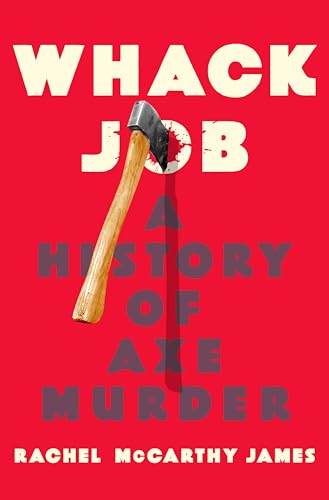
Review: "Whack Job" by Rachel McCarthy James

Whack Job by Rachel McCarthy James
Published May 2025 via St. Martin's Press
★★★★


When the author says, in the introduction, Early on in the process of writing my first book about axe murder (loc. 17*), you know you're in for a ride.

This calls itself a history of axe murder, but I don't think that's quite right—it's more that this is a romp through various historical axe murders, with a lot of discussion of why axes used to be more common (and thus more likely to be used in murder) and what they meant about social status and how the term "axe murderer" came about. The specific stories range from ones I've never heard of (I'm not up on my Viking history, nor really my ancient Egyptian history) to famous cases (Lizzie Borden, anyone?) to just really devastating cases. I found that my interest increased as the book went on, partly because I just don't have that much interest in ancient history and partly because the more recent stories simply have so much more that is known—even when a lot of what is known about, say, the Borden case is just how much went wrong in the investigations.

The energy here is high: Don't go in expecting to come out an expert in axe murder, but do expect chapters that end with a lead-in to the next chapter, making it hard to put the book down for the night. This is one to read for entertainment purposes rather than for research purposes (though the endnotes might get you somewhere with the latter), but if you like your entertainment with a side of axe murder, this will do you well.

Thanks to the author and publisher for providing a review copy through NetGalley.

*Quotes are from an ARC and may not be final.

Sunday, May 4, 2025

Review: "Sunrise on the Reaping" by Suzanne Collins

Sunrise on the Reaping by Suzanne Collins
Published March 2025 via Scholastic Press
★★★★


Back a quarter century before the first Hunger Games book, and here we go: Haymitch's story. I reread the original trilogy, plus read the first prequel for the first time, in advance of Sunrise on the Reaping's release, so the books were much fresher in my mind than they would have been otherwise. (Make no mistake: I managed to forget a lot of crucial details anyway. But it helped.)

In the original trilogy, Haymitch is something of a bad-tempered alcoholic. It's so obvious that he gave up years ago—in two and a half decades of mentoring tributes in the Hunger Games, none of those tributes has ever come home. Even if he'd started out fresh and eager (as opposed to, say, fresh off the trauma of being subjected to the Hunger Games himself), mentoring child after child to their death, year after year, would be enough to drive anyone to the bottle.

But this is not that story: this is Haymitch as a sixteen-year-old, one whose odds put him in the arena. And you know...I'm mostly not going to talk about what happens in that arena, because you can read the book (or probably one of many extensive breakdowns that has already been written) to find out what happens there. What interests me more are the choices Collins must have had to make here. We see some of Haymitch's story already in the original trilogy, so Collins had to make sure that whatever was in this book was—one way or another—consistent with those nuggets. She's also made a concerted effort to bring in as many recurring characters as possible: Snow, of course, and Effie Trinket, and other people Katniss knows. This is Haymitch's backstory, but it's also a backstory for a number of other recurring characters. (Though I'm not as much a fan of the Covey story—felt a bit too similar to that in The Ballad of Songbirds and Snakes.) It leaves me wondering how long Collins had these backstories in mind, and how much she must have had to figure out later down the line.

The other thing this made me realize: Haymitch is so young. He's 16 at these 50th Hunger Games; by the time Katniss's Games roll around (the 74th), he'd be only 40. A reminder of how much trauma and hard lives can age a person, I guess. (Also—it strikes me that statistically speaking, there's a good chance that at some point there would have been a teenage parent or two drawn for the Hunger Games. I can see why Collins wouldn't want to add that to the mix, if she even considered it, but another reminder of how many people are affected by war. Well, and also that even the Hunger Games books have their moments of sanitizing for a teenaged audience.)

Overall, an unsurprisingly wildly depressing book but a satisfying one.

Saturday, May 3, 2025

Review: "The Ballad of Songbirds and Snakes" by Suzanne Collins

The Ballad of Songbirds and Snakes by Suzanne Collins
Published May 2020 via Scholastic Press
★★★


With a new Hunger Games prequel on my radar, it was time for two things: to reread the original trilogy, and to give the first prequel a go.

This was previously only vaguely on my radar. I'm not sure why, but although I sped through the original trilogy when it came out, I pretty much ignored Ballad—perhaps because I'm not usually all that interested in prequels, or perhaps because I'm not all that interested in reading the blatant villain's side of the story. (Snow does not, you know, come off all too well in the originals.)

So Collins had a difficult task here: to take a villain and give him an origin story that keeps him a villain but also makes him relatable enough, or sympathetic enough, to keep readers hanging on throughout the book. By and large I think Collins succeeds, but what interests me most is not Snow (I can never quite forget that he starts out rather grasping and turns into a tyrant) but the look back into the early days of the Hunger Games. Because these are Hunger Games unlike the ones Katniss survived: no costume designers or feasts, no preparation—just children locked in animal cages at the zoo and then thrown in the ruins of a stadium to (most likely) die a violent death. Snow and his classmates are the first "mentors" (a role that is primarily about their own clout and has almost nothing to do with actual mentoring), and they are instrumental in shaping what the Games will become.

I probably won't be returning to this, but it made for a fascinating addition to the lore. Will have to see what Haymitch's story brings.

Thursday, May 1, 2025

Review: "Alive Day" by Karie Fugett

Alive Day by Karie Fugett
Published May 2025 via The Dial Press
★★★★


Barely out of her teens, Fugett got married on a whim—because she was in love, yes, but also because she was jobless and homeless and marriage to her middle-school sweetheart promised some level of security. Marriage meant she could be added to Cleve's military health care plan, and it meant she'd have some assistance in figuring out where to live.

Cleve and I weren't heroes. He was just a boy who loved his mama and hoped to afford her a better life one day. And I was just a girl searching for home. (loc. 4840*)

Then Cleve was deployed again. And this time, he didn't come back in one piece. And every bit of stability Fugett had cobbled together over the past months went out the window.

The military often reminded me that I was a "wounded warrior's caregiver." They told me I was "strong, brave, and essential." I understand now that the military relies on young spouses like me as cheap—sometimes free—labor. Military brass knows what to say to make young women think their labor is their duty. But at the same time, I believed those pretty words: Courageous. Self-sacrificing. Brave. Hero. (loc. 1364)

This makes for a quietly devastating read. All the things Fugett had hoped for were sidelined again and again as she struggled to care for her injured husband, whose medical care was centered on his physical wounds and did not take into account mental health—think PTSD—or the fact that he was still basically a kid without the experience or education to understand what he was going through, or to understand the risks of being prescribed opioid upon opioid to dull his pain. She describes learning on the fly how to fill out reams and reams of paperwork without which they would be left to fall through the cracks—and then falling through the cracks anyway, because the military wasn't prepared to treat psychological wounds or addiction. She's both precise in her language and unflinching in the details she shares, and you're left wondering just how many ways things could have been different.

If you're thinking about reading this—and I'd recommend doing so—you might want to avoid looking up Fugett in advance, or reading too many reviews; this is one that unfolds better if you don't have too much information going in.

Thanks to the author and publisher for providing a review copy through NetGalley.

Tuesday, April 29, 2025

Review: "A Physical Education" by Casey Johnston

A Physical Education by Casey Johnston
Published May 2025 via Grand Central Publishing
★★★★


Before she took up weight lifting, Johnston was a runner. Not because she loved running, not because she even liked running, but because she thought she had to be to fit the mold of Thin Delicate Woman that she'd spent most of her life striving to be. She was sick of running, and she was sick of dieting.

For a long time, "weight loss" formed my entire conception of my body. Either I was small enough (and always getting smaller), or I was a disappointment. [...] But it's hard to recognize how narrow your worldview is until you become receptive to having it challenged. (loc. 110*)

This is one of those books that is so far up my alley it's knocking on my door. I'd read a couple of chapters and then go to work and talk to one of my coworkers about the books (plural!) I was reading about weightlifting and similar exercise, and then later in the week I'd meet the same coworker for a weightlifting class and spend half the class thinking about my form and half the class spacing out a little and half the class thinking about how much of those books did and didn't apply in the moment. (You do the math.)

I come at weightlifting from a different place than Johnston, and I doubt I'll ever end up in the same place as her, but there are definite intersections. I genuinely love running and spin classes and just cardio generally (give me spin classes or give me death). If I go to the gym on my own I will look at the weights and tell myself I should, but then I don't, because...I could lift something heavy, or I could get on the elliptical and read, and I'd rather read. But I go to weightlifting partly because it's good for my bones and partly because it's very social (you haven't lived until you've heard one of the middle-aged women in the class lecturing an overconfident barrel-chested man in too-tight shorts for lifting too much weight with bad form and not protecting his back) and partly because I'd like my arms to someday not be noodles (wishful thinking) and partly because, yes, strength training requires actually thinking about things like consuming enough protein and eating all the meals (two things that I have not, historically, been great at). I'm not committed enough to build up my weights much, or to abandon my cardio-happy routine.

But Johnston went all in. Not right away: She tested the waters first, did her research, and gave her body a chance to tell her if it was going to rebel from the change in routine (or regime). And gradually, as she gained strength and improved her form and got comfortable being the only woman lifting weights in the gym, she started to find that her relationship with her body changed—she didn't want to be thin. She wanted to be strong. And because she was a writer already, she knew how to dig into the research and science to figure out why things worked the way they did, and why they didn't work the way she'd always been told they were supposed to.

This leaves me with a lot to unpack. I already devote more thought that I probably should to ambivalence about what lifting weight does to the body, but I'm so terribly curious about the shift in mindset that Johnston describes. This doesn't inspire me to throw out my cardio classes (I made my knuckles bleed at boxing! Probably a sign that I'm doing something wrong, but also I'm proud of myself), but it does make me think that it's maybe time to actually check out the weight rack at the gym outside of class hours. Maybe. And chocolate protein powder in porridge sounds oddly edible...

*Quotes are from an ARC and may not be final.

Thanks to the author and publisher for providing a review copy through NetGalley.

Sunday, April 27, 2025

Review: "A Vampire in the Bathhouse" by Niko Izuki

A Vampire in the Bathhouse by Niko Izuki
Published April 2025 via Kodansha Comics
★★★


Sakura has enough to handle between working at his family's bathhouse and taking care of his brother—he doesn't need a powerful and entitled (if good-natured) vampire added to the mix. But nobody asked what he needed...

I'm not one much for manga, but I can't resist something that promises this kind of silliness. The cover also brought to mind Rubber Duckie Shifter Next Door, so in a way I guess I'm just doubling down on the weird.

The story is a bit madcap—Luka turns up and wreaks some unintentional havoc, and then when that havoc is pretty much played out a new villain is introduced. There were some things that I couldn't quite follow (e.g., Pequeño getting sick), and I'm not sure that the plot always made all that much sense, but considering that this started as a one-shot comic that seems to have grown somewhat of its own volition, that makes sense.

The art is super pretty—I did have to remind myself repeatedly that both Luka and Sakura are written as male characters, because Sakura is quite delicate and they're both, well, pretty, but I think the only problem there is my lack of experience with manga. I can't draw anything beyond a stick figure, but I wish I could draw Sakura...or Luka's hair.

Thanks to the author and publisher for providing a review copy through NetGalley.

Friday, April 25, 2025

Review: "Church Camp" by Cara Meredith


Church Camp by Cara Meredith
Published April 2025 via Broadleaf Books
★★★


For years, church camp defined huge parts of Meredith's life. First she was a camper, then a counselor, and then, as an adult, a speaker—she'd be hired to spend a week giving nightly talks to the latest crop of (mostly white, mostly evangelical) campers, spinning a progressive story that reminded them how pathetic and how loved they were, and with any luck by the end of the week there would be a new list of converts to report back to the higher-ups. But eventually, Meredith moved away from evangelical Christianity—and eventually, she started to question the things she'd always believed. Eventually, she started to question church camp.

Church camp was such a win to me: I thrived in the camp environment, and camp, in turn, saw to my flourishing. But I was also exactly who white evangelicalism sought to promote: white and straight, I fit the mold. Outgoing and extroverted, I fought for my place as a woman, which camp rewarded me for when I proved I could do as the men had always done. But this was not the case for everyone. (loc. 874*)

Now: I should note that I never went to church camp. I am fascinated by religion, and particularly by certain iterations of it, but I was raised merrily heathen. My sister went to a YMCA sleepaway camp once, when she was about eight; she came away saying "JOY! Jesus first, others second, yourself last!" and so that was the end of my parents sending any of us to camp.** My point here is that I am not really the intended audience here: I read because I'm curious, but this book is really written for adults who were once church camp kids—maybe one summer, or maybe year after year after year, but readers who can hear Meredith's stories and conjure up visceral memories.

This book is structured around a week at camp and around the talks Meredith once gave. It's not about a specific camp—there are hundreds, and that's before you even get to the Vacation Bible School day camps—but about the messaging taught in these camps, or at least many of them. Jesus as superhero and God as benevolent father who happens to think you're pretty worthless. Cry night and purity standards. I struggled some with the structure—it took me a while to figure out why, but it's that Meredith doesn't tell her stories directly; she tells the reader how she might have told a story on any given night at any given camp. She might have told this story, she probably added that detail, campers probably reacted this way. It adds a level of distance to the writing; as a lover of memoir, I thrive on details and specifics, and I'd have found a walk through a specific summer at camp, specific campers, specific memories a bit more engaging.

I did value the research that Meredith weaves throughout, though, including the interviews with other once-upon-a-church-camp-kid folks. I'd have liked to know a bit more about Meredith's disillusionment with evangelical Christianity (before or after she had her kids and had to think about how the world, and how church camp, would treat them?) and a little more about how her views changed through the writing of the book, because at times my impression was that a lot of her understanding came about only through the interviews she conducted with people who were not straight and white. (Underscored by the last line, which I think undermines some of her stronger points.)

But again: this isn't really a book written for me. If, like me, you're just too curious for your own good, this is one for your "maybe" pile or your "rainy day" pile. If church camp was once your jam, in any of its iterations, you'll probably see some of your experience reflected here, and it's much more likely to be a book for you.

*Quotes are from an ARC and may not be final.

**I asked my sister about this, and she doesn't remember JOY, but she did say that she was scandalized by saying grace before meals...and also that camp was a good experience, 10/10. So I guess the YMCA did its job, and my parents did theirs.

Thanks to the author and publisher for providing a review copy through NetGalley.

Wednesday, April 23, 2025

Review: "The Story of a Single Woman" by Uno Chiyo

The Story of a Single Woman by Uno Chiyo, translated by Rebecca Copeland
English translation published April 2025 via Pushkin Press Classics
★★★


Most of Uno Chiyo's works, writes Rebecca Copeland, who translated this one, [...] fall under the category of watakushi-shōsetsu or 'I-novel', a distinctly Japanese form that is not fiction but not strictly autobiography either. (loc. 30*) And this is just that: a fictionalized version of Uno's life through the age of 30 or so, taking her from country to city and job to job and lover to lover. It's told from a looking-back perspective (Uno's self-insert, Kazue, reflecting on her youth from the perspective of her seventies) and thus carries some distance.

It's so clear that Uno just wasn't all that interested in conventionality. Here, Kazue is married off to a cousin at the age of thirteen (it was the early 1900s); the marriage goes nowhere, so Kazue quietly goes home and never returns to her once-upon-a-husband, and nobody really presses her on it. Later, she takes jobs as they come to her and works hard at them without any real passion; she drifts from lover to lover with no intent of marrying again and a cheerful disregard for the knowledge that such informal affairs are (again, it was the early 1900s) societally taboo.

This was something of an oddity of a book. I don't think I've read anything else in the watakushi-shōsetsu category, though of course I've read plenty of Western autobiographical fiction. It's hard for me to know how much of the things where I wanted more (more connection between Kazue and the reader, more details about her daily life, less floating through months or years in just a few sentences) are a function of me reacting to this particular book and how much they're a function of me not understanding the specific genre very well. The second half in particular focuses quite heavily on...not romance, not really, but various men in whose beds Kazue finds herself, sometimes with passion and sometimes because they were there and sometimes because they've taken advantage of her. On the one hand I really love the neutrality with which Uno presents Kazue (she's treated neither as hypersexual nor someone to be shamed, simply as someone who is comfortable with her desires), but on the other hand I wished for a bit less "and then she slept with this guy and then she slept with that guy".

The book ends rather abruptly (in a way that, oddly, reminds me of The Four Corners of the Heart), and I'll have to have a look to see whether there is (or was intended to be) a follow-up covering later parts of Kazue's life.

Even if you don't read the book (which I definitely recommend to lovers of literary oddities), it's worth having a read through Copeland's blog series about meeting Uno in the 80s.

*Quotes are from an ARC and may not be final.

Thanks to the author and publisher for providing a review copy through NetGalley.

Monday, April 21, 2025

Review: "My Best Friend's Honeymoon" by Meryl Wilsner

My Best Friend's Honeymoon by Meryl Wilsner
Published April 2025 via St. Martin's Griffin
★★★


Elsie is good with going along with it: she goes along with what her family wants her to do at their family-owned small business, she doesn't make waves, and she's stayed comfortably in a good-enough relationship because it's...well, because it's good enough. And it's not until her long-time fiancé decides to spring a wedding on her that she realizes that it's time to form some of her own opinions. And what better way to do that than take her best friend Ginny along with her on the all-inclusive honeymoon that Elsie's now ex-fiancé insists that she take anyway? Meanwhile, Ginny is determined that Elsie will spend the not-a-honeymoon asking for what she really wants...and if that happens to be Ginny, well. Ginny's been in love with Elsie for years.

There's plenty to like here: it's a fun setup, first of all, with bisexual and enby rep (plus an MC who is not a size two and is comfortable with that), and I love that the ex-fiancé isn't evil—he's a little clueless, yes, but he genuinely cares for Elsie and isn't about to intentionally make her life difficult. I'm a broken record on the subject, but this is so rare for ex-partners in romance novels, and I'm always happy to see not-evil exes who just aren't the One. (Bonus: the ex gets some character growth throughout the book.) Both MCs have solid family support (even if that support is also sometimes a bit clueless), which isn't a given and is always nice to see. And although I'm generally not interested in resort vacations (give me a tent in the woods and some bug spray), the honeymoon location sounds pretty fab. I did have a bit of trouble telling Elsie and Ginny's voices apart, I think partly because they have...well, their names aren't actually similar, but they're each two syllables with an "ee" sound at the end, and I guess that tripped me up.

The thing that tripped me up in a bigger way: I really would have liked a discussion of consent and just of interest before things heat up. Because...Elsie knows that Ginny was interested when they were teenagers, but she doesn't actually know if Ginny is interested now. The reader knows that Ginny is still in love with and happy to jump into bed with Elsie, but Elsie more or less takes it for granted that "whatever you want" includes a whole lot of banging. It's chapter 14 (39%) when things heat up, and then it's not until two chapters later (51%) that Elsie thinks to ask "Not just because I want to ... Do you want me to?" (loc. 1601*) Twelve percent of a book might not sound like much, but it feels like quite a lot when that twelve percent is, you know, mostly banging.

Between the sometimes shaky communication and the similar sense I got from their voices, I'm left thinking that Ginny has just as much trouble articulating what they want as Elsie has. I would have loved to see that be more of a realization throughout the book. Later in the book, Elsie throws some pretty hefty accusations at Ginny, ones that I'm honestly surprised their relationship can recover from so quickly; they take a look at some of the patterns in that relationship and what is and isn't working, but...I suppose I would have liked that look to be even deeper. To be fair, they're young—young and passionate and I think still trying to figure out what healthy relationships (platonic and/or romantic and/or sexual) look like.

I don't think this was quite the right book for me, but I'll still happily read more of Wilsner's books, and I do think it'll go over like gangbusters for readers looking for a lot of heat and perhaps a queer escape to the Caribbean.

*Quotes are from an ARC and may not be final.

Thanks to the author and publisher for providing a review copy through NetGalley.

Children's books: Deutsch II: "Ein Herz für Elefanten", "Sturmgefühle, Schattenbilder", und "Bagger Bens Tag am Meer"

Ein Herz für Elefanten von R.G. de Rouen Sturmgefühle, Schattenbilder von Michelle Müller-Nagy (Verlag Monika Fuchs) Bagger Bens Tag am Me...