Friday, May 16, 2025

Review: "The Nightmare Before Kissmas" by Sara Raasch

The Nightmare Before Kissmas by Sara Raasch
Published October 2024 via Bramble
★★★


When Christmas meets Halloween...

I picked this up thinking it was YA, and to be perfectly honest it wasn't until I'd finished the book and read a brief interview with the author that I realised it was marketed as a romance novel. It's spicier than your average YA book, but then lines have gotten more and more blurred between YA and NA and adults romance, so... With Coal and Hex in college, this is largely a coming-of-age story; Coal has to figure out how to grow up and distinguish himself from his father (or rather, from Father Christmas), and, well...I think I'm going to carry on mentally treating this as YA.

At any rate, it's a basically cute story. The Red, White & Royal Blue comparison is bollocks, of course, but I guess when a book (an excellent book!) gets that much press, everyone wants it as a comp title. I think I'd have liked a bit more worldbuilding, and in particular an acknowledgement of non-Western holidays—Father Winter this book's Santa talks about expanding Christmas's global reach, but (perhaps to keep him from looking irredeemably bad-guy?) nobody ever explicitly mentions that that probably means he wants to have Christmas overrun things like Eid and Holi. The optics would not be great, would they? Except...I think that's exactly what he's trying to do. Would have liked to see that discussed a bit more directly, because it could have added quite a bit of depth and I'd be side-eyeing the concept less now.

I won't go out of my way to read the next book, but if a future book in the series brings in some holidays I know less about, I'd consider jumping back in.

Thursday, May 15, 2025

Review: Short story: "The Bookstore Family" by Alice Hoffman

The Bookstore Family by Alice Hoffman
Published May 2025 via Amazon Original Stories


And we're back to the bookstore in Maine—well, first we're off to Paris, where Violet has been living for the past few years. She's found success, but it's clear (to Violet, even if she won't admit it, and to everyone who knows Violet) that she hasn't found what she's looking for, and that she doesn't know what that is.

This is the third of this short-story series that I've read (encompassing, still, the only Hoffman I've read). It's nice to see more of a character who was a bit on the periphery in earlier books—and of course I'll never object to a vicarious trip to Paris!

As with the other short stories in this series, this leans a little saccharine for my tastes. (Partly it's the pastry names, I think, and partly it's the insistence that everything can be solved with love—generally the romantic and heterosexual kind.) I can see why people like Hoffman, but I think I'm best off sticking to these bite-sized stories rather than digging into something longer.

One for those looking for something quick and cozy.

Thanks to the author and publisher for providing a review copy through NetGalley.

Tuesday, May 13, 2025

Review: "Wards of the State" by Claudia Rowe

Wards of the State by Claudia Rowe
Published May 2025 via Abrams Press
★★★★


By the time Maryanne was sixteen, she'd been arrested for murder. Rowe met her in the context of that trial: she was used to writing about murder and didn't think there would be anything special here—but then she started to hear the arguments about foster care.

In Wards of the State, Rowe dives deep into what happens when a child is removed from their family and placed in foster care. The statistics are dire:

A study of nearly one thousand foster youth in the Midwest found that half left the system with criminal records, and more than 30 percent were imprisoned for violent crime within a year of leaving state care. At least 20 percent of prison inmates nationally are believed to be former foster children. (loc. 70*)

Conventional wisdom holds that these kids are more likely to end up in prison (or without a diploma, or homeless, or otherwise just struggling) because of troubled family backgrounds—they struggle because of the reasons for which they were placed in foster care. But the more Rowe dug into it, the more she questioned that assumption, and the more the research seemed to support the opposite: foster care wasn't reducing trauma but rather compounding it. When a child is moved from placement to placement to placement—I'm not sure if an average number of moves was mentioned, but Rowe does cite cases of children who were moved fifty or more (sometimes many more) times in a year—how is that child expected to develop healthy attachments and relationships, to keep up in school, and to learn the basic life skills that aren't really taught but learned through observation and repetition?

There are a lot of questions here that just don't have good answers: at what point is it safer to leave a child in a home where neglect or abuse is suspected, and at what point is it safer to remove that child to a system that is stopgap after stopgap after stopgap? And how often does "neglect" (e.g., an empty fridge) simply mean "poverty"? And when the state-as-parent does cause harm, how much can it be held responsible? (Other questions have much clearer answers, such as those surrounding the deep racism embedded in foster care.)

This is compassionate and complex reportage. The people Rowe profiles—former foster children who have found themselves in places ranging from PhD programs to life sentences—are treated with a lot of care, withoug skating over their darker moments. (Whole people, in shades of grey.) What she describes is much in line with other things I have read about foster care and about group homes (some suggestions for further reading below), but very, very pointed.

I am a little unclear on how some of the statistics play out—for example, how often is a child who is placed in foster care returned to their family, and after an average of how long? How do the outcomes differ? What is the tipping point? And, more broadly: What are other countries doing, and does anyone seem to have figured it out? Rowe mentions a program in the New York that is based on a UK model—a program that seems brilliant until (as with so many of the possible fixes Rowe investigates) the cracks begin to show. But the biggest difference between the British version of Chelsea Foyer and New York City's showed up around education. The academic deficits among former foster youth in New York were severe [...] such that the requirement to be in school became a barrier. [...] Within a few years of opening, New York jettisoned the three-pronged European model of housing, education, and career, retooling to emphasize housing and employment only. (loc. 2670)

It's easy to look at this all and think "well, X would help"—but it becomes then a matter of "in order for X to happen, we'd need Y, for which we'd need Z, for which we'd need..." until you come back around to X. Maryanne's situation is one of the more high-profile of those Rowe includes. She was sentenced in 2019, but it seems that some parts of her case are ongoing. (Not getting more specific because how her case played out is a significant part of the book and worth reading in its entirety.) I couldn't find anything particularly recent online, but she's emblematic of a broken system that chews children up until they, too, leave broken.

Somewhere between 4 and 5 stars. Highly recommended.

*Quotes are from an ARC and may not be final.

Thanks to the author and publisher for providing a review copy through NetGalley.

Related books that readers might find interesting:

Home Made (group home)
How the Other Half Eats (food and poverty politics)
To the End of June (foster care)
No House to Call My Home (group home)
The Turnaway Study (abortion; poverty and body politics)

Sunday, May 11, 2025

Review: "Falling for Korea" by Piper Jean

Falling for Korea by Piper Jean
Published June 2022 via Vaniker Press
★


That was...a ride. Untagged spoilers below the fold.

The cover: Is lovely.

The heroine, part 1: A blonde, blue-eyed California girl who is sent to Korea by her mother, who will not tell her why. Sydney's first language is, improbably, Korean (learned from her similarly white mother), and virtually nobody in Korea blinks at this. Despite speaking fluent and apparently unaccented Korean, has never heard of most Korean food and openly talks about American food as "real food". (Cue all the Korean boys falling over themselves to make sure she never has to eat Korean food.)

The heroine's friends: Nonexistent. I think the book technically does pass the Bechdel test, because there are other female characters and Sydney occasionally engages with them, but it passes only on a technicality. After all, why would a seventeen-year-old need friends when she has a stalker godbrother boyfriend husband around to fulfill all her social needs?

The heroine's godparents: Running Sydney's life without any agreement from her or, like, telling her what they're doing. Have planned out her adoption, where she'll go to university, where she'll live, and who she'll marry...all while she still thinks she's returning to her mother in California in a few weeks.

Literally everyone but Sydney: Actively lying to Sydney for most of the book.

Villain #1: A mean bitchy mean bitchy meanie who is not above chucking a rock at someone's head or putting a terminally ill child's already shortened life at risk to make the (completely innocent, naturally) heroine look bad. Throws herself constantly at the hero (though everyone understands that she doesn't actually want him; she just wants him to want her). Runs rampant through the book, chucking rocks and all, until she drops off the page because there's a bigger villain in town.

Villain #2: Not actually the bigger villain (that one's still to come). One of the boys who immediately falls head over heels for Sydney for no particular reason except that she's there. Gets aggressive fast. Eventually sees the error of his ways and dedicates himself to protecting Sydney from villain #1...until she drops off the page and so does he.

The hero: One giant red flag. Is a literal stalker—puts tracking software on Sydney's phone before even meeting her, reads Sydney's emails, interferes with her emails, hacks her bank account, reads her text messages, etc., etc. Gets mad and tells Sydney she is "too emotional" when she's upset at learning the truth about the first of his lies. By the time we get to lie #713, she's thinking that "only Chul could make stalking romantic" (185). IT IS NOT ROMANTIC, SYDNEY. HE'S AN ASSHOLE. Also low-key tries to guilt Sydney into sex, after she has been married to him without her knowledge or agreement, by asking how much more sure she can be than married. SHE DIDN'T AGREE TO MARRY YOU, YOU ASSHOLE.

The heroine, part 2: A doormat. One who feels guilty that the guy who forced her to marry him is now stuck with her.

Villain #3: On paper he has Munchausen by proxy (albeit a manifestation that I don't think exists in real life). In practice he's just unhinged.

The plot: Also unhinged.

I don't know what I expected out of the book, but this was not it. If I'd ever seen a K-drama, would this all make more sense? I'm not sure I've ever seen even an American soap opera. Though, if Chul is the sort of hero one can expect in a soap opera—from any country—then nope, nope, I'm out. Nobody needs that many red flags in their life.

Friday, May 9, 2025

Review: "Learning to Fall" by Peach Morris

Learning to Fall by Peach Morris
Published May 2025 via 8th Note Press
★★★★


When Casey catches her boyfriend in bed with someone else, her summer plans go up in smoke—but she almost immediately finds something much better. Before she knows it, she's training for a sport she didn't know existed, and taking spontaneous day trips, and expanding her social circle beyond what she could have imagined. But those things can't stop her anxiety at the thought of leaving her mother behind for uni in a year, and they can't tell her what to do about the feelings she's caught for a teammate.

I don't want to play roller derby (I like my osteopenic bones intact), but gosh it's fun to watch, and fun to read about. I knew from the first couple of scenes that this was going to be a good one: so many books that open with the POV character catching their partner in bed with someone else immediately spiral off into drama and bad decisions, and I loved seeing Casey be so...rational about it, I guess. Not happy, but rational. Seriously underrated, that.

Other things that are nice to see: how matter-of-fact Casey is about taking care of her mother. Chronic illness that's presented in a way that just is—not a good thing, and sometimes a source of worry, but not a source of drama. A romance that goes in unexpected directions. I don't want to say too much about the plot or the various sources of tension, because they're better unfolding as you go, but this is an excellent addition to the slowly growing library of roller derby books out there, and an excellent debut.

Thanks to the author and publisher for providing a review copy through NetGalley.

Wednesday, May 7, 2025

Review: "A Sharp Endless Need" by Marisa Crane


A Sharp Endless Need by Marisa Crane
Published May 2025 via The Dial Press
★★★


It was as if we'd been playing together our entire lives. We didn't even have to say anything; we knew when the other's blood was hot with fury. We were alone together; we were a crowd all our own. We were ethereal; we were of the world. We were untouchable; we were touching each other all the time, with every pass, every play, every time-out, every steal. (loc. 1339*)

Another time and another place: When Mack and Liv meet, it's an instant connection. They're both basketball players with Division I dreams and the skills to back it up. The air sizzles between them, on and off the court. But: It's a different time. Liv has a boyfriend; heterosexuality is the only option that has ever been modelled for them; Mack, too, is unwilling to take that first step out of bounds.

This is set in 2004, putting Mack in her last year of high school around the same time I was in mine (though I was a sports-averse nerd, and Mack sees college primarily as a vehicle to play basketball at a higher level). The year is there in the details: Mack and her mother share a flip phone; communication via AIM (or AIM away status) is the norm; social media isn't yet a thing, but word gets around anyway. Word always gets around.

For whatever reason, most of the basketball books I've read have been about queer girls figuring it out. This reminds me strongly of Nina Revoyr's The Necessary Hunger, which remains one of the best queer-girls-figuring-it-out books I know and also features characters whose lives revolve around the next basket. Different settings, different time periods, different plots, of course. But both of them with this push-pull of will they and won't they and how much does it cost to put yourself forward, to be open about want.

There are a few things here that I'm still puzzling over after finishing the book (what was up with Liv's father? And the end—where does that leave them, both individually and together?), and I think I might have liked a slower timeline—Mack and Liv have one of those teenage relationships (platonic/romantic/sexual, doesn't matter) that burns so bright and so fast that it's clear that something will have to give—but this makes for a dynamic coming-of-age story.

Thanks to the author and publisher for inviting me to read a review copy through NetGalley.

Monday, May 5, 2025

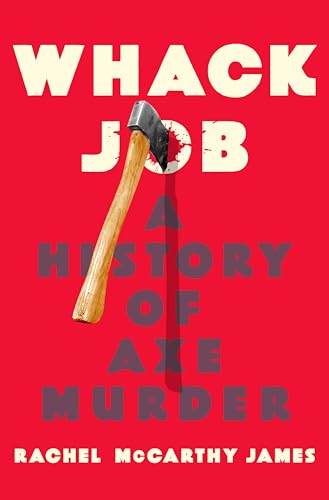
Review: "Whack Job" by Rachel McCarthy James

Whack Job by Rachel McCarthy James
Published May 2025 via St. Martin's Press
★★★★


When the author says, in the introduction, Early on in the process of writing my first book about axe murder (loc. 17*), you know you're in for a ride.

This calls itself a history of axe murder, but I don't think that's quite right—it's more that this is a romp through various historical axe murders, with a lot of discussion of why axes used to be more common (and thus more likely to be used in murder) and what they meant about social status and how the term "axe murderer" came about. The specific stories range from ones I've never heard of (I'm not up on my Viking history, nor really my ancient Egyptian history) to famous cases (Lizzie Borden, anyone?) to just really devastating cases. I found that my interest increased as the book went on, partly because I just don't have that much interest in ancient history and partly because the more recent stories simply have so much more that is known—even when a lot of what is known about, say, the Borden case is just how much went wrong in the investigations.

The energy here is high: Don't go in expecting to come out an expert in axe murder, but do expect chapters that end with a lead-in to the next chapter, making it hard to put the book down for the night. This is one to read for entertainment purposes rather than for research purposes (though the endnotes might get you somewhere with the latter), but if you like your entertainment with a side of axe murder, this will do you well.

Thanks to the author and publisher for providing a review copy through NetGalley.

*Quotes are from an ARC and may not be final.

Sunday, May 4, 2025

Review: "Sunrise on the Reaping" by Suzanne Collins

Sunrise on the Reaping by Suzanne Collins
Published March 2025 via Scholastic Press
★★★★


Back a quarter century before the first Hunger Games book, and here we go: Haymitch's story. I reread the original trilogy, plus read the first prequel for the first time, in advance of Sunrise on the Reaping's release, so the books were much fresher in my mind than they would have been otherwise. (Make no mistake: I managed to forget a lot of crucial details anyway. But it helped.)

In the original trilogy, Haymitch is something of a bad-tempered alcoholic. It's so obvious that he gave up years ago—in two and a half decades of mentoring tributes in the Hunger Games, none of those tributes has ever come home. Even if he'd started out fresh and eager (as opposed to, say, fresh off the trauma of being subjected to the Hunger Games himself), mentoring child after child to their death, year after year, would be enough to drive anyone to the bottle.

But this is not that story: this is Haymitch as a sixteen-year-old, one whose odds put him in the arena. And you know...I'm mostly not going to talk about what happens in that arena, because you can read the book (or probably one of many extensive breakdowns that has already been written) to find out what happens there. What interests me more are the choices Collins must have had to make here. We see some of Haymitch's story already in the original trilogy, so Collins had to make sure that whatever was in this book was—one way or another—consistent with those nuggets. She's also made a concerted effort to bring in as many recurring characters as possible: Snow, of course, and Effie Trinket, and other people Katniss knows. This is Haymitch's backstory, but it's also a backstory for a number of other recurring characters. (Though I'm not as much a fan of the Covey story—felt a bit too similar to that in The Ballad of Songbirds and Snakes.) It leaves me wondering how long Collins had these backstories in mind, and how much she must have had to figure out later down the line.

The other thing this made me realize: Haymitch is so young. He's 16 at these 50th Hunger Games; by the time Katniss's Games roll around (the 74th), he'd be only 40. A reminder of how much trauma and hard lives can age a person, I guess. (Also—it strikes me that statistically speaking, there's a good chance that at some point there would have been a teenage parent or two drawn for the Hunger Games. I can see why Collins wouldn't want to add that to the mix, if she even considered it, but another reminder of how many people are affected by war. Well, and also that even the Hunger Games books have their moments of sanitizing for a teenaged audience.)

Overall, an unsurprisingly wildly depressing book but a satisfying one.

Saturday, May 3, 2025

Review: "The Ballad of Songbirds and Snakes" by Suzanne Collins

The Ballad of Songbirds and Snakes by Suzanne Collins
Published May 2020 via Scholastic Press
★★★


With a new Hunger Games prequel on my radar, it was time for two things: to reread the original trilogy, and to give the first prequel a go.

This was previously only vaguely on my radar. I'm not sure why, but although I sped through the original trilogy when it came out, I pretty much ignored Ballad—perhaps because I'm not usually all that interested in prequels, or perhaps because I'm not all that interested in reading the blatant villain's side of the story. (Snow does not, you know, come off all too well in the originals.)

So Collins had a difficult task here: to take a villain and give him an origin story that keeps him a villain but also makes him relatable enough, or sympathetic enough, to keep readers hanging on throughout the book. By and large I think Collins succeeds, but what interests me most is not Snow (I can never quite forget that he starts out rather grasping and turns into a tyrant) but the look back into the early days of the Hunger Games. Because these are Hunger Games unlike the ones Katniss survived: no costume designers or feasts, no preparation—just children locked in animal cages at the zoo and then thrown in the ruins of a stadium to (most likely) die a violent death. Snow and his classmates are the first "mentors" (a role that is primarily about their own clout and has almost nothing to do with actual mentoring), and they are instrumental in shaping what the Games will become.

I probably won't be returning to this, but it made for a fascinating addition to the lore. Will have to see what Haymitch's story brings.

Thursday, May 1, 2025

Review: "Alive Day" by Karie Fugett

Alive Day by Karie Fugett
Published May 2025 via The Dial Press
★★★★


Barely out of her teens, Fugett got married on a whim—because she was in love, yes, but also because she was jobless and homeless and marriage to her middle-school sweetheart promised some level of security. Marriage meant she could be added to Cleve's military health care plan, and it meant she'd have some assistance in figuring out where to live.

Cleve and I weren't heroes. He was just a boy who loved his mama and hoped to afford her a better life one day. And I was just a girl searching for home. (loc. 4840*)

Then Cleve was deployed again. And this time, he didn't come back in one piece. And every bit of stability Fugett had cobbled together over the past months went out the window.

The military often reminded me that I was a "wounded warrior's caregiver." They told me I was "strong, brave, and essential." I understand now that the military relies on young spouses like me as cheap—sometimes free—labor. Military brass knows what to say to make young women think their labor is their duty. But at the same time, I believed those pretty words: Courageous. Self-sacrificing. Brave. Hero. (loc. 1364)

This makes for a quietly devastating read. All the things Fugett had hoped for were sidelined again and again as she struggled to care for her injured husband, whose medical care was centered on his physical wounds and did not take into account mental health—think PTSD—or the fact that he was still basically a kid without the experience or education to understand what he was going through, or to understand the risks of being prescribed opioid upon opioid to dull his pain. She describes learning on the fly how to fill out reams and reams of paperwork without which they would be left to fall through the cracks—and then falling through the cracks anyway, because the military wasn't prepared to treat psychological wounds or addiction. She's both precise in her language and unflinching in the details she shares, and you're left wondering just how many ways things could have been different.

If you're thinking about reading this—and I'd recommend doing so—you might want to avoid looking up Fugett in advance, or reading too many reviews; this is one that unfolds better if you don't have too much information going in.

Thanks to the author and publisher for providing a review copy through NetGalley.

Children's books: Deutsch II: "Ein Herz für Elefanten", "Sturmgefühle, Schattenbilder", und "Bagger Bens Tag am Meer"

Ein Herz für Elefanten von R.G. de Rouen Sturmgefühle, Schattenbilder von Michelle Müller-Nagy (Verlag Monika Fuchs) Bagger Bens Tag am Me...