Caroline's Mystery Dolls by Molly Mia Stewart (created by Francine Pascal)
First published 1991
★★★
Continuing the spin through Sweet Valley—this one is largely unremarkable, but I remembered it vaguely from when I was little. I suppose the writers didn't want to let Jessica go full bonkers at this point (bad example for the kiddos!), so she's pretty mild in these younger books. Though she does still get a more interesting plot than Elizabeth...
The doll plot isn't too exciting, but I remember being really jealous of how many "name" items Jessica had—my name is uncommon enough that I've never seen a single premade (as opposed to customisable) "name" item that fit me, or even one with my middle names. (I prefer my uncommon name, but it does have occasional downsides!) Reminds me a little bit of one of the Face on the Milk Carton books, actually, where Janie meets her biological family and is presented with a lot of items with her name...
Anyway. These Sweet Valley Kids books are way, way out of my age range these days, but the nostalgia factor is nice. And there's still hope for Jessica in this series! Oh, those bright, optimistic days...
Friday, March 1, 2024
Thursday, February 29, 2024
Review: "Here After" by Amy Lin
Here After by Amy Lin
Published March 2024 via Zibby Books
★★★★
Amy Lin's husband was here, and then he went out for a run and was gone: unexpectedly dead at 32. Here After chronicles those first fresh waves of grief as she learned to navigate the world—and an unexpected health crisis of her own—as a young widow.
The book moves effortlessly between then and now—then, when they were healthy and in love and thought it would last forever, and now, when Lin came up against, over and over, her new reality.
When Kurtis has been dead two years, it is still an impossibility. If people ask me how long it has been, I say a year because that is how it feels. (loc. 1099*)
It is, for obvious reasons, not a particularly easy read. Lin had had her eye on a career as a writer even before her husband died, but this was never the book she wanted to write. There's an interesting bit early on regarding someone else's grief—a woman roughly Lin's age whose husband also died young, someone Lin didn't reach out to at the time because she didn't want to intrude on the other woman's grief. I have yet to realize silence only isolates the bereaved even more than death already has (loc. 216). A hard lesson to learn, but not a surprising one. (What surprises me is the 'friend', later in the book, who steps away from being supportive because they "have to protect [their] light" (loc. 452)—don't be that friend.)
The thing I like best is probably the fluid back-and-forth structure—I'm not sure if the before and after will be more visibly separated in the final print version (I read a digital ARC), but the fluid shifts from then to now and back again feel very fitting for the immediacy of grief. But be prepared for a read that is fully and fundamentally about grief and how it reshapes your entire existence.
Thanks to the author and publisher for providing a review copy through NetGalley.
*Quotes are from an ARC and may not be final.
Published March 2024 via Zibby Books
★★★★
Amy Lin's husband was here, and then he went out for a run and was gone: unexpectedly dead at 32. Here After chronicles those first fresh waves of grief as she learned to navigate the world—and an unexpected health crisis of her own—as a young widow.
The book moves effortlessly between then and now—then, when they were healthy and in love and thought it would last forever, and now, when Lin came up against, over and over, her new reality.
When Kurtis has been dead two years, it is still an impossibility. If people ask me how long it has been, I say a year because that is how it feels. (loc. 1099*)
It is, for obvious reasons, not a particularly easy read. Lin had had her eye on a career as a writer even before her husband died, but this was never the book she wanted to write. There's an interesting bit early on regarding someone else's grief—a woman roughly Lin's age whose husband also died young, someone Lin didn't reach out to at the time because she didn't want to intrude on the other woman's grief. I have yet to realize silence only isolates the bereaved even more than death already has (loc. 216). A hard lesson to learn, but not a surprising one. (What surprises me is the 'friend', later in the book, who steps away from being supportive because they "have to protect [their] light" (loc. 452)—don't be that friend.)
The thing I like best is probably the fluid back-and-forth structure—I'm not sure if the before and after will be more visibly separated in the final print version (I read a digital ARC), but the fluid shifts from then to now and back again feel very fitting for the immediacy of grief. But be prepared for a read that is fully and fundamentally about grief and how it reshapes your entire existence.
Thanks to the author and publisher for providing a review copy through NetGalley.
*Quotes are from an ARC and may not be final.
Wednesday, February 28, 2024
Review: "The Older Boy" by Jamie Suzanne (created by Francine Pascal)
The Older Boy by Jamie Suzanne (created by Francine Pascal)
First published 1987
★★
You know what's wild about this? Lila is the voice of reason. Lila! Who until I started rereading some Sweet Valley books I thought was the proverbial mean girl of the books! But it turns out that Lila is actually pretty dull (just rich), and Jessica is the hyperpsychobitch of the series. It's Lila who first points out that a twelve-year-old should not set her sights on a sixteen-year-old: Lila still couldn't believe it. "He's too old for you," she objected. "I'm telling you, Jess. The second he finds out you're still in middle school, he'll skate off into the sunset" (2).
I remember sympathizing more with Elizabeth than with Jessica when I read these books as a kid, but as an adult I can't decide what to think. On the one hand Jessica is a self-obsessed, overdramatic, self-serving, gaslighting mess. On the other hand...Elizabeth is really pretty boring, isn't she? She tells us in one breath that she's bailed her twin out of her chores too often that week already (35) and then in the next breath agrees to help again even though she ordinarily...wouldn't have been so generous (35). And then not long thereafter she lets Jessica gaslight her into apologizing when (as usual) it's Jessica who's gone off the rails, and Jessica of course feels not the slightest bit of remorse. (Elizabeth, kiddo, it's time to grow a spine. And a bit of self-awareness.) The rest of the family is similarly bewitched—when Jessica thinks she'll be missing a trip to the circus because she has out-of-town plans (which, to be clear, she doesn't: she has plans for a secret date), her parents are like "oh, poor thing, going to a lake house for the weekend, we'll have to make it up to her by taking her on a special trip by herself".
Anyway. The short version is that Jessica gets caught but not as caught as she should be; she gets off almost scot-free, because Jessica and consequences don't mix; and dear god, a sixteen-year-old should be able to tell that a twelve-year-old is too young for him (even one who's claiming to be fourteen—which is also too young for him).
The more of these I reread, the more I think that it's never actually been a double-heroine series—Jessica is the heroine, or as close as we get to one, and Elizabeth is her not-terribly-sharp foil.
First published 1987
★★
You know what's wild about this? Lila is the voice of reason. Lila! Who until I started rereading some Sweet Valley books I thought was the proverbial mean girl of the books! But it turns out that Lila is actually pretty dull (just rich), and Jessica is the hyperpsychobitch of the series. It's Lila who first points out that a twelve-year-old should not set her sights on a sixteen-year-old: Lila still couldn't believe it. "He's too old for you," she objected. "I'm telling you, Jess. The second he finds out you're still in middle school, he'll skate off into the sunset" (2).
I remember sympathizing more with Elizabeth than with Jessica when I read these books as a kid, but as an adult I can't decide what to think. On the one hand Jessica is a self-obsessed, overdramatic, self-serving, gaslighting mess. On the other hand...Elizabeth is really pretty boring, isn't she? She tells us in one breath that she's bailed her twin out of her chores too often that week already (35) and then in the next breath agrees to help again even though she ordinarily...wouldn't have been so generous (35). And then not long thereafter she lets Jessica gaslight her into apologizing when (as usual) it's Jessica who's gone off the rails, and Jessica of course feels not the slightest bit of remorse. (Elizabeth, kiddo, it's time to grow a spine. And a bit of self-awareness.) The rest of the family is similarly bewitched—when Jessica thinks she'll be missing a trip to the circus because she has out-of-town plans (which, to be clear, she doesn't: she has plans for a secret date), her parents are like "oh, poor thing, going to a lake house for the weekend, we'll have to make it up to her by taking her on a special trip by herself".
Anyway. The short version is that Jessica gets caught but not as caught as she should be; she gets off almost scot-free, because Jessica and consequences don't mix; and dear god, a sixteen-year-old should be able to tell that a twelve-year-old is too young for him (even one who's claiming to be fourteen—which is also too young for him).
The more of these I reread, the more I think that it's never actually been a double-heroine series—Jessica is the heroine, or as close as we get to one, and Elizabeth is her not-terribly-sharp foil.
Tuesday, February 27, 2024
Review: "The Berlin Letters" by Katherine Reay
The Berlin Letters by Katherine Reay
Published March 2024 via Harper Muse
★★★
1961: As the Berlin Wall goes up, Monica makes a wrenching choice—she passes her daughter over the barrier to her parents in West Berlin. Their lives will never be the same.
1989: Having moved to the US with her grandparents as a young child, Luisa has grown up knowing the power of secrets—enough so that she's a CIA codebreaker. But the discovery of a cache of letters turns everything she thought she knew about her past on its head and upsets her orderly life and sends her deep into the desperation of a crumbling East Berlin.
I've been more and more curious about life in East Berlin and the DDR more generally, and I absolutely flew through The Berlin Letters. There are two timelines here, and although initially I was far more invested in the 1961+ timeline, it didn't take long to get wrapped up in Luisa's story as well. As the plot goes on, Luisa gets more and more invested not just in what happened in the early days of the Cold War but in what is happening now, with the DDR teetering on the edge of collapse—and with crucial parts of her own story trapped behind the wall. I said above that I was initially more invested in the earlier timeline, but I didn't expect to sympathize so much with that section's narrator. Reay does skilful work in the gradual growth and learning of her characters.
The codebreaking aspect is fascinating, though I wished I better understood what the particular key in a given letter was—not sure if that will be clearer in hard copies of the book (I read an e-copy, and sometimes hard copies manage differences in color, formatting, etc., than e-copies do). I was also a bit sorry not to see...more urgency to Luisa's present-day work, maybe. Without giving too much away, I'll say that the codes she's breaking here have huge implications for the earlier timeline, but the implications for the later timeline are more abstract—enough so that, because we learn about them first in the later timeline, they don't hold quite as much suspense as they might otherwise.
All told, this makes me want to look for more of its ilk—accessible fiction about a time and place that I struggle to bring to life in my own imagination.
Thanks to the author and publisher for providing a review copy through NetGalley. (I received a complimentary copy of this book. Opinions expressed in this review are completely my own.)
Published March 2024 via Harper Muse
★★★
1961: As the Berlin Wall goes up, Monica makes a wrenching choice—she passes her daughter over the barrier to her parents in West Berlin. Their lives will never be the same.
1989: Having moved to the US with her grandparents as a young child, Luisa has grown up knowing the power of secrets—enough so that she's a CIA codebreaker. But the discovery of a cache of letters turns everything she thought she knew about her past on its head and upsets her orderly life and sends her deep into the desperation of a crumbling East Berlin.
I've been more and more curious about life in East Berlin and the DDR more generally, and I absolutely flew through The Berlin Letters. There are two timelines here, and although initially I was far more invested in the 1961+ timeline, it didn't take long to get wrapped up in Luisa's story as well. As the plot goes on, Luisa gets more and more invested not just in what happened in the early days of the Cold War but in what is happening now, with the DDR teetering on the edge of collapse—and with crucial parts of her own story trapped behind the wall. I said above that I was initially more invested in the earlier timeline, but I didn't expect to sympathize so much with that section's narrator. Reay does skilful work in the gradual growth and learning of her characters.
The codebreaking aspect is fascinating, though I wished I better understood what the particular key in a given letter was—not sure if that will be clearer in hard copies of the book (I read an e-copy, and sometimes hard copies manage differences in color, formatting, etc., than e-copies do). I was also a bit sorry not to see...more urgency to Luisa's present-day work, maybe. Without giving too much away, I'll say that the codes she's breaking here have huge implications for the earlier timeline, but the implications for the later timeline are more abstract—enough so that, because we learn about them first in the later timeline, they don't hold quite as much suspense as they might otherwise.
All told, this makes me want to look for more of its ilk—accessible fiction about a time and place that I struggle to bring to life in my own imagination.
Thanks to the author and publisher for providing a review copy through NetGalley. (I received a complimentary copy of this book. Opinions expressed in this review are completely my own.)
Monday, February 26, 2024
Review: "Dead Weight" by Emmeline Clein
Dead Weight by Emmeline Clein
Published February 2024 via Knopf
★★★
Clein spent years entrenched in eating disorders, and in Dead Weight she examines some of the personal and societal obsessions that influenced her illness, and that of so many others.
Structured as a series of essays, Dead Weight leans heavily into pop culture, with an occasional academic bent. Clein has clearly read extensively—and consumed large amounts of other media—on the subject, and she quotes heavily. In places this works well, giving a sense of just how pervasive an issue is or in how many works it's reflected. I did end up wishing that fewer of the chapters/essays had taken this rapid-fire structure, with quotation following source following quotations, because it can feel very much like a montage, and I usually prefer to dive deeper into a topic or source (more analysis and fewer examples, I think). The pop culture parts have a very American lens; as someone who is American but is other things as well, I drew some very different conclusions (e.g., from the discussion of Girls vs. Fleabag) than Clein does, but there will be resonance for those whose media consumption is primarily American.
One thing that readers should be mindful of: While Clein makes a concerted effort to avoid potential triggers in the form of numbers and certain details of eating disorders and so on, I'm not sure she ever really manages to write past a level of latent ambivalence about her eating disorder. It's understandable but still a risky place to be writing from, and in places the compulsion to write, or perhaps just to delve into this in a sanctioned way, overrides caution. I don't know how to write about her without making her struggle into a manual or a vision board, writes Clein in a chapter that I can only describe as highly ill advised (and one of the most triggering things I've read in years). But I am going to try to write about her anyway... (loc. 3947*) An interesting read, but one I cannot recommend to anyone with anything other than a very healthy, uncomplicated relationship with their body.
*Quotes are from an ARC and may not be final.
Thanks to the author and publisher for providing a review copy through NetGalley.
Published February 2024 via Knopf
★★★
Clein spent years entrenched in eating disorders, and in Dead Weight she examines some of the personal and societal obsessions that influenced her illness, and that of so many others.
Structured as a series of essays, Dead Weight leans heavily into pop culture, with an occasional academic bent. Clein has clearly read extensively—and consumed large amounts of other media—on the subject, and she quotes heavily. In places this works well, giving a sense of just how pervasive an issue is or in how many works it's reflected. I did end up wishing that fewer of the chapters/essays had taken this rapid-fire structure, with quotation following source following quotations, because it can feel very much like a montage, and I usually prefer to dive deeper into a topic or source (more analysis and fewer examples, I think). The pop culture parts have a very American lens; as someone who is American but is other things as well, I drew some very different conclusions (e.g., from the discussion of Girls vs. Fleabag) than Clein does, but there will be resonance for those whose media consumption is primarily American.
One thing that readers should be mindful of: While Clein makes a concerted effort to avoid potential triggers in the form of numbers and certain details of eating disorders and so on, I'm not sure she ever really manages to write past a level of latent ambivalence about her eating disorder. It's understandable but still a risky place to be writing from, and in places the compulsion to write, or perhaps just to delve into this in a sanctioned way, overrides caution. I don't know how to write about her without making her struggle into a manual or a vision board, writes Clein in a chapter that I can only describe as highly ill advised (and one of the most triggering things I've read in years). But I am going to try to write about her anyway... (loc. 3947*) An interesting read, but one I cannot recommend to anyone with anything other than a very healthy, uncomplicated relationship with their body.
*Quotes are from an ARC and may not be final.
Thanks to the author and publisher for providing a review copy through NetGalley.
Sunday, February 25, 2024
Review: "49 Days" by Agnes Lee
49 Days by Agnes Lee
Published March 2024 via Levine Querido
★★★★
Kit is on a journey she didn't ask for: in Buddhist tradition, it takes 49 days for the spirit of a recently deceased person to pass over to the next life, but Kit hadn't expected to be on this path anytime soon.
Drawn in spare, black-and-white illustrations, 49 Days proves to be quietly devastating. Alongside Kit's journey, we see the parallel journeys of the people she's left behind—family, mostly, but also some friends—and memories of the time before. What's particularly resonant, I think, is Kit's own grief; just as her family is not ready for her to be gone, she is not ready to leave them behind. I'm not a crier, but I suspect that this will be a tear-jerker for many.
This feels like something new in both graphic novels and books about grief. I'd also recommend Marie Mutsuki Mockett's Where the Dead Pause, and the Japanese Say Goodbye to readers who want a further look at grief in non-Western cultures.
Thanks to the author and publisher for providing a review copy through NetGalley.
Published March 2024 via Levine Querido
★★★★
Kit is on a journey she didn't ask for: in Buddhist tradition, it takes 49 days for the spirit of a recently deceased person to pass over to the next life, but Kit hadn't expected to be on this path anytime soon.
Drawn in spare, black-and-white illustrations, 49 Days proves to be quietly devastating. Alongside Kit's journey, we see the parallel journeys of the people she's left behind—family, mostly, but also some friends—and memories of the time before. What's particularly resonant, I think, is Kit's own grief; just as her family is not ready for her to be gone, she is not ready to leave them behind. I'm not a crier, but I suspect that this will be a tear-jerker for many.
This feels like something new in both graphic novels and books about grief. I'd also recommend Marie Mutsuki Mockett's Where the Dead Pause, and the Japanese Say Goodbye to readers who want a further look at grief in non-Western cultures.
Thanks to the author and publisher for providing a review copy through NetGalley.
Friday, February 23, 2024
Review: "Don't Want You Like a Best Friend" by Emma Alban
Don't Want You Like a Best Friend by Emma Alban
Published January 2024 via Avon
★★★
Beth's goal for the debutante season is simple—snag a wealthy enough husband to keep her and her mother from the poorhouse. And Gwen's is even simpler—have some fun and avoid being saddled with a husband. It hasn't quite clicked for either of them that there's something else they both desperately want...
I read this for the cover, mostly, and generally it's a fun read. What it's not, though, is historical fiction: only the evil villains (who are evil) have 1800s attitudes, while the 'good' characters are all extremely modern in the way they think; the dialogue and slang is distinctly modern and often American ("Damn, I guess I've got to go" (96)—said nobody, ever, in 1800s Britain). In some ways that makes this an easier read for me, as I'm not all that interested in historical fiction, but at the same time...if I'm going to read historical fiction, I'd rather feel that I can trust the accuracy of, uh, anything within.
Beth and Gwen are both fine, though they don't seem to have much going on beyond worrying about the future (Beth) and drinking a whole lot more hard liquor than would be socially acceptable for teenage girls in the 1800s or...ever, really (Gwen). This will still be a good one for you if you don't mind insta-love and historical inaccuracy—that came out snarkier than I intended—but it ends up feeling more like fantasy to me than historical fiction.
Published January 2024 via Avon
★★★
Beth's goal for the debutante season is simple—snag a wealthy enough husband to keep her and her mother from the poorhouse. And Gwen's is even simpler—have some fun and avoid being saddled with a husband. It hasn't quite clicked for either of them that there's something else they both desperately want...
I read this for the cover, mostly, and generally it's a fun read. What it's not, though, is historical fiction: only the evil villains (who are evil) have 1800s attitudes, while the 'good' characters are all extremely modern in the way they think; the dialogue and slang is distinctly modern and often American ("Damn, I guess I've got to go" (96)—said nobody, ever, in 1800s Britain). In some ways that makes this an easier read for me, as I'm not all that interested in historical fiction, but at the same time...if I'm going to read historical fiction, I'd rather feel that I can trust the accuracy of, uh, anything within.
Beth and Gwen are both fine, though they don't seem to have much going on beyond worrying about the future (Beth) and drinking a whole lot more hard liquor than would be socially acceptable for teenage girls in the 1800s or...ever, really (Gwen). This will still be a good one for you if you don't mind insta-love and historical inaccuracy—that came out snarkier than I intended—but it ends up feeling more like fantasy to me than historical fiction.
Thursday, February 22, 2024
Review: "The Forgotten Beasts of Eld" by Patricia McKillip
The Forgotten Beasts of Eld by Patricia McKillip
50th Anniversary Edition published February 2024 via Tachyon Publications
★★★★
High on a mountain, far outside the confines of society lives a woman, a wizard—Sybel. Hers is a solitary existence, with only the great magical beasts passed down from her father to keep her company, and it's a life that suits her. But times change, and when she is given charge of an infant to raise, she can no longer predict and shape the path of her life the way she once could.
"Is this all you want? To live here on this mountain, speaking only to animals who live in the dreams of their past, and to Tam, who will have a future that you cannot have? You are bound here by your father's rules, you live his life. You will live, grow old, and die here, living for others who do not need you. Tam one day will not need you. What, in years to come, will you have in your life but a silence that is meaningless, ancient names that are never spoken beyond these walls?" (loc. 581)
I first read The Forgotten Beasts of Eld more than two decades ago—I think I must have been twelve or thirteen. It was and is not my usual reading fare, so it was likely something of my sister's that made its way into the family bookshelves (my family has never been short of books). And I promptly forgot most of it, retaining only the barest outline of a wintery protagonist and the bird named Liralen, which I (also promptly) borrowed for a username and have yet to return.
As long ago as I read this, it's been around longer:The Forgotten Beasts of Eld was first published in 1974, and so 2024 marks its 50th anniversary. And it has held up to the test of time: I understand Sybel and her—not coldness, perhaps, but distance from the world—much better as an adult than I ever could twenty-odd years ago. She's distant from the world and at home in her isolation, yet also drawn to things she cannot name or fully understand; drawn to both a world of men and a world of magical creatures. I don't want to get too much into the plot (or the Liralen—again, I'd forgotten the details, and I am puzzled anew, which pleases me), but this is a classic of the genre for a reason. I'm looking forward to reading it again in another decade or two.
Thanks to the publisher for providing a review copy through NetGalley.
50th Anniversary Edition published February 2024 via Tachyon Publications
★★★★
High on a mountain, far outside the confines of society lives a woman, a wizard—Sybel. Hers is a solitary existence, with only the great magical beasts passed down from her father to keep her company, and it's a life that suits her. But times change, and when she is given charge of an infant to raise, she can no longer predict and shape the path of her life the way she once could.
"Is this all you want? To live here on this mountain, speaking only to animals who live in the dreams of their past, and to Tam, who will have a future that you cannot have? You are bound here by your father's rules, you live his life. You will live, grow old, and die here, living for others who do not need you. Tam one day will not need you. What, in years to come, will you have in your life but a silence that is meaningless, ancient names that are never spoken beyond these walls?" (loc. 581)
I first read The Forgotten Beasts of Eld more than two decades ago—I think I must have been twelve or thirteen. It was and is not my usual reading fare, so it was likely something of my sister's that made its way into the family bookshelves (my family has never been short of books). And I promptly forgot most of it, retaining only the barest outline of a wintery protagonist and the bird named Liralen, which I (also promptly) borrowed for a username and have yet to return.
As long ago as I read this, it's been around longer:The Forgotten Beasts of Eld was first published in 1974, and so 2024 marks its 50th anniversary. And it has held up to the test of time: I understand Sybel and her—not coldness, perhaps, but distance from the world—much better as an adult than I ever could twenty-odd years ago. She's distant from the world and at home in her isolation, yet also drawn to things she cannot name or fully understand; drawn to both a world of men and a world of magical creatures. I don't want to get too much into the plot (or the Liralen—again, I'd forgotten the details, and I am puzzled anew, which pleases me), but this is a classic of the genre for a reason. I'm looking forward to reading it again in another decade or two.
Thanks to the publisher for providing a review copy through NetGalley.
Wednesday, February 21, 2024
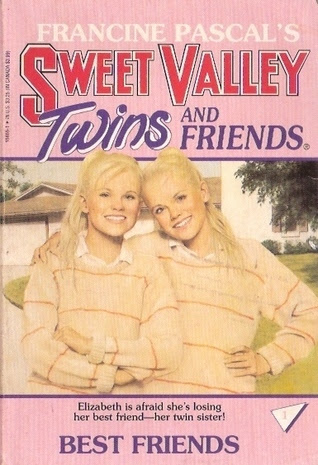
Review: "Best Friends" by Jamie Suzanne (created by Francine Pascal)
Best Friends by Jamie Suzanne (created by Francine Pascal)
First published 1986
★★★
I wondered when I reread the first Sweet Valley Kids book just how long it would take for Jessica's true sociopathic colours to show—and we have a partial answer. In this first book of the middle-school series, Jessica is already wreaking havoc, and not one of the other characters is in the slightest surprised. (Note: There are untagged spoilers below the fold, if you're worried about spoilers for a very outdated, toxic-ideals book published 38 years ago.)
There are yellow sweatsuits in this one as well as in the first SV Kids book, which makes me wonder whether the sweatsuits in the SV Kids book (which was written later) were a nod to the ones here or whether sweatsuits were just really, really popular in the 80s. But mostly it's all about the drama:
The big to-do of the book is Jessica's quest to join the Unicorn club, which is made up of popular girls whose great quest is to maintain their popularity, mostly through putting down anyone who is not a Unicorn themselves. (This is right up Jessica's alley.) Anyway, Jessica's in, but next it's Elizabeth's turn because...twins have to do everything together, right? Right? Wrong. Jessica's hazing tasks have been relatively mild, but—because the Unicorns don't want Elizabeth any more than Elizabeth wants them—Elizabeth is tasked with publicly humiliating Lois, the local Unpopular Girl.
You can guess how this goes. Elizabeth refuses (because, though she doesn't recognise a sociopath when she lives with one, she's not one herself), Jessica is horrified about what Elizabeth's refusal will mean for Jessica's reputation, Jessica decides to take matters into her own hands, Jessica goes forth and humiliates Lois. (The fat-shaming starts early in these books—the first SV High one is full of it too.)
Now...none of this is surprising, because...Jessica. But what's interesting to me is this: When Elizabeth and Lois get revenge, Jessica gets off scot-free. She wouldn't view it that way, of course (if the Unicorns are humiliated, Jessica is humiliated), but to me it looks an awful lot like Jessica doing awful things and then suffering no consequences...which, if I remember correctly, rapidly becomes something of a theme in these books. Suddenly the Jessica of Sweet Valley High makes a lot more sense...
First published 1986
★★★
I wondered when I reread the first Sweet Valley Kids book just how long it would take for Jessica's true sociopathic colours to show—and we have a partial answer. In this first book of the middle-school series, Jessica is already wreaking havoc, and not one of the other characters is in the slightest surprised. (Note: There are untagged spoilers below the fold, if you're worried about spoilers for a very outdated, toxic-ideals book published 38 years ago.)
There are yellow sweatsuits in this one as well as in the first SV Kids book, which makes me wonder whether the sweatsuits in the SV Kids book (which was written later) were a nod to the ones here or whether sweatsuits were just really, really popular in the 80s. But mostly it's all about the drama:
The big to-do of the book is Jessica's quest to join the Unicorn club, which is made up of popular girls whose great quest is to maintain their popularity, mostly through putting down anyone who is not a Unicorn themselves. (This is right up Jessica's alley.) Anyway, Jessica's in, but next it's Elizabeth's turn because...twins have to do everything together, right? Right? Wrong. Jessica's hazing tasks have been relatively mild, but—because the Unicorns don't want Elizabeth any more than Elizabeth wants them—Elizabeth is tasked with publicly humiliating Lois, the local Unpopular Girl.
You can guess how this goes. Elizabeth refuses (because, though she doesn't recognise a sociopath when she lives with one, she's not one herself), Jessica is horrified about what Elizabeth's refusal will mean for Jessica's reputation, Jessica decides to take matters into her own hands, Jessica goes forth and humiliates Lois. (The fat-shaming starts early in these books—the first SV High one is full of it too.)
Now...none of this is surprising, because...Jessica. But what's interesting to me is this: When Elizabeth and Lois get revenge, Jessica gets off scot-free. She wouldn't view it that way, of course (if the Unicorns are humiliated, Jessica is humiliated), but to me it looks an awful lot like Jessica doing awful things and then suffering no consequences...which, if I remember correctly, rapidly becomes something of a theme in these books. Suddenly the Jessica of Sweet Valley High makes a lot more sense...
Monday, February 19, 2024
Review: "That's Not My Name" by Megan Lally
That's Not My Name by Megan Lally
Published December 2023 via Sourcebooks Fire
★★★★
When she comes out of the woods, there's only one thing she knows—something is wrong. Everything else, from her name to what is wrong, is missing. At the police station, a man shows up with an ID for her, clothing...proof that she is his daughter, Mary.
Or is she?
Not too far away, Drew is desperate—the longer Lola is missing, the more the town is convinced that he has murdered his girlfriend. He knows he didn't do it...but the police aren't looking elsewhere, and he's more and more convinced that it's up to him to find new clues.
I rarely shelve YA mysteries as 'mystery' on Goodreads because...they often focus too much on romance, I think, and don't usually tingle my scare reflex. But That's Not My Name walks a terrific dual-storyline path, showing us Drew and 'Mary's' stories as they get closer and closer to the truth—keeping the reader guessing. Twists at the end keep this surprising, and the story's villain has enough complexity (...combined with some oh-yikes, but still) to stay interesting too. I swallowed this one pretty much whole and would happily have read more.
Published December 2023 via Sourcebooks Fire
★★★★
When she comes out of the woods, there's only one thing she knows—something is wrong. Everything else, from her name to what is wrong, is missing. At the police station, a man shows up with an ID for her, clothing...proof that she is his daughter, Mary.
Or is she?
Not too far away, Drew is desperate—the longer Lola is missing, the more the town is convinced that he has murdered his girlfriend. He knows he didn't do it...but the police aren't looking elsewhere, and he's more and more convinced that it's up to him to find new clues.
I rarely shelve YA mysteries as 'mystery' on Goodreads because...they often focus too much on romance, I think, and don't usually tingle my scare reflex. But That's Not My Name walks a terrific dual-storyline path, showing us Drew and 'Mary's' stories as they get closer and closer to the truth—keeping the reader guessing. Twists at the end keep this surprising, and the story's villain has enough complexity (...combined with some oh-yikes, but still) to stay interesting too. I swallowed this one pretty much whole and would happily have read more.
Subscribe to:
Posts (Atom)
Children's books: Deutsch II: "Ein Herz für Elefanten", "Sturmgefühle, Schattenbilder", und "Bagger Bens Tag am Meer"
Ein Herz für Elefanten von R.G. de Rouen Sturmgefühle, Schattenbilder von Michelle Müller-Nagy (Verlag Monika Fuchs) Bagger Bens Tag am Me...
-
The Ferryman and His Wife by Frode Grytten, translated from the Norwegian by Alison McCullough Published November 2025 via Algonquin Books ★...
-
The Keeper by Tana French Published March 2026 via Viking ★★★★ Book three—of three—in the Cal Hooper series. Time has passed: Trey is growin...
-
Three Ordinary Girls by Tim Brady Published February 2021 via Citadel Press ★★★ For all that I've heard about the strength of the Dutch ...