Hanami by Julia Cejas
Published August 2024 via Life Drawn
★★★★
Sometimes a dream is just a dream—but sometimes we get to live it. When Spain's economy took a downturn and Cejas's partner lost his job, the couple took a leap of faith—they moved to Japan to learn Japanese and explore their creative options for a while. It wasn't permanent (and was never meant to be permanent), but that meant that they could really lean into exploring and enjoying the nuances and quirks of their temporary home.
Hanami is structured more as short vignettes than as a fully linear story. For that reason it's a more of a 3.5-star read for me (personal preference for longer stories rather than smaller things stitched together), but the vignettes do work really well both on their own and as part of a longer story. (There's one about sleeping on separate sleeping mats and Cejas insisting that her partner still suffer her cold feet—and, well, for apartment reasons my partner and I temporarily have two twin beds shoved together, and he still suffers my cold feet. So I showed that page to him, and it made us both laugh a lot.)
I've never been to Japan and have no immediate plans to change that, but I love reading about this sort of long travel—the sort where you have enough time to feel the rhythms of a place rather than just blasting through the top tourist spots. It's not all sunshine and cherry blossoms: finances are tight, doldrums loom, language barriers persist, and at some point they'll have to think about what comes next. But for the duration...this was well worth the read.
Thanks to the author and publisher for providing a review copy through NetGalley.
Thursday, October 31, 2024
Tuesday, October 29, 2024
Review: "Bedtime Stories for Privileged Children" by Daniel Foxx
Bedtime Stories for Privileged Children by Daniel Foxx
Published November 2024 via Monoray
★★★
Now put on your designer pyjamas and tuck yourself into your bespoke silk bed sheets and sip your 230 Fifth King Cocoa. It's time for a bedtime story of a type that only the lucky few get. These are not your average bedtime stories with fairies and ogres—these are stories in which Clementine rides off in her private helicopter, and Cucumber fires Nanny 2, and Coriander dresses up as poverty for Halloween, and Crumpet forces Nanny 3 to eat mud, and Caviar is horrified that the neighbor's dog doesn't get private French lessons, and Cashew fires Nanny 1.
I made a lot of that up,* but you get the gist. Think short, think verrrrry snarky, think definitely not appropriate for children in need of a bedtime story (except, perhaps, for those from a certain class that I do not rub shoulders with, but what do I know). I'm not sure who the ideal audience is for this, really, but I'm guessing it would go over well as a stocking stuffer or novelty book to keep on a bathroom shelf.
(If your stockings aren't already filled with blood diamonds and your bathroom shelves aren't home to the lesser of your Fabergé egg collection, of course.)
The entire thing is very ridiculous, which is exactly as intended. I think I might have preferred a bit more plot and/or character development (one character followed throughout, as in My Naughty Little Sister?), but then that's probably beside the point. In any case, I think you'll know just from the description whether this might be a book for you!
Thanks to the author and publisher for providing a review copy through NetGalley.
*I don't have the book at hand while writing this, so I've picked arbitrary c-named foods for names (very in line with the book, I promise) and also fudged the details of the activities...except for the constant nanny abuse. It's my poor upbringing, I suppose.
Published November 2024 via Monoray
★★★
Now put on your designer pyjamas and tuck yourself into your bespoke silk bed sheets and sip your 230 Fifth King Cocoa. It's time for a bedtime story of a type that only the lucky few get. These are not your average bedtime stories with fairies and ogres—these are stories in which Clementine rides off in her private helicopter, and Cucumber fires Nanny 2, and Coriander dresses up as poverty for Halloween, and Crumpet forces Nanny 3 to eat mud, and Caviar is horrified that the neighbor's dog doesn't get private French lessons, and Cashew fires Nanny 1.
I made a lot of that up,* but you get the gist. Think short, think verrrrry snarky, think definitely not appropriate for children in need of a bedtime story (except, perhaps, for those from a certain class that I do not rub shoulders with, but what do I know). I'm not sure who the ideal audience is for this, really, but I'm guessing it would go over well as a stocking stuffer or novelty book to keep on a bathroom shelf.
(If your stockings aren't already filled with blood diamonds and your bathroom shelves aren't home to the lesser of your Fabergé egg collection, of course.)
The entire thing is very ridiculous, which is exactly as intended. I think I might have preferred a bit more plot and/or character development (one character followed throughout, as in My Naughty Little Sister?), but then that's probably beside the point. In any case, I think you'll know just from the description whether this might be a book for you!
Thanks to the author and publisher for providing a review copy through NetGalley.
*I don't have the book at hand while writing this, so I've picked arbitrary c-named foods for names (very in line with the book, I promise) and also fudged the details of the activities...except for the constant nanny abuse. It's my poor upbringing, I suppose.
Sunday, October 27, 2024
Review: Short story: "Holiday Hideaway" by Mary Kay Andrews
Holiday Hideaway by Mary Kay Andrews
Published October 2024 via Amazon Original Stories
Tilly just needs two weeks—two weeks in an empty rental house until she can move into her new place and get her feet back under her. Nobody's been there in months, so it shouldn't be a problem...until one of the new owners shows up, and she can't hide in the attic forever.
This is a short holiday-adjacent story. I'm not sure what it's doing in the "Christian romance" and "Religious romance" categories on Amazon—if there's any religion in here, it went straight over my head—and it's not really a Christmas story, either; although it takes place near the holidays, we really only know it from context clues and a Christmas tree or two.
What interests me most is how much context matters. That is: in a mystery, a stranger (or former classmate) hiding in the attic would be creepy as all get-out. In a thriller, it would be a sign that blood will be spilled by the end of the book. But this is a romance novel, so it's grounds for a meet-cute. Or, alternatively—if Tilly discovered that a strange man were hiding in her attic and occasionally creeping downstairs to watch her sleep, that would hopefully prompt her to call 911, no matter how much she disliked her ex on the other end of the line. But because Holiday Hideaway features a woman hiding in a man's house, the man can just go "Huh. Okay then" and go back to sleep as though he doesn't value his own life.
At any rate, this feels like a setup that probably could have been the basis for a full-length book, but as a short story it made for a very quick not-yet-the-holidays read. It feels a little outdated in places (Tilly doesn't hesitate to slut-shame her ex's dates, for example, and the hospital doesn't hesitate to discharge a confused, concussed man to a total stranger who expresses reluctance to take responsibility), but if you enjoy Andrews' longer works you'll probably enjoy this.
Thanks to the author and publisher for providing a review copy through NetGalley.
Published October 2024 via Amazon Original Stories
Tilly just needs two weeks—two weeks in an empty rental house until she can move into her new place and get her feet back under her. Nobody's been there in months, so it shouldn't be a problem...until one of the new owners shows up, and she can't hide in the attic forever.
This is a short holiday-adjacent story. I'm not sure what it's doing in the "Christian romance" and "Religious romance" categories on Amazon—if there's any religion in here, it went straight over my head—and it's not really a Christmas story, either; although it takes place near the holidays, we really only know it from context clues and a Christmas tree or two.
What interests me most is how much context matters. That is: in a mystery, a stranger (or former classmate) hiding in the attic would be creepy as all get-out. In a thriller, it would be a sign that blood will be spilled by the end of the book. But this is a romance novel, so it's grounds for a meet-cute. Or, alternatively—if Tilly discovered that a strange man were hiding in her attic and occasionally creeping downstairs to watch her sleep, that would hopefully prompt her to call 911, no matter how much she disliked her ex on the other end of the line. But because Holiday Hideaway features a woman hiding in a man's house, the man can just go "Huh. Okay then" and go back to sleep as though he doesn't value his own life.
At any rate, this feels like a setup that probably could have been the basis for a full-length book, but as a short story it made for a very quick not-yet-the-holidays read. It feels a little outdated in places (Tilly doesn't hesitate to slut-shame her ex's dates, for example, and the hospital doesn't hesitate to discharge a confused, concussed man to a total stranger who expresses reluctance to take responsibility), but if you enjoy Andrews' longer works you'll probably enjoy this.
Thanks to the author and publisher for providing a review copy through NetGalley.
Saturday, October 26, 2024
Review: "First Métis Man of Odesa" by Matthew MacKenzie and Mariya Khomutova
First Métis Man of Odesa by Matthew MacKenzie and Mariya Khomutova
Published October 2024 via Playwrights Canada Press
★★★★
When MacKenzie and Khomutova met, the odds were stacked against them: they lived half a world apart from each other, and they each had lives and commitments and passions of their own; too, though they didn't know it at the time, their lives were about to be turned upside down and then inside out by a pandemic and then a war. But life does not always follow the odds, and this is that story.
It's a curious thing, reading a nonfiction play. First Métis Man of Odesa was born out of frustration, in part: frustration that their relationship was impacted so much by external forces, and frustration that there was so little they could do about the war in Ukraine. The structure is as much MacKenzie and Khomutova telling their story as it is them acting it out, but one of the things I love about plays is that the rules are so different than the rules for writing, say, a novel.
While this play was pretty clearly written to be performed by the writers, it would be fascinating to see the differences on stage between their own interpretation (i.e., the play as written) and the interpretation of two actors who do not know the writers—there are a number of lines where inflection would determine meaning. Is this line angry or sad or passionate? What the actor and director decides changes the shape of the scene. (Again, plays work differently from novels; this ambiguity is a plus.) I sort of love that this is a collaboration between a writer and an actor, and they both wrote and acted despite not having experience in each other's realms.
The Canadian tour of this play wrapped up recently, so I imagine no chance of seeing it anytime soon, but one to return to for explorations in playwriting.
Thanks to the authors and publisher for providing a review copy through NetGalley.
Published October 2024 via Playwrights Canada Press
★★★★
When MacKenzie and Khomutova met, the odds were stacked against them: they lived half a world apart from each other, and they each had lives and commitments and passions of their own; too, though they didn't know it at the time, their lives were about to be turned upside down and then inside out by a pandemic and then a war. But life does not always follow the odds, and this is that story.
It's a curious thing, reading a nonfiction play. First Métis Man of Odesa was born out of frustration, in part: frustration that their relationship was impacted so much by external forces, and frustration that there was so little they could do about the war in Ukraine. The structure is as much MacKenzie and Khomutova telling their story as it is them acting it out, but one of the things I love about plays is that the rules are so different than the rules for writing, say, a novel.
While this play was pretty clearly written to be performed by the writers, it would be fascinating to see the differences on stage between their own interpretation (i.e., the play as written) and the interpretation of two actors who do not know the writers—there are a number of lines where inflection would determine meaning. Is this line angry or sad or passionate? What the actor and director decides changes the shape of the scene. (Again, plays work differently from novels; this ambiguity is a plus.) I sort of love that this is a collaboration between a writer and an actor, and they both wrote and acted despite not having experience in each other's realms.
The Canadian tour of this play wrapped up recently, so I imagine no chance of seeing it anytime soon, but one to return to for explorations in playwriting.
Thanks to the authors and publisher for providing a review copy through NetGalley.
Thursday, October 24, 2024
Review: "The Hawthorne Legacy" by Jennifer Lynn Barnes
The Hawthorne Legacy by Jennifer Lynn Barnes
Published September 2021 via Penguin
★★★
Book 2! And…having just read book 3 as well, I’ve already forgotten much of what happens in book 2. I’m afraid that’s the problem with trilogies—the middle book so often feels like filler. Here, Avery has been in the house for a whole three weeks, which naturally means that the four brothers who thought they’d inherit have accepted her as one of their own and are willing to step in front of bullets for her (while two of the four occasionally beat each other up because they both have the hots for Avery). Because…that’s definitely how it works.
I’ll keep this short (because really, I should have written this review before reading the next book)—all is fine and still fun as far as the wish-fulfillment part of things goes, but it’s also very much, well, the second book of a trilogy. Oh, and I’m mother-faxing tired of the way every other piece of Max’s dialogue has fake swearing.
Published September 2021 via Penguin
★★★
Book 2! And…having just read book 3 as well, I’ve already forgotten much of what happens in book 2. I’m afraid that’s the problem with trilogies—the middle book so often feels like filler. Here, Avery has been in the house for a whole three weeks, which naturally means that the four brothers who thought they’d inherit have accepted her as one of their own and are willing to step in front of bullets for her (while two of the four occasionally beat each other up because they both have the hots for Avery). Because…that’s definitely how it works.
I’ll keep this short (because really, I should have written this review before reading the next book)—all is fine and still fun as far as the wish-fulfillment part of things goes, but it’s also very much, well, the second book of a trilogy. Oh, and I’m mother-faxing tired of the way every other piece of Max’s dialogue has fake swearing.
Tuesday, October 22, 2024
Review: "Gaza Medic" by Richard Villar
Gaza Medic by Richard Villar
Published October 2024 via Pen and Sword Military
★★★
Every day is a mass casualty day. (loc. 1456*)
Villar is an England-based surgeon, but he also has what sounds like extensive experience volunteering in conflict zones. His most recent travels took him to Gaza (not for the first time) in April of 2024 for a two-week stint providing medical care to locals. (See note about politics at the end of this review.)
I read this largely because although I read quite a lot of news (four news apps send me notifications, and chances are good that I've already read the article by the time the notification come through), it has felt difficult to grasp the scope of the situation in Gaza; sometimes it can be helpful to read a deeper dive of one person's experiences and observations. Villar is, for obvious reasons, focused on the medical situation in Gaza, and he points to things that I would not have thought to wonder about. Take some of the things he says about infection:
Back home in the UK, I work on an infection rate of 0.25 per cent of my patients. Even that small percentage distresses me. After the GMR [Great March of Return, in 2018], an infection rate of 80 per cent was normal. (loc. 127).
And in 2024: A war surgeon should think infection from the moment they first see a patient and keep thinking infection until it is time for the patient to be discharged. The infection rate at Al Aqsa Hospital was 100 per cent. Every wound was infected – a feature of circumstance. (loc. 929)
The score used by the IRC for Infection Prevention Control (IPC) allowed a maximum (best) score of 100 per cent. The pass mark was 75 per cent but Al Aqsa Hospital scored 29 per cent. This was far below what it should be, did not surprise me, and went a fair way to explain the hospital's huge infection rate. (loc. 1968)
Elsewhere, Villar describes the unique experience, in modern war surgery, of patients' families coming forward with phones in hand, each showing photos of their injured loved ones and begging for help; he makes estimates of a million or more surgeries needed in Gaza even if the war were to end in April and no more injuries were incurred, because so many injuries need so many surgeries over time.
As a book, it's not great. It's based on Villar's diaries from the time, which means (by the nature of diaries) that it's often repetitious and doesn't always have satisfactory answers. Although some of the numbers Villar mentions are striking, there weren't sources provided, so I'd want to check other sources as well (including for the infection rates mentioned above); moreover, the war has now doubled in length since Villar was in Gaza, meaning that some of the numbers, even assuming they were correct then, are simply outdated. That said, I have my eye on a few more recent and upcoming books about this war, from people of various backgrounds, and I expect there will be many more to come. This was a decent starting point to get a glimpse into an experience that is not mine and that can feel too big to grasp.
A note on politics: Villar notes many times throughout the book that he is a medic, not a politician. It is important to remain apolitical in warfare, he writes, and not to be seen to support any side. (loc. 1162) He may have managed that for the two weeks he spent in Gaza, but his personal opinions are very clear in the book. I guessed this going in (I don't expect that many books from volunteers in Gaza who are gung-ho about the Israeli government), but if you are gung-ho about the Israeli government (I don't particularly want to get into politics in a review either, but please note the distinction between government and people), this is not going to be the book for you; feel free to politely close this tab and look elsewhere.
Thanks to the author and publisher for providing a review copy through NetGalley.
*Quotes are from an ARC and may not be final.
Published October 2024 via Pen and Sword Military
★★★
Every day is a mass casualty day. (loc. 1456*)
Villar is an England-based surgeon, but he also has what sounds like extensive experience volunteering in conflict zones. His most recent travels took him to Gaza (not for the first time) in April of 2024 for a two-week stint providing medical care to locals. (See note about politics at the end of this review.)
I read this largely because although I read quite a lot of news (four news apps send me notifications, and chances are good that I've already read the article by the time the notification come through), it has felt difficult to grasp the scope of the situation in Gaza; sometimes it can be helpful to read a deeper dive of one person's experiences and observations. Villar is, for obvious reasons, focused on the medical situation in Gaza, and he points to things that I would not have thought to wonder about. Take some of the things he says about infection:
Back home in the UK, I work on an infection rate of 0.25 per cent of my patients. Even that small percentage distresses me. After the GMR [Great March of Return, in 2018], an infection rate of 80 per cent was normal. (loc. 127).
And in 2024: A war surgeon should think infection from the moment they first see a patient and keep thinking infection until it is time for the patient to be discharged. The infection rate at Al Aqsa Hospital was 100 per cent. Every wound was infected – a feature of circumstance. (loc. 929)
The score used by the IRC for Infection Prevention Control (IPC) allowed a maximum (best) score of 100 per cent. The pass mark was 75 per cent but Al Aqsa Hospital scored 29 per cent. This was far below what it should be, did not surprise me, and went a fair way to explain the hospital's huge infection rate. (loc. 1968)
Elsewhere, Villar describes the unique experience, in modern war surgery, of patients' families coming forward with phones in hand, each showing photos of their injured loved ones and begging for help; he makes estimates of a million or more surgeries needed in Gaza even if the war were to end in April and no more injuries were incurred, because so many injuries need so many surgeries over time.
As a book, it's not great. It's based on Villar's diaries from the time, which means (by the nature of diaries) that it's often repetitious and doesn't always have satisfactory answers. Although some of the numbers Villar mentions are striking, there weren't sources provided, so I'd want to check other sources as well (including for the infection rates mentioned above); moreover, the war has now doubled in length since Villar was in Gaza, meaning that some of the numbers, even assuming they were correct then, are simply outdated. That said, I have my eye on a few more recent and upcoming books about this war, from people of various backgrounds, and I expect there will be many more to come. This was a decent starting point to get a glimpse into an experience that is not mine and that can feel too big to grasp.
A note on politics: Villar notes many times throughout the book that he is a medic, not a politician. It is important to remain apolitical in warfare, he writes, and not to be seen to support any side. (loc. 1162) He may have managed that for the two weeks he spent in Gaza, but his personal opinions are very clear in the book. I guessed this going in (I don't expect that many books from volunteers in Gaza who are gung-ho about the Israeli government), but if you are gung-ho about the Israeli government (I don't particularly want to get into politics in a review either, but please note the distinction between government and people), this is not going to be the book for you; feel free to politely close this tab and look elsewhere.
Thanks to the author and publisher for providing a review copy through NetGalley.
*Quotes are from an ARC and may not be final.
Sunday, October 20, 2024
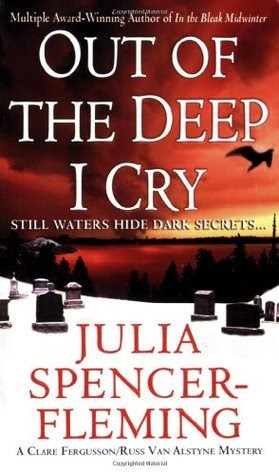
Review: "Out of the Deep I Cry" by Julia Spencer-Fleming
Out of the Deep I Cry by Julia Spencer-Fleming
Published 2004 via St. Martin's
★★★
Book 3 in the series sees Clare battling a number of problems: the church roof is leaking in ways that will become catastrophic if not addressed promptly (but with money the church doesn’t have), a local doctor has gone missing not long after a confrontation by a woman convinced that the vaccines he gave her son caused autism, and—Clare finds as she digs deeper into the town’s past—a decades-old unsolved disappearance still haunts the present day.
I enjoy this series and will probably keep reading (eventually and piecemeal), though <i>Out of the Deep I Cry</i> ended up feeling a bit dated to me—the fact that Clare entertains Debba’s anti-vaccine rantings for more than three seconds tells me that the book was written, well, much closer to Wakefield’s (flawed and thoroughly discredited) study than to…now. (Make no mistake—I know full well that people still get fearful about vaccines. But the combination of fear of autism + Clare’s initial reaction put this book in a specific time frame.) I also struggled at times to hold the timelines and the relationships between the different characters steady in my mind, though I got there in the end.
Clare’s relationship with Russ continues to develop, and that’s one of the more genuinely interesting parts of the book—because Russ is married, and although his marriage isn’t perfect, it also can’t be written off as ‘well, his wife is an evil bitch who tricked him into marrying her anyway’ (the sort of thing that shows up a lot in romance novels); that Clare and Ross end up in this morally suspect place is all the more interesting for Clare’s position in the church. I’d want to keep reading for the writing anyway, but the series is so much more interesting to me if they’re actually going to be, you know, flawed humans facing imperfect decisions.
Published 2004 via St. Martin's
★★★
Book 3 in the series sees Clare battling a number of problems: the church roof is leaking in ways that will become catastrophic if not addressed promptly (but with money the church doesn’t have), a local doctor has gone missing not long after a confrontation by a woman convinced that the vaccines he gave her son caused autism, and—Clare finds as she digs deeper into the town’s past—a decades-old unsolved disappearance still haunts the present day.
I enjoy this series and will probably keep reading (eventually and piecemeal), though <i>Out of the Deep I Cry</i> ended up feeling a bit dated to me—the fact that Clare entertains Debba’s anti-vaccine rantings for more than three seconds tells me that the book was written, well, much closer to Wakefield’s (flawed and thoroughly discredited) study than to…now. (Make no mistake—I know full well that people still get fearful about vaccines. But the combination of fear of autism + Clare’s initial reaction put this book in a specific time frame.) I also struggled at times to hold the timelines and the relationships between the different characters steady in my mind, though I got there in the end.
Clare’s relationship with Russ continues to develop, and that’s one of the more genuinely interesting parts of the book—because Russ is married, and although his marriage isn’t perfect, it also can’t be written off as ‘well, his wife is an evil bitch who tricked him into marrying her anyway’ (the sort of thing that shows up a lot in romance novels); that Clare and Ross end up in this morally suspect place is all the more interesting for Clare’s position in the church. I’d want to keep reading for the writing anyway, but the series is so much more interesting to me if they’re actually going to be, you know, flawed humans facing imperfect decisions.
Friday, October 18, 2024
Review: "The Inheritance Games" by Jennifer Lynn Barnes
The Inheritance Games by Jennifer Lynn Barnes
Published September 2020 via Little, Brown Books for Young Readers
★★★★
Avery is getting by, and if she continues to get by long enough she’ll be able to get out: off to college, no longer living in her car, a stable future in front of her.
What she can’t predict is that she’ll be called upon to be present at the reading of a will—the will of a man she never met. A billionaire. If he leaves her even a thousand dollars, it’ll be life-changing—but he doesn’t leave her a thousand dollars. He leaves her almost the entire fortune, billions upon billions of dollars and properties all over the world…with just a catch or two.
Now, I read Barnes’ cheerleading books when I was younger, and I’ve never entirely gotten over the fact that there were only two of those books. I’m also always low-key on the lookout for a mystery series that takes place in some sort of enormous mansion or castle—none of this business about moving to a quaint little cottage in a quaint little town; I want chaotic buildings so big we’re still exploring new rooms in book 10. And guess what? Here we have that. Not the cozy mystery series part, but the place Avery inherits is less house than sprawling complex, with wing upon wing, secret corridors, and riddles just about everywhere she looks. And, of course, with billions of dollars on the line…not everyone is happy.
This was a lot of fun. There’s a little too much all-the-boys-want-her for my liking (though two of the four Hawthorne boys take themselves out of the running pretty quickly), but the commitment to over-the-top-ness in the house is pretty great. I could have used more house details (like, Avery has her own wing—but what exactly is in there, beyond bedroom and study and bathroom? C’mon, let me live vicariously through the uber rich!), but it’s still fun, fast-moving wish fulfillment.
Published September 2020 via Little, Brown Books for Young Readers
★★★★
Avery is getting by, and if she continues to get by long enough she’ll be able to get out: off to college, no longer living in her car, a stable future in front of her.
What she can’t predict is that she’ll be called upon to be present at the reading of a will—the will of a man she never met. A billionaire. If he leaves her even a thousand dollars, it’ll be life-changing—but he doesn’t leave her a thousand dollars. He leaves her almost the entire fortune, billions upon billions of dollars and properties all over the world…with just a catch or two.
Now, I read Barnes’ cheerleading books when I was younger, and I’ve never entirely gotten over the fact that there were only two of those books. I’m also always low-key on the lookout for a mystery series that takes place in some sort of enormous mansion or castle—none of this business about moving to a quaint little cottage in a quaint little town; I want chaotic buildings so big we’re still exploring new rooms in book 10. And guess what? Here we have that. Not the cozy mystery series part, but the place Avery inherits is less house than sprawling complex, with wing upon wing, secret corridors, and riddles just about everywhere she looks. And, of course, with billions of dollars on the line…not everyone is happy.
This was a lot of fun. There’s a little too much all-the-boys-want-her for my liking (though two of the four Hawthorne boys take themselves out of the running pretty quickly), but the commitment to over-the-top-ness in the house is pretty great. I could have used more house details (like, Avery has her own wing—but what exactly is in there, beyond bedroom and study and bathroom? C’mon, let me live vicariously through the uber rich!), but it’s still fun, fast-moving wish fulfillment.
Wednesday, October 16, 2024
Review: "Finding Georgina" by Colleen Faulkner
Finding Georgina by Colleen Faulkner
Published February 2018 via Kensington
★★★
In the blink of an eye, Harper has everything she's wanted for the past fourteen years—she's found her daughter, who was abducted at the age of two. Georgina is living with her again; her ex-husband has moved back into the house; things will be perfect now. Except: Georgina isn't two anymore—she's sixteen, and as far as she can remember she's only ever had one parent, and that parent is not Harper. Harper has imagined Georgina coming home, but she's never imagined that Georgina wouldn't want to come home, or that she would want to be called by a different name, or that she wouldn't be Catholic.
I'm reminded, of course, of Twice Taken, which may be the reason I picked this up. I've read quite a few books along these lines, although I think always or almost always from the child's perspective. Here we get multiple perspectives—Harper, Georgina/Lilla, Harper's younger daughter JoJo. I can't say that I was entirely there for it. I don't think we got all that much into Georgina/Lilla's head, or into JoJo's, and Harper was...I don't know how to put this other than to say that she was so Midwestern Basic that I found her completely unrelatable. (At one point someone suggests to Harper that she might like a particular book because it's the sort that gets discussed a lot in book clubs, and that felt so very very on point.) I don't mean that as snark—if Midwestern Basic is your thing, fab! I know some lovely Midwestern Basic folks. (I just don't understand them very well.) And the characters in this book don't even live in the Midwest. But Harper is so locked into her limited worldview and her idea of how her daughter should fit into her family and into the world. I'm not a parent, and maybe if that someday changes I'll view books like this differently, but I would have found Harper easier to take if she'd tried earlier—much earlier—to meet her reunited child where she was rather than stubbornly holding on to the idea that they would be singing in the church choir and going to book club together, hand in hand.
It's fair to say that I wasn't really the reader for this book, but it's tackling some interesting questions. Every so often a real-life version of this crops up in the news, and it's hard to think beyond, just...how devastating for everyone involved. Even if there are clear rights and wrongs, there's no way forward that doesn't turn lives upside-down.
Published February 2018 via Kensington
★★★
In the blink of an eye, Harper has everything she's wanted for the past fourteen years—she's found her daughter, who was abducted at the age of two. Georgina is living with her again; her ex-husband has moved back into the house; things will be perfect now. Except: Georgina isn't two anymore—she's sixteen, and as far as she can remember she's only ever had one parent, and that parent is not Harper. Harper has imagined Georgina coming home, but she's never imagined that Georgina wouldn't want to come home, or that she would want to be called by a different name, or that she wouldn't be Catholic.
I'm reminded, of course, of Twice Taken, which may be the reason I picked this up. I've read quite a few books along these lines, although I think always or almost always from the child's perspective. Here we get multiple perspectives—Harper, Georgina/Lilla, Harper's younger daughter JoJo. I can't say that I was entirely there for it. I don't think we got all that much into Georgina/Lilla's head, or into JoJo's, and Harper was...I don't know how to put this other than to say that she was so Midwestern Basic that I found her completely unrelatable. (At one point someone suggests to Harper that she might like a particular book because it's the sort that gets discussed a lot in book clubs, and that felt so very very on point.) I don't mean that as snark—if Midwestern Basic is your thing, fab! I know some lovely Midwestern Basic folks. (I just don't understand them very well.) And the characters in this book don't even live in the Midwest. But Harper is so locked into her limited worldview and her idea of how her daughter should fit into her family and into the world. I'm not a parent, and maybe if that someday changes I'll view books like this differently, but I would have found Harper easier to take if she'd tried earlier—much earlier—to meet her reunited child where she was rather than stubbornly holding on to the idea that they would be singing in the church choir and going to book club together, hand in hand.
It's fair to say that I wasn't really the reader for this book, but it's tackling some interesting questions. Every so often a real-life version of this crops up in the news, and it's hard to think beyond, just...how devastating for everyone involved. Even if there are clear rights and wrongs, there's no way forward that doesn't turn lives upside-down.
Monday, October 14, 2024
Review: "Lost at Windy River" by Trina Rathgeber
Lost at Windy River by Trina Rathgeber, illustrated by Alina Pete
Published October 2024 via Orca Book Publishers
★★★★
When Ilse Schweder was a young teenager, she set out by doglsed with her brothers to return home from checking the trapline. What should have taken perhaps a few hours became a nine-day ordeal as a storm blew in, Schweder was separated from her brothers—and she found herself lost in the wilderness, in the winter.
Schweder's story has been told before: Farley Mowat wrote about it in People of the Deer. But Mowat is known to have passed off a great deal of his fiction as nonfiction, and it always bothered Schweder that it was his (fictionalized) version of events that endured. And so Schweder's granddaughter set out to correct the record, with Lost at Windy River as a result.
This is an absolutely fantastic tribute to a beloved grandmother, and it does a brilliant job of encapsulating how smart and resourceful Schweder was, even as a teenager. She'd grown up in the remote wilds of Canada, the daughter of a German trapper and a First Nations mother, and she'd survived Canada's residential schools (one of her sisters hadn't). You never want a child to be lost in a winter storm, but if any child could survive that, it was Schweder—she'd been learning from her family since before she could read. Relying on her knowledge of snow and the skies and animal movements, to say nothing of survival skills like how to make a snow cave and how to protect a wet foot in the bitter cold, she made her way slowly, slowly back to safety.
The art is a slightly simpler style than I prefer, but it is consistently and cleanly done. There are also small informational asides—relevant to the story—that teach the reader a bit about life in the time and place and context. They, and the occasional side stories, add an additional depth to the story. And don't miss the dialogue-poem at the end, sourced from The Barren Ground of Northern Canada.
4.5 stars. I'm afraid I'm guilty of wanting to read Mowat's fictional version now, but if I do I'll at least do so with the knowledge that Mowat's character wouldn't have survived, because he—and thus she—did not have Schweder's skill or lived experience.
Thanks to the author and publisher for providing a review copy through NetGalley.
Published October 2024 via Orca Book Publishers
★★★★
When Ilse Schweder was a young teenager, she set out by doglsed with her brothers to return home from checking the trapline. What should have taken perhaps a few hours became a nine-day ordeal as a storm blew in, Schweder was separated from her brothers—and she found herself lost in the wilderness, in the winter.
Schweder's story has been told before: Farley Mowat wrote about it in People of the Deer. But Mowat is known to have passed off a great deal of his fiction as nonfiction, and it always bothered Schweder that it was his (fictionalized) version of events that endured. And so Schweder's granddaughter set out to correct the record, with Lost at Windy River as a result.
This is an absolutely fantastic tribute to a beloved grandmother, and it does a brilliant job of encapsulating how smart and resourceful Schweder was, even as a teenager. She'd grown up in the remote wilds of Canada, the daughter of a German trapper and a First Nations mother, and she'd survived Canada's residential schools (one of her sisters hadn't). You never want a child to be lost in a winter storm, but if any child could survive that, it was Schweder—she'd been learning from her family since before she could read. Relying on her knowledge of snow and the skies and animal movements, to say nothing of survival skills like how to make a snow cave and how to protect a wet foot in the bitter cold, she made her way slowly, slowly back to safety.
The art is a slightly simpler style than I prefer, but it is consistently and cleanly done. There are also small informational asides—relevant to the story—that teach the reader a bit about life in the time and place and context. They, and the occasional side stories, add an additional depth to the story. And don't miss the dialogue-poem at the end, sourced from The Barren Ground of Northern Canada.
4.5 stars. I'm afraid I'm guilty of wanting to read Mowat's fictional version now, but if I do I'll at least do so with the knowledge that Mowat's character wouldn't have survived, because he—and thus she—did not have Schweder's skill or lived experience.
Thanks to the author and publisher for providing a review copy through NetGalley.
Subscribe to:
Posts (Atom)
Children's books: Deutsch II: "Ein Herz für Elefanten", "Sturmgefühle, Schattenbilder", und "Bagger Bens Tag am Meer"
Ein Herz für Elefanten von R.G. de Rouen Sturmgefühle, Schattenbilder von Michelle Müller-Nagy (Verlag Monika Fuchs) Bagger Bens Tag am Me...
-
The Ferryman and His Wife by Frode Grytten, translated from the Norwegian by Alison McCullough Published November 2025 via Algonquin Books ★...
-
The Keeper by Tana French Published March 2026 via Viking ★★★★ Book three—of three—in the Cal Hooper series. Time has passed: Trey is growin...
-
Three Ordinary Girls by Tim Brady Published February 2021 via Citadel Press ★★★ For all that I've heard about the strength of the Dutch ...


